ENGINE IMMOBILISER SYSTEM (w/o Smart Entry and Start System) Key Cannot be Registered
DESCRIPTION
A maximum of 5 master key ID codes and 3 sub key ID codes can be registered.
WIRING DIAGRAM
Refer to "B2780" Click here
INSPECTION PROCEDURE
Note
If the transponder key ECU assembly is replaced, refer to Service Bulletin.
PROCEDURE
-
CHECK REGISTRATION MODE
-
Check that the system enters registration mode.
Tech Tips
Refer to Service Bulletin.
OK System enters registration mode.
NG 
INSPECT UNLOCK WARNING SWITCH ASSEMBLY Click here
OK 
-
-
CHECK SECURITY INDICATOR LIGHT OPERATION
-
In registration mode, insert the door control transmitter assembly into the ignition key cylinder and check the security indicator light.
Tech Tips
If the new key ID code registration fails, code 2-1 will be output through the security light. Trying to re-register an already registered door control transmitter assembly will cause code 2-2 to be output when the door control transmitter assembly is inserted. If the number of registered key ID codes exceeds the maximum limit, code 2-3 will be output through the security indicator light. The output details are shown in the following illustration.
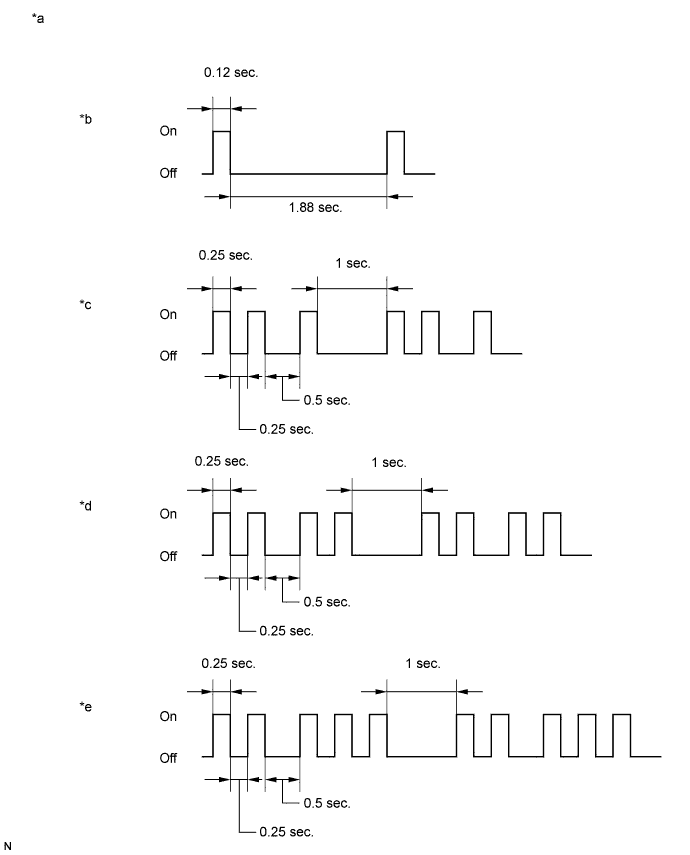
*a Security Indicator Light *b Normal (Immobiliser system is operating normally) *c Code 2-1 *d Code 2-2 *e Code 2-3 - - Result Result Proceed to Code 2-2 is output A Code 2-1 or Code 2-3 is output B
B
READ VALUE USING INTELLIGENT TESTER (TRANSPONDER S-CODE, TRANSPONDER M-CODE) Click here
A 
END (REGISTERED DOOR CONTROL TRANSMITTER ASSEMBLY WAS USED)
-
-
READ VALUE USING INTELLIGENT TESTER (TRANSPONDER S-CODE, TRANSPONDER M-CODE)
-
Connect the intelligent tester to the DLC3.
-
Turn the ignition switch to ON.
-
Turn the intelligent tester on.
-
Enter the following menus: Body / Immobiliser / Data List.
-
Read the Data List according to the display on the intelligent tester.
Tester Display Measurement Item/Range Normal Condition Diagnostic Note Transponder S-code Number of registered sub key/min. 0, max. 15 Number of registered sub keys displayed - Transponder M-code Number of registered master key/min. 0, max. 15 Number of registered master keys displayed - Result Result Proceed to Values are other than above A 5 is displayed for "Transponder M-code" and 0 is displayed for "Transponder S-code" B 0 is displayed for "Transponder M-code" and 3 is displayed for "Transponder S-code" C 5 is displayed for "Transponder M-code" and 3 is displayed for "Transponder S-code" D
B 
KEY REGISTRATION (SUB-KEY)
C
KEY REGISTRATION (MASTER KEY)
D
MAXIMUM NUMBER OF DOOR CONTROL TRANSMITTER ASSEMBLIES ALREADY REGISTERED
A
-
-
KEY REGISTRATION
-
Refer to the table below to determine if additional door control transmitter assemblies can be registered.
Number of Door control transmitter assemblies Registered (Master and Sub Proceed to 0 New key ID code registration 1 to 7 Additional key ID code registration -
Check if an additional door control transmitter assembly can be registered.
OK Additional door control transmitter assembly can be registered.
NG
REPLACE TRANSPONDER KEY ECU ASSEMBLY
OK
END (DOOR CONTROL TRANSMITTER ASSEMBLY MALFUNCTION)
-
-
INSPECT UNLOCK WARNING SWITCH ASSEMBLY
-
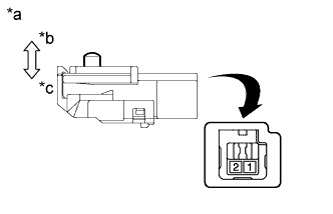
Text in Illustration *a Component without harness connected
(Unlock Warning Switch Assembly)
*b Free *c Pushed Remove the unlock warning switch assembly Click here.
-
Measure the resistance according to the value(s) in the table below.
Standard Resistance Tester Connection Condition Specified Condition 1 - 2 Pushed
(Key set)
Below 1 Ω 1 - 2 Free
(Key removed)
10 kΩ or higher
NG
REPLACE UNLOCK WARNING SWITCH ASSEMBLY Click here
OK
-
-
CHECK HARNESS AND CONNECTOR (TRANSPONDER KEY ECU ASSEMBLY - UNLOCK WARNING SWITCH ASSEMBLY - BODY GROUND)
-
Disconnect the I19 transponder key ECU assembly connector.
-
Measure the resistance according to the value(s) in the table below.
Standard Resistance Tester Connection Condition Specified Condition I19-3 (KSW) - I33-1 (UN+) Always Below 1 Ω I19-3 (KSW) or I33-1 (UN+) - Body ground Always 10 kΩ or higher I33-2 (UN-) - Body ground Always Below 1 Ω
NG
REPAIR OR REPLACE HARNESS OR CONNECTOR
OK
REPLACE TRANSPONDER KEY ECU ASSEMBLY
-