CYLINDER BLOCK DISASSEMBLY
-
INSPECT CONNECTING ROD THRUST CLEARANCE
-
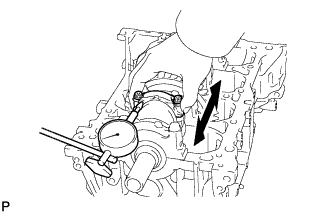
Using a dial indicator, measure the thrust clearance while moving the connecting rod back and forth.
Standard thrust clearance 0.160 to 0.512 mm (0.00630 to 0.0202 in.) Maximum thrust clearance 0.512 mm (0.0202 in.) If the thrust clearance is more than the maximum, replace the connecting rod. If necessary, replace the crankshaft.
-
-
INSPECT CONNECTING ROD OIL CLEARANCE
-
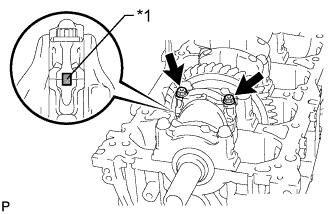
Text in Illustration *1 Alignment Mark Check the alignment marks on the connecting rod and cap to ensure correct reassembly.
-
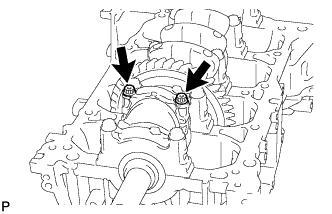
Remove the 2 bolts and connecting rod cap.
Tech Tips
Keep the lower bearing and connecting rod cap together.
-
Clean the crank pin and bearing.
-
Check the crank pin and bearing for pitting and scratches.
If the crank pin or bearing is damaged, replace the bearings. If necessary, replace the crankshaft.
-
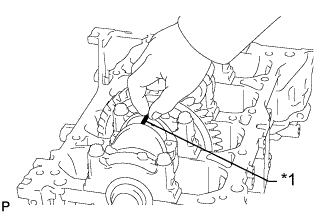
Text in Illustration *1 Plastigage Lay a strip of Plastigage on the crank pin.
-
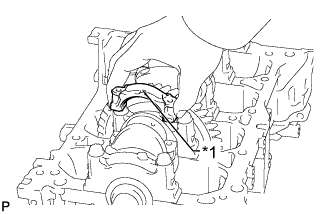
Text in Illustration *1 Front Mark Check that the front mark of the connecting rod cap is facing in the correct direction.
-
Apply a light coat of engine oil to the threads and under the heads of the connecting rod bolts.
-
Install and alternately tighten the bolts of the connecting rod cap in several steps.
- Torque:
- 40 N*m { 408 kgf*cm, 30 ft.*lbf }
Note
Do not turn the crankshaft during the measurement.
If any one of the connecting rod bolts does not meet the torque specification, replace the connecting rod bolts.
-
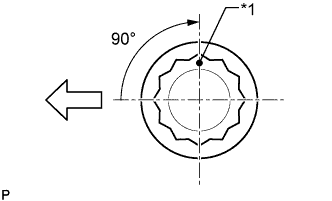
Text in Illustration *1 Paint Mark 
Engine Front Mark the front of each connecting rod bolt with paint.
-
Tighten the bolts 90° as shown in the illustration.
Note
Do not turn the crankshaft during the measurement.
-
Remove the 2 bolts and connecting rod cap.
Tech Tips
Keep the lower bearing and connecting rod cap together.
-
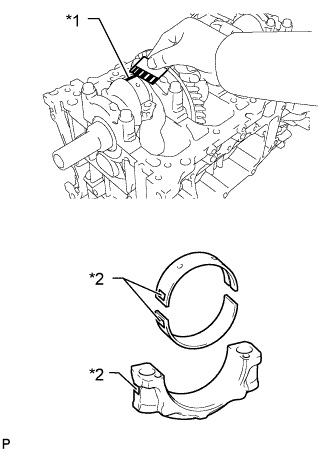
Text in Illustration *1 Plastigage *2 Number Mark Measure the Plastigage at its widest point.
Standard oil clearance 0.030 to 0.063 mm (0.00118 to 0.00248 in.) or 0.033 to 0.063 mm (0.00130 to 0.00248 in.) Maximum oil clearance 0.07 mm (0.00276 in.) Note
Remove the Plastigage completely after the measurement.
If the oil clearance is more than the maximum, replace the connecting rod bearing. If necessary, grind or replace the crankshaft.
Tech Tips
If replacing a bearing, select a new one with the same number as marked on the connecting rod. There are 3 sizes of standard bearings, marked "1", "2" and "3" accordingly.
Standard crank pin diameter 51.492 to 51.500 mm (2.0272 to 2.0276 in.) Standard Connecting Rod Big End Inside Diameter Item Specified Condition Mark 1 54.500 to 54.508 mm (2.1457 to 2.1460 in.) Mark 2 54.509 to 54.516 mm (2.1460 to 2.1463 in.) Mark 3 54.517 to 54.524 mm (2.1463 to 2.1466 in.) Standard Size Connecting Rod Bearing Center Wall Thickness (Part No. 13281-0V010 or 13281-0V020) Item Specified Condition Mark 1 1.483 to 1.487 mm (0.0584 to 0.0585 in.) Mark 2 1.488 to 1.491 mm (0.0586 to 0.0587 in.) Mark 3 1.492 to 1.495 mm (0.0587 to 0.0589 in.) Standard Size Connecting Rod Bearing Center Wall Thickness (Part No. 13281-36021) Item Specified Condition Mark 1 1.486 to 1.490 mm (0.0585 to 0.0587 in.) Mark 2 1.491 to 1.494 mm (0.0587 to 0.0588 in.) Mark 3 1.495 to 1.498 mm (0.0589 to 0.0590 in.) -
Perform the inspection above for each cylinder.
-
-
REMOVE PISTON WITH CONNECTING ROD
-
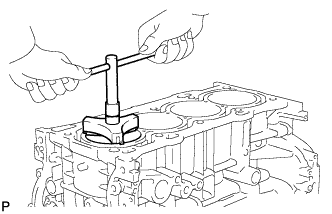
Using a ridge reamer, remove all the carbon from the top of the cylinder.
-
Remove the 8 bolts, 4 connecting rod caps and 4 lower bearings.
-
Push the piston, connecting rod assembly and upper bearing through the top of the cylinder block.
Tech Tips
-
Keep the bearings, connecting rod and cap together.
-
Arrange the piston and connecting rod assemblies in the correct order.
-
Be sure to arrange the removed piston and connecting rod assemblies in such a way that they can be reinstalled exactly as before.
-
-
-
REMOVE CONNECTING ROD BEARING
-
Remove the connecting rod bearings from the connecting rods and connecting rod caps.
Tech Tips
Arrange the removed parts in the correct order.
-
-
INSPECT CRANKSHAFT THRUST CLEARANCE
-
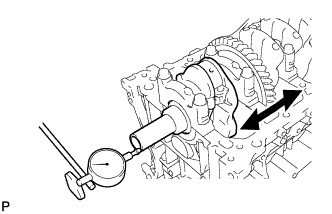
Using a dial indicator, measure the thrust clearance while prying the crankshaft back and forth with a screwdriver.
Standard thrust clearance 0.04 to 0.24 mm (0.00157 to 0.00945 in.) Maximum thrust clearance 0.30 mm (0.0118 in.) If the thrust clearance is more than the maximum, replace the thrust washers as a set. If necessary, replace the crankshaft.
Standard thrust washer thickness 1.93 to 1.98 mm (0.0760 to 0.0780 in.)
-
-
REMOVE CRANKSHAFT
-
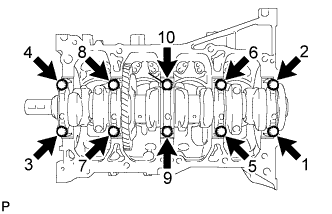
Using several steps, uniformly loosen and remove the 10 bearing cap bolts in the sequence shown in the illustration.
-
Remove the 5 bearing caps from the cylinder block.
Tech Tips
-
Keep the No. 2 crankshaft bearings and crankshaft bearing caps together.
-
Arrange the bearing caps in the correct order.
-
-
Remove the crankshaft from the cylinder block.
Tech Tips
Keep the crankshaft bearings and crankshaft thrust washers together with the cylinder block.
-
Check each crankshaft journal and bearing for pitting and scratches.
If the journal or bearing is damaged, replace the bearings. If necessary, replace the crankshaft.
-
-
REMOVE CRANKSHAFT THRUST WASHER
-
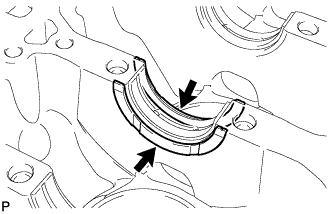
Remove the thrust washers from the cylinder block.
-
-
REMOVE CRANKSHAFT BEARING
-
Remove the crankshaft bearings from the cylinder block and bearing caps.
Tech Tips
Arrange the bearings in the correct order.
-
-
REMOVE CRANKSHAFT PULLEY KEY
-
Using a screwdriver, remove the 2 pulley keys from the crankshaft.
-
-
REMOVE PISTON RING SET
Tech Tips
Type A and type B can be distinguished by the mark on the piston and the shape of the oil ring.
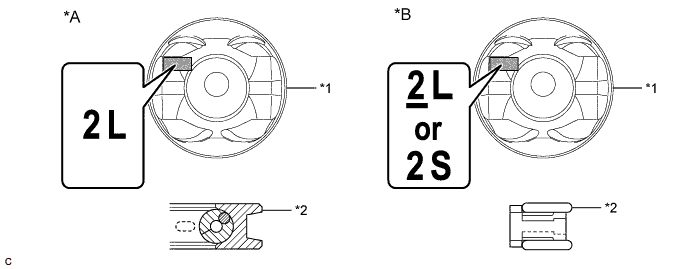
Text in Illustration *A Type A *B Type B *1 Piston *2 Oil Ring
-
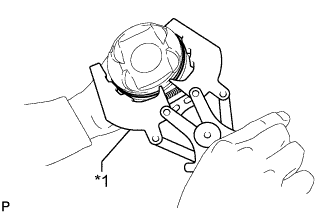
Text in Illustration *1 Piston Ring Expander Using a piston ring expander, remove the No. 1 compression ring and No. 2 compression ring.
-
Type A:
-
Remove the oil ring and expander by hand.
Tech Tips
Arrange the removed parts in the correct order.
-
-
Type B:
-
Remove the oil ring expander, upper oil ring side rail and lower oil ring side rail by hand.
Tech Tips
Arrange the removed parts in the correct order.
-
-
-
REMOVE PISTON PIN HOLE SNAP RING
-
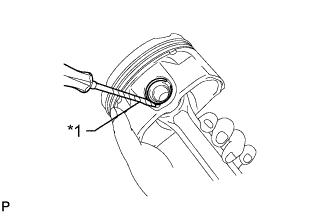
Text in Illustration *1 Protective Tape Using a screwdriver, pry out the 2 snap rings.
Tech Tips
Tape the screwdriver tip before use.
-
-
REMOVE PISTON
-
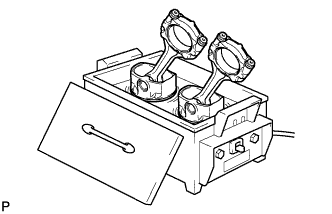
Gradually heat each piston up to 80 to 90°C (176 to 194°F).
-
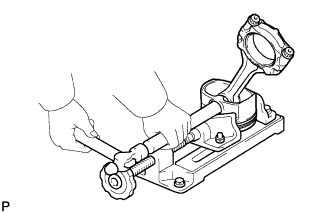
Using a plastic-faced hammer and brass bar, lightly tap out the piston pin. Then remove the connecting rod.
Tech Tips
-
The piston and pin are a matched set.
-
Be sure to arrange the removed pistons, pins, rings, connecting rods and bearings in such a way that the parts can be reinstalled exactly as before.
-
Arrange the pistons, pins, rings, connecting rods and bearings in the correct order.
-
-
-
REMOVE NO. 1 OIL NOZZLE SUB-ASSEMBLY
-
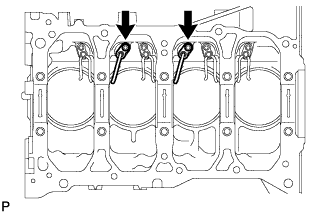
Using a 5 mm hexagon wrench, remove the 2 bolts and 2 oil nozzles.
-
-
REMOVE NO. 2 OIL NOZZLE SUB-ASSEMBLY
-
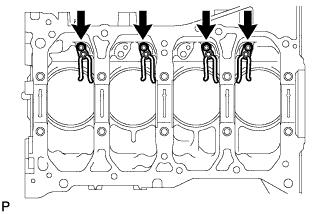
Using a 5 mm hexagon wrench, remove the 4 bolts and 4 oil nozzles.
-
-
REMOVE STUD BOLT
Note
If a stud bolt is deformed or its threads are damaged, replace it.