AUDIO AND VISUAL SYSTEM(for Radio Receiver Type) Speaker Circuit
DESCRIPTION
The sound signals amplified by the radio receiver assembly are sent to the speakers from the radio receiver assembly via the speaker circuit.
If there is a short in a speaker circuit, the radio receiver assembly detects it and stops output to the speakers.
Thus sound cannot be heard from the speakers even if there is no malfunction in the radio receiver assembly or speakers.
If a short is detected in a speaker circuit, no sound can be heard from the speakers.
WIRING DIAGRAM
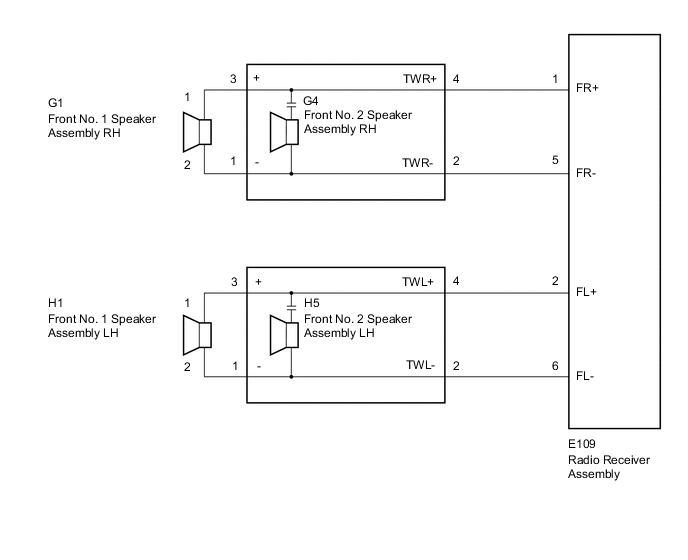
PROCEDURE
-
CHECK HARNESS AND CONNECTOR
-
Disconnect the E109 radio receiver assembly connector.
-
Disconnect the G1 and H1 front No. 1 speaker assembly connectors.
-
Disconnect the G4 and H5 front No. 2 speaker assembly connectors.
-
Measure the resistance between each of the front No. 2 speaker assemblies and the radio receiver assembly to check for an open circuit in the wire harness.
Standard Resistance Tester Connection Condition Specified Condition E109-1 (FR+) - G4-4 (TWR+) Always Below 1 Ω E109-5 (FR-) - G4-2 (TWR-) Always Below 1 Ω E109-2 (FL+) - H5-4 (TWL+) Always Below 1 Ω E109-6 (FL-) - H5-2 (TWL-) Always Below 1 Ω -
Measure the resistance between each of the front No. 1 speaker assemblies and the front No. 2 speaker assemblies to check for an open circuit in the wire harness.
Standard Resistance Tester Connection Condition Specified Condition G4-3 (+) - G1-1 Always Below 1 Ω G4-1 (-) - G1-2 Always Below 1 Ω H5-3 (+) - H1-1 Always Below 1 Ω H5-1 (-) - H1-2 Always Below 1 Ω -
Measure the resistance between the radio receiver assembly and body ground to check for a short circuit in the wire harness.
Standard Resistance Tester Connection Condition Specified Condition E109-1 (FR+) - Body ground Always 10 kΩ or higher E109-5 (FR-) - Body ground Always 10 kΩ or higher E109-2 (FL+) - Body ground Always 10 kΩ or higher E109-6 (FL-) - Body ground Always 10 kΩ or higher -
Measure the resistance between each of the front No. 2 speaker assemblies and body ground to check for a short circuit in the wire harness.
Standard Resistance Tester Connection Condition Specified Condition G4-3 (+) - Body ground Always 10 kΩ or higher G4-1 (-) - Body ground Always 10 kΩ or higher H5-3 (+) - Body ground Always 10 kΩ or higher H5-1 (-) - Body ground Always 10 kΩ or higher Result Proceed to OK NG
NG 
REPAIR OR REPLACE HARNESS OR CONNECTOR
OK 
-
-
INSPECT FRONT NO. 1 SPEAKER ASSEMBLY
-
Remove the front No. 1 speaker assembly.
-
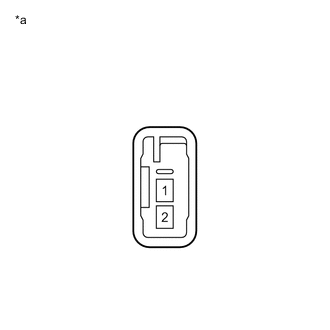
*a Component without harness connected
(Front No. 1 Speaker Assembly)
Measure the resistance according to the value(s) in the table below.
Standard Resistance Tester Connection Condition Specified Condition 1 - 2 Always 3.2 to 4.8 Ω Result Proceed to OK NG
NG
REPLACE FRONT NO. 1 SPEAKER ASSEMBLY Click here
OK
-
-
INSPECT FRONT NO. 2 SPEAKER ASSEMBLY
-
Remove the front No. 2 speaker assembly.
-
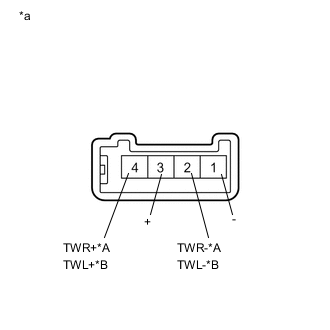
*A for RH *B for LH *a Component without harness connected
(Front No. 2 Speaker Assembly)
Measure the resistance according to the value(s) in the table below.
Standard Resistance for RH Tester Connection Condition Specified Condition 4 (TWR+) - 2 (TWR-) Always 10 kΩ or higher 1 (-) - 2 (TWR-) Always Below 1 Ω 3 (+) - 4 (TWR+) Always Below 1 Ω for LH Tester Connection Condition Specified Condition 4 (TWL+) - 2 (TWL-) Always 10 kΩ or higher 1 (-) - 2 (TWL-) Always Below 1 Ω 3 (+) - 4 (TWL+) Always Below 1 Ω Result Proceed to OK NG
NG
REPLACE FRONT NO. 2 SPEAKER ASSEMBLY Click here
OK
-
-
REPLACE FRONT NO. 2 SPEAKER ASSEMBLY
-
Check that the malfunction disappears when a known good speaker is installed.
OK Malfunction disappears. Tech Tips
-
Connect all the connectors to the front No. 2 speaker assemblies that were disconnected.
-
When there is a possibility that either the right or left front speaker is defective, inspect by interchanging the right one with the left one.
-
Perform the above inspection on both LH and RH sides.
Result Proceed to OK NG -
OK
END (FRONT NO. 2 SPEAKER ASSEMBLY WAS DEFECTIVE)
NG
PROCEED TO NEXT SUSPECTED AREA SHOWN IN PROBLEM SYMPTOMS TABLE Click here
-