CYLINDER BLOCK INSPECTION

PROCEDURE
-
INSPECT CONNECTING ROD THRUST CLEARANCE
-
Install the connecting rod cap.
-
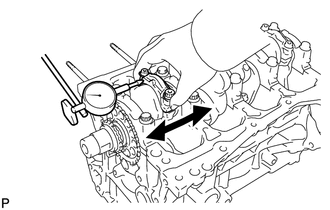
Using a dial indicator, measure the thrust clearance while moving the connecting rod back and forth.
Standard Thrust Clearance 0.1 to 0.5 mm (0.00394 to 0.0197 in.) Maximum Thrust Clearance 0.5 mm (0.0197 in.) If the thrust clearance is greater than the maximum, replace the connecting rod sub-assembly as necessary. If necessary, replace the crankshaft.
-
-
INSPECT CONNECTING ROD OIL CLEARANCE
-
Clean the crank pin and connecting rod bearing.
-
Check the crank pin and connecting rod bearing for pitting and scratches.
-
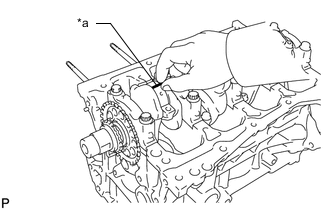
*a Plastigage Lay a strip of Plastigage across the crank pin.
-
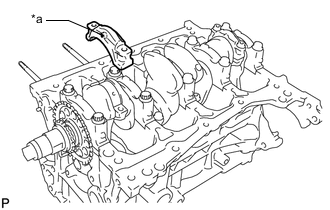
*a Front Mark Check that the front mark of the connecting rod cap is facing forward.
-
Install the connecting rod cap.
Note
Do not turn the crankshaft.
-
Remove the connecting rod cap.
-
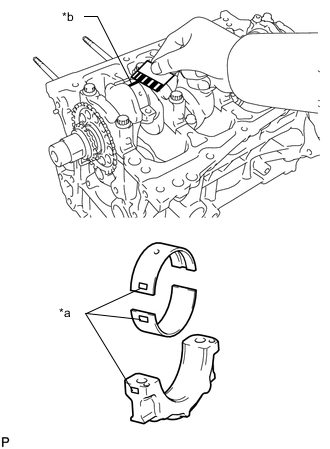
*a Mark *b Plastigage Measure the Plastigage at its widest point.
Standard Oil Clearance 0.020 to 0.052 mm (0.000787 to 0.002047 in.) Maximum Oil Clearance 0.055 mm (0.00217 in.) If the connecting rod oil clearance is greater than the maximum, replace the connecting rod bearings. If necessary, replace the crankshaft.
Note
Completely remove the Plastigage after the measurement.
Tech Tips
If replacing a connecting rod bearing, replace it with one that has the same number as its respective connecting rod cap. Each connecting rod bearing's standard thickness is indicated by mark 1, 2, or 3 on its surface.
Standard Connecting Rod Large End Bore Diameter Mark Specified Condition 1 45.000 to 45.008 mm (1.77165 to 1.77197 in.) 2 45.009 to 45.016 mm (1.77200 to 1.77228 in.) 3 45.017 to 45.024 mm (1.77232 to 1.77259 in.) Standard Connecting Rod Bearing Thickness Mark Specified Condition 1 1.492 to 1.495 mm (0.0587 to 0.05886 in.) 2 1.496 to 1.498 mm (0.05890 to 0.05898 in.) 3 1.499 to 1.501 mm (0.05902 to 0.0591 in.) Standard Crankshaft Pin Diameter Mark Specified Condition 1, 2, 3 41.992 to 42.000 mm (1.6532 to 1.6535 in.)
-
-
INSPECT CYLINDER BLOCK FOR WARPAGE
-
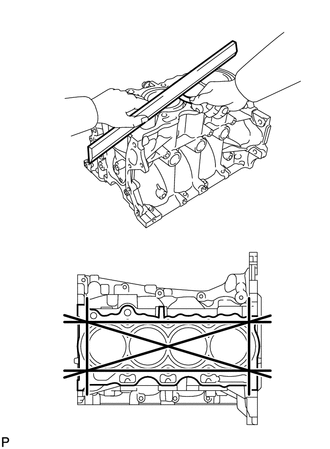
Using a precision straightedge and feeler gauge, check the surface which contacts the cylinder head gasket for warpage.
Maximum Warpage 0.05 mm (0.00197 in.) If the warpage is greater than the maximum, replace the cylinder block sub-assembly.
-
-
INSPECT CYLINDER BORE
-
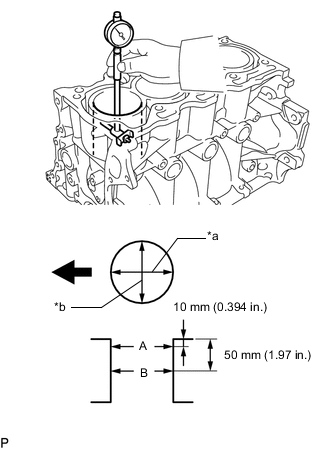
*a Axial Direction *b Thrust Direction 
Front Using a cylinder gauge, measure the cylinder bore diameter at the positions (A) and (B) in both thrust and axial directions.
Standard Diameter 72.500 to 72.513 mm (2.8543 to 2.8548 in.) Maximum Diameter 72.63 mm (2.8594 in.) If the average diameter of the 4 positions is greater than the maximum, replace the cylinder block sub-assembly.
-
-
INSPECT PISTON
-
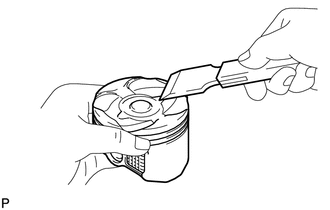
Using a gasket scraper, scrape off any carbon on the top of the piston.
-
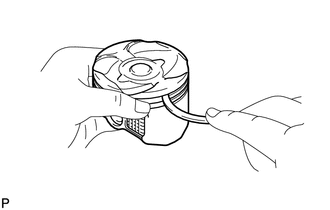
Using a groove cleaning tool or broken ring, clean the piston ring grooves.
-
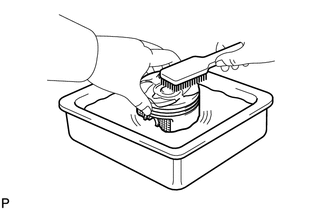
Using a brush and solvent, thoroughly clean the piston.
Note
Do not use a wire brush.
-
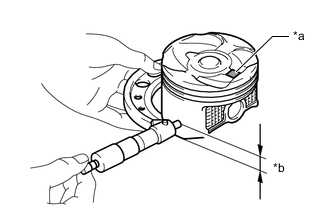
*a Front Mark *b Front Mark (1): 8.8 mm (0.346 in.)
Front Mark (1B): 9.33 mm (0.367 in)
Using a micrometer, measure the piston diameter at right angles to the piston pin hole, and at a point 8.8 mm (0.346 in.) or 9.33 mm (0.367 in) from the piston bottom.
Standard Piston Diameter 72.445 to 72.465 mm (2.8522 to 2.8529 in.) If the diameter is not as specified, replace the piston with pin sub-assembly.
-
-
INSPECT PISTON OIL CLEARANCE
-
Subtract the piston diameter measurement from the cylinder bore diameter measurement.
Standard Oil Clearance 0.035 to 0.068 mm (0.00138 to 0.00268 in.) Maximum Oil Clearance 0.108 mm (0.00425 in.) If the piston oil clearance is greater than the maximum, replace all the pistons. If necessary, replace the cylinder block sub-assembly.
-
-
INSPECT RING GROOVE CLEARANCE
-
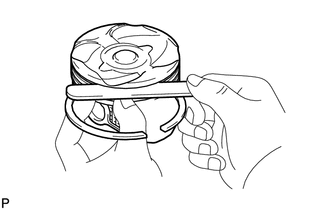
Using a feeler gauge, measure the ring groove clearance between a new piston ring and the wall of the ring groove.
Standard Ring Groove Clearance Item Specified Condition No. 1 Compression Ring 0.02 to 0.07 mm (0.000787 to 0.00276 in.) No. 2 Compression Ring 0.02 to 0.06 mm (0.000787 to 0.00236 in.) Oil Ring 0.07 to 0.15 mm (0.00276 to 0.00591 in.) If the ring groove clearance is not as specified, replace the piston.
-
-
INSPECT PISTON RING END GAP
-
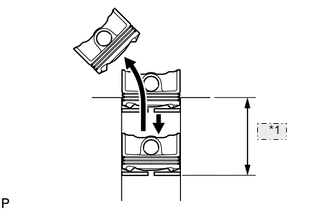
*1 50 mm Using a piston, push the piston ring a little beyond the bottom of the piston ring travel, 50 mm (1.97 in.) from the top of the cylinder block sub-assembly.
-
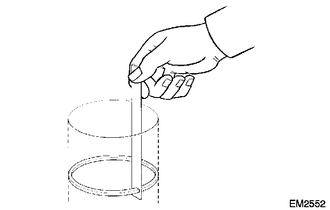
Using a feeler gauge, measure the end gap.
Standard End Gap Item Specified Condition No. 1 Compression Ring 0.18 to 0.25 mm (0.00709 to 0.00984 in.) No. 2 Compression Ring 0.30 to 0.45 mm (0.0118 to 0.0177 in.) Oil Ring (Side Rail) 0.10 to 0.40 mm (0.00394 to 0.0157 in.) Maximum End Gap Item Specified Condition No. 1 Compression Ring 0.45 mm (0.0177 in.) No. 2 Compression Ring 0.65 mm (0.0256 in.) Oil Ring (Side Rail) 0.55 mm (0.0217 in.) If the piston ring end gap is greater than the maximum, replace the piston ring. If the piston ring end gap is greater than the maximum, even with a new piston ring, replace the cylinder block sub-assembly.
-
-
INSPECT CONNECTING ROD BOLT
-
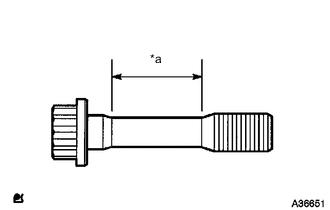
*a Measurement Area Using a vernier caliper, measure the diameter of the connecting rod bolt in the area shown in the illustration.
Standard Diameter 6.6 to 6.7 mm (0.2598 to 0.2638 in.) Minimum Diameter 6.4 mm (0.2520 in.) If the diameter is less than the minimum, replace the connecting rod bolt.
Tech Tips
-
Diameter measurements should be done at several points.
-
If the diameter is less than the minimum, replace the connecting rod bolt with a new one. Failure to do so may lead to engine damage.
-
If there is any thread deformation, replace the connecting rod bolt with a new one.
-
-
-
INSPECT CRANKSHAFT
-
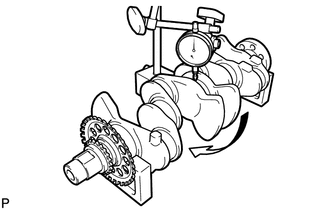
Using a dial indicator and V-blocks, measure the runout as shown in the illustration.
Maximum Runout 0.02 mm (0.000787 in.) If the runout is greater than the maximum, replace the crankshaft.
-
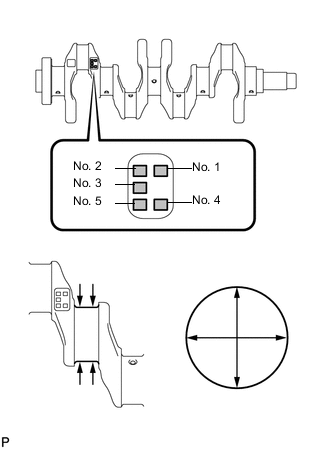
Using a micrometer, measure the diameter of each main journal.
Standard Diameter 47.988 to 48.000 mm (1.88929 to 1.88976 in.) If the diameter is not as specified, check the crankshaft oil clearance.
-
Check each main journal for taper and distortion as shown in the illustration.
Maximum Taper and Out-of-round 0.003 mm (0.000118 in.) If the taper or out-of-round is greater than the maximum, replace the crankshaft.
Standard Diameter (Reference) Mark Specified Condition 0 47.999 to 48.000 mm (1.88972 to 1.88976 in.) 1 47.997 to 47.998 mm (1.88964 to 1.88968 in.) 2 47.995 to 47.996 mm (1.88956 to 1.88960 in.) 3 47.993 to 47.994 mm (1.88948 to 1.88952 in.) 4 47.991 to 47.992 mm (1.88941 to 1.88945 in.) 5 47.988 to 47.990 mm (1.88929 to 1.88937 in.) -
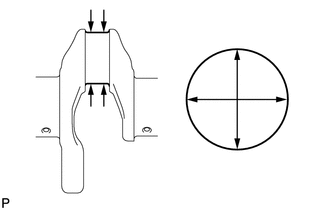
Using a micrometer, measure the diameter of each crank pin.
Standard Diameter 41.992 to 42.000 mm (1.6532 to 1.6535 in.) If the diameter is not as specified, check the connecting rod oil clearance.
-
Inspect each crank pin for taper and out-of-round as shown in the illustration.
Maximum Taper and Out-of-round 0.003 mm (0.000118 in.) If the taper or out-of-round is greater than the maximum, replace the crankshaft.
-
-
INSPECT CRANKSHAFT THRUST CLEARANCE
-
Install the crankshaft bearing cap.
-
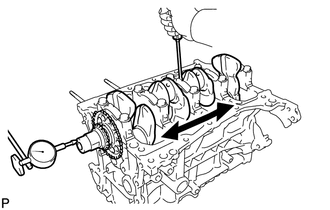
Using a dial indicator, measure the thrust clearance while prying the crankshaft back and forth with a screwdriver.
Standard Thrust Clearance 0.04 to 0.24 mm (0.00157 to 0.00945 in.) Maximum Thrust Clearance 0.28 mm (0.0110 in.) If the thrust clearance is greater than the maximum, replace the upper crankshaft thrust washers as a set.
Tech Tips
The thrust washer thickness is 1.93 to 1.98 mm (0.0760 to 0.0780 in.).
-
-
INSPECT CRANKSHAFT OIL CLEARANCE
-
Check the crank journal and crankshaft bearing for pitting and scratches.
-
Install the crankshaft bearing.
-
Place the crankshaft on the cylinder block sub-assembly.
-
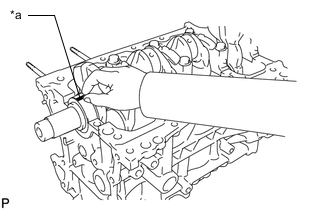
*a Plastigage Lay a strip of Plastigage across each journal.
-
Check the front marks and numbers and install the crankshaft bearing caps on the cylinder block sub-assembly.
Tech Tips
A number is marked on each crankshaft bearing cap to indicate the installation position.
-
Install the crankshaft bearing caps.
Note
Do not turn the crankshaft.
-
Remove the crankshaft bearing caps.
-
Measure the Plastigage at its widest point.
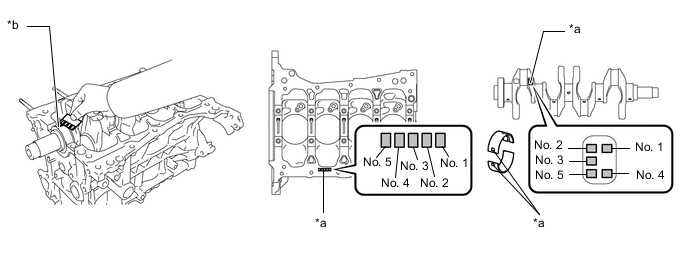
*a Number Marks *b Plastigage Standard Oil Clearance 0.019 to 0.043 mm (0.000748 to 0.00169 in.) Maximum Oil Clearance 0.049 mm (0.00193 in.) If the crankshaft oil clearance is greater than the maximum, replace the crankshaft bearing. If necessary, replace the crankshaft.
Note
Remove the Plastigage completely after the measurement.
Tech Tips
-
If replacing a crankshaft bearing, select a new one with the same number. If the number of the crankshaft bearing cannot be determined, calculate the correct crankshaft bearing number by adding together the numbers imprinted on the cylinder block sub-assembly and crankshaft. Then select a new crankshaft bearing with the calculated number according to the chart below. There are 4 sizes of standard bearings, marked "2", "3", "4" or "5" accordingly.
-
EXAMPLE: Cylinder block "3" + Crankshaft "5" = Total number 8 (Use bearing "4")
Cylinder block + Crankshaft 0 to 2 3 to 5 6 to 8 9 to 11 Bearing to be used "2" "3" "4" "5" Standard Cylinder Block Journal Bore Diameter Mark Specified Condition 0 52.000 to 52.002 mm (2.04724 to 2.04732 in.) 1 52.003 to 52.004 mm (2.04736 to 2.04740 in.) 2 52.005 to 52.006 mm (2.04744 to 2.04748 in.) 3 52.007 to 52.009 mm (2.04752 to 2.04759 in.) 4 52.010 to 52.011 mm (2.04763 to 2.04767 in.) 5 52.012 to 52.013 mm (2.04771 to 2.04775 in.) 6 52.014 to 52.016 mm (2.04779 to 2.04787 in.) Standard Crankshaft Journal Diameter Mark Specified Condition 0 47.999 to 48.000 mm (1.88972 to 1.88976 in.) 1 47.997 to 47.998 mm (1.88964 to 1.88968 in.) 2 47.995 to 47.996 mm (1.88956 to 1.88960 in.) 3 47.993 to 47.994 mm (1.88948 to 1.88952 in.) 4 47.991 to 47.992 mm (1.88941 to 1.88945 in.) 5 47.988 to 47.990 mm (1.88929 to 1.88937 in.) Standard Bearing Center Wall Thickness Mark Specified Condition 2 1.994 to 1.997 mm (0.07850 to 0.07862 in.) 3 1.998 to 2.000 mm (0.07866 to 0.07874 in.) 4 2.001 to 2.003 mm (0.07878 to 0.07886 in.) 5 2.004 to 2.006 mm (0.07890 to 0.07898 in.) -
-
-
INSPECT CRANKSHAFT BEARING CAP SET BOLT
-
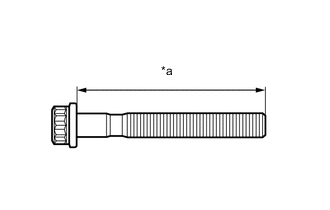
*a Measurement Length Using a vernier caliper, measure the length of the crankshaft bearing cap set bolt from the seat to the end.
Standard Length 75.3 to 76.7 mm (2.965 to 3.020 in.) Maximum Length 77.2 mm (3.039 in.) If the length is greater than the maximum, replace the crankshaft bearing cap set bolt with a new one.
-
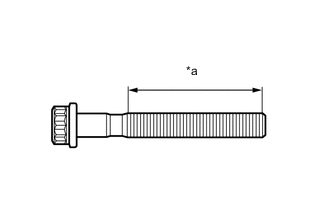
*a Measurement Area Using a vernier caliper, measure the diameter of the crankshaft bearing cap set bolt in the area shown in the illustration.
Standard Diameter 9.94 to 9.96 mm (0.3913 to 0.3921 in.) Minimum Diameter 9.6 mm (0.378 in.) If the diameter is less than the minimum, replace the crankshaft bearing cap set bolt with a new one.
Tech Tips
-
Diameter measurements should be done at several points.
-
If the diameter is less than the minimum, replace the crankshaft bearing cap set bolt with a new one. Failure to do so may lead to engine damage.
-
If there is any thread deformation, replace the crankshaft bearing cap set bolt with a new one.
-
-
-
INSPECT NO. 1 OIL NOZZLE SUB-ASSEMBLY
-
Check the No. 1 oil nozzle sub-assembly for damage or clogging.
Tech Tips
If there is damage or clogging, replace the No. 1 oil nozzle sub-assembly.
-