ENGINE ON-VEHICLE INSPECTION

PROCEDURE
-
INSPECT ENGINE COOLANT
-
INSPECT ENGINE OIL
-
INSPECT BATTERY
-
INSPECT AIR CLEANER FILTER ELEMENT SUB-ASSEMBLY
-
Remove the air cleaner cap sub-assembly.
-
Remove the air cleaner filter element sub-assembly.
-
Visually check that the air cleaner filter element sub-assembly is not excessively damaged or oily. If necessary, replace the air cleaner filter element sub-assembly.
Tech Tips
-
If there is any dirt or clogs in the air cleaner filter element sub-assembly, clean it with compressed air.
-
If any dirt or clogs remain even after cleaning the air cleaner filter element sub-assembly with compressed air, replace it.
-
-
Install the air cleaner filter element sub-assembly.
-
Install the air cleaner cap sub-assembly.
-
-
INSPECT V-RIBBED BELT
-
INSPECT ENGINE IDLE SPEED
Note
-
Turn all the electrical systems and A/C off.
-
Inspect the engine idle speed with the cooling fan off.
-
When checking the engine idle speed, the transaxle should be in neutral or park.
Tech Tips
-
For more information about the GTS, refer to the operator's manual.
-
If a GTS is not available, use a tachometer as a substitute.
-
Warm up and stop the engine.
-
When using the GTS:
-
Connect the GTS to the DLC3.
-
Turn the ignition switch to ON.
-
Turn the GTS on.
-
Enter the following menus: Powertrain / Engine and ECT/ Data List / Engine Speed.
Powertrain > Engine and ECT > Data ListTester Display Engine Speed -
Inspect the engine idle speed.
Standard Engine Idle Speed 720 to 820 rpm -
Fully depress the accelerator pedal.
-
Inspect the maximum engine speed.
Maximum Engine Speed 5100 to 5250 rpm -
Turn the ignition switch off.
-
Disconnect the GTS from the DLC3.
-
-
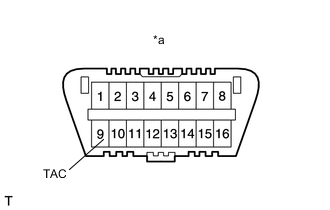
*a DLC3 When not using the GTS:
-
Using SST, connect a tachometer probe to terminal 9 (TAC) of the DLC3.
- SST
- 09843-18030
Note
Be sure to connect the tachometer to the correct terminal. Connecting the wrong terminals can cause damage.
-
Turn the ignition switch to ON.
-
Inspect the engine idle speed.
Standard Engine Idle Speed 720 to 820 rpm -
Fully depress the accelerator pedal.
-
Inspect the maximum engine speed.
Maximum Engine Speed 5100 to 5250 rpm -
Turn the ignition switch off.
-
Disconnect the tachometer probe from the DLC3.
-
-
-
INSPECT COMPRESSION
-
Warm up and stop the engine.
-
Disconnect the 4 connectors from the 4 injectors.
-
Remove the 4 glow plug assemblies.
Note
In order to avoid shorting the circuit of the wire harness connected to the No. 1 glow plug connector, wrap protective tape around the wire harness terminal.
-
Inspect the cylinder compression pressure.
-
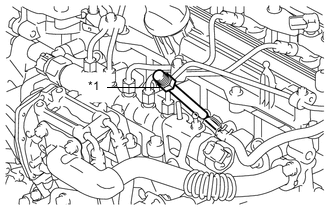
*1 SST (Attachment) Insert SST (attachment) into the glow plug hole.
- SST
- 09992-00026 ( 09992-00121 )
-
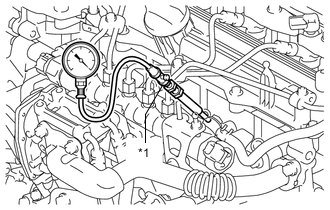
*1 SST (Compression Gauge) Connect SST (compression gauge) to SST (attachment).
- SST
- 09992-00026 ( 09992-00211 )
-
While cranking the engine, measure the compression pressure.
Standard Compression Pressure 2500 kPa (25.5 kgf/cm2, 363 psi) Minimum Pressure 2200 kPa (22.4 kgf/cm2, 319 psi) Difference Between each Cylinder 500 kPa (5.1 kgf/cm2, 73 psi) or less Note
-
Use a fully-charged battery to obtain an engine speed of 280 rpm or more.
-
Inspect the other cylinders in the same way.
-
Measure the compression in as short a time as possible.
-
-
If the cylinder compression is low, pour a small amount of engine oil into the cylinder through the glow plug holes, and then inspect it again.
Tech Tips
-
If adding oil increases the compression pressure, the piston rings and/or cylinder bore may be worn or damaged.
-
If the pressure stays low, a valve may be stuck or seated improperly, or there may be leakage from the cylinder head gasket.
-
-
-
Remove SST (attachment and compression gauge).
-
Connect the 4 connectors to the 4 injectors.
-
Install the 4 glow plugs.
-