SFI SYSTEM Fuel Pump Control Circuit
DESCRIPTION
When the engine is cranked, the starter (ST NO. 1) relay drive signal output from the ignition or starter switch assembly*1 or certification ECU (smart key ECU assembly)*2 is input into the STA terminal of the ECM, and the NE signal generated by the crankshaft position sensor is also input into the NE+ terminal. The ECM interprets that the engine is cranked, and turns transistor Tr1 in the ECM internal circuit on. Current flows to the C/OPN (Circuit Opening) relay by turning Tr1 on. Then, the fuel pump operates.
While the NE signal is input into the ECM with the engine running, the ECM turns Tr1 on continuously.
*1: w/o entry and start system.
*2: w/ entry and start system.
WIRING DIAGRAM
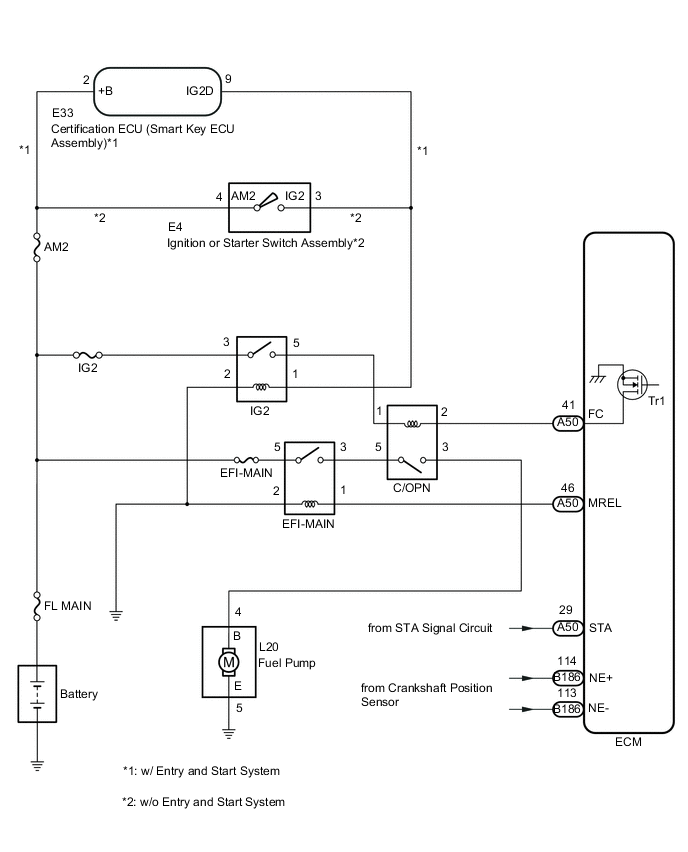
CAUTION / NOTICE / HINT
Note
Inspect the fuses for circuits related to this system before performing the following procedure.
PROCEDURE
-
PERFORM ACTIVE TEST USING GTS (CONTROL THE FUEL PUMP / SPEED)
-
Connect the GTS to the DLC3.
-
Turn the ignition switch to ON.
-
Turn the GTS on.
-
Enter the following menus: Powertrain / Engine and ECT / Active Test / Control the Fuel Pump / Speed.
Powertrain > Engine and ECT > Active TestTester Display Control the Fuel Pump / Speed -
Check whether the fuel pump operating sound occurs when performing the Active Test on the GTS.
Result Result Proceed to Fuel pump operating sound does not occur A Fuel pump operating sound occurs B
B 
READ VALUE USING GTS (STARTER SIGNAL) Click here
A 
-
-
CHECK TERMINAL VOLTAGE (POWER SOURCE OF C/OPN RELAY)
-
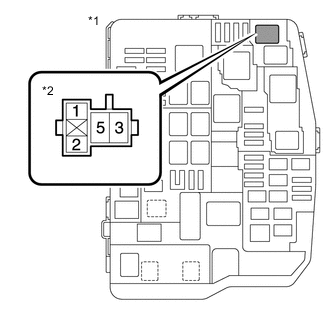
*1 Engine Room Relay Block and Junction Block Assembly *2 C/OPN Relay Remove the C/OPN relay from the engine room relay block and junction block assembly.
-
Turn the ignition switch to ON.
-
Measure the voltage according to the value(s) in the table below.
Standard Voltage Tester Connection Condition Specified Condition 1 (C/OPN relay) - Body ground Ignition switch ON 11 to 14 V Result Proceed to OK NG
NG
CHECK HARNESS AND CONNECTOR (C/OPN RELAY - IG2 RELAY) Click here
OK
-
-
INSPECT C/OPN RELAY
-
Inspect the C/OPN relay.
Result Proceed to OK NG
NG 
REPLACE C/OPN RELAY
OK
-
-
CHECK HARNESS AND CONNECTOR (C/OPN RELAY - ECM)
-
Remove the C/OPN relay from the engine room relay block and junction block assembly.
-
Disconnect the ECM connector.
-
Measure the resistance according to the value(s) in the table below.
Standard Resistance Tester Connection Condition Specified Condition 2 (C/OPN relay) - A50-41 (FC) Always Below 1 Ω 2 (C/OPN relay) or A50-41 (FC) - Body ground Always 10 kΩ or higher Result Proceed to OK NG
NG
REPAIR OR REPLACE HARNESS OR CONNECTOR
OK
-
-
CHECK HARNESS AND CONNECTOR (C/OPN RELAY - FUEL PUMP)
-
Remove the C/OPN relay from the engine room relay block and junction block assembly.
-
Disconnect the fuel pump connector.
-
Measure the resistance according to the value(s) in the table below.
Standard Resistance Tester Connection Condition Specified Condition 3 (C/OPN relay) - L20-4 (B) Always Below 1 Ω 3 (C/OPN relay) or L20-4 (B) - Body ground Always 10 kΩ or higher Result Proceed to OK NG
NG
REPAIR OR REPLACE HARNESS OR CONNECTOR
OK
-
-
CHECK HARNESS AND CONNECTOR (FUEL PUMP - BODY GROUND)
-
Disconnect the fuel pump connector.
-
Measure the resistance according to the value(s) in the table below.
Standard Resistance Tester Connection Condition Specified Condition L20-5 (E) - Body ground Always Below 1 Ω Result Proceed to OK NG
NG
REPAIR OR REPLACE HARNESS OR CONNECTOR
OK
-
-
INSPECT FUEL PUMP
-
Inspect the fuel pump.
Result Proceed to OK NG
NG
REPLACE FUEL PUMP Click here
OK
-
-
CHECK HARNESS AND CONNECTOR (C/OPN RELAY - EFI-MAIN RELAY)
-
Remove the C/OPN relay and EFI-MAIN relay from the engine room relay block and junction block assembly.
-
Measure the resistance according to the value(s) in the table below.
Standard Resistance Tester Connection Condition Specified Condition 5 (C/OPN relay) - 3 (EFI-MAIN relay) Always Below 1 Ω 5 (C/OPN relay) or 3 (EFI-MAIN relay) - Body ground Always 10 kΩ or higher Result Proceed to OK NG
OK
GO TO ECM POWER SOURCE CIRCUIT Click here
NG
REPAIR OR REPLACE HARNESS OR CONNECTOR
-
-
CHECK HARNESS AND CONNECTOR (C/OPN RELAY - IG2 RELAY)
-
Remove the C/OPN relay and IG2 relay from the engine room relay block and junction block assembly.
-
Measure the resistance according to the value(s) in the table below.
Standard Resistance Tester Connection Condition Specified Condition 1 (C/OPN relay) - 5 (IG2 relay) Always Below 1 Ω 1 (C/OPN relay) or 5 (IG2 relay) - Body ground Always 10 kΩ or higher Result Proceed to OK NG
OK
GO TO ECM POWER SOURCE CIRCUIT Click here
NG
REPAIR OR REPLACE HARNESS OR CONNECTOR
-
-
READ VALUE USING GTS (STARTER SIGNAL)
-
Connect the GTS to the DLC3.
-
Turn the ignition switch to ON.
-
Turn the GTS on.
-
Enter the following menus: Powertrain / Engine and ECT / Data List / All Data / Starter Signal.
Powertrain > Engine and ECT > Data ListTester Display Starter Signal -
Check the result when the ignition switch is ON and the engine starts.
OK Condition Starter Signal Ignition switch ON OFF Engine Started ON Result Proceed to OK NG
NG
CHECK STARTER SIGNAL CIRCUIT Click here
OK
-
-
READ VALUE USING GTS (ENGINE SPEED)
-
Connect the GTS to the DLC3.
-
Turn the ignition switch to ON.
-
Turn the GTS on.
-
Enter the following menus: Powertrain / Engine and ECT / Data List / All Data / Engine Speed.
Powertrain > Engine and ECT > Data ListTester Display Engine Speed -
Read the values displayed on the GTS while cranking.
OK Values are displayed continuously. Result Proceed to OK NG
OK
PROCEED TO NEXT SUSPECTED AREA SHOWN IN PROBLEM SYMPTOMS TABLE Click here
NG
CHECK CRANKSHAFT POSITION SENSOR CIRCUIT Click here
-