SFI SYSTEM Ignition Circuit
DESCRIPTION
A direct ignition system is used on this vehicle. The direct ignition system is a 1 cylinder ignition system which ignites one cylinder with one No. 1 ignition coil. In the 1 cylinder ignition system, one spark plug is connected to the end of the secondary winding. High voltage is generated in the secondary winding and is applied directly to the spark plug. The spark of the spark plug passes from the center electrode to the ground electrode.
The ECM determines the ignition timing and transmits the ignition signals for each cylinder. Using the ignition signal, the ECM turns on and off the power transistor inside the igniter, which switches on and off a current to the primary coil. When the current to the primary coil is cut off, high voltage is generated in the secondary coil and this voltage is applied to the spark plugs to create sparks inside the cylinders.
WIRING DIAGRAM
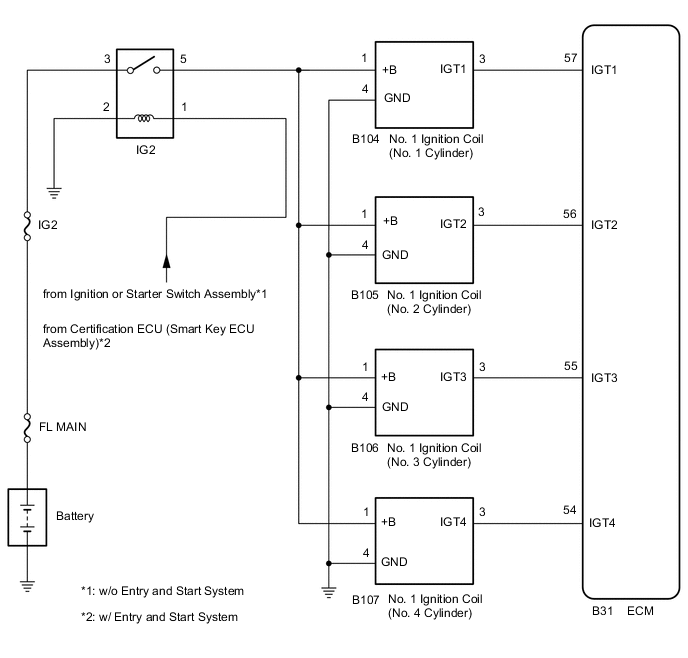
CAUTION / NOTICE / HINT
Note
Inspect the fuses for circuits related to this system before performing the following procedure.
PROCEDURE
-
CHECK TERMINAL VOLTAGE (POWER SOURCE OF NO. 1 IGNITION COIL)
-
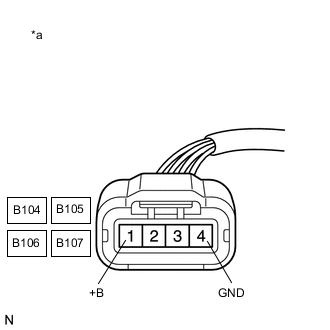
*a Front view of wire harness connector
(to No. 1 Ignition Coil)
Disconnect the No. 1 ignition coil connectors.
-
Turn the ignition switch to ON.
-
Measure the voltage according to the value(s) in the table below.
Standard Voltage Tester Connection Condition Specified Condition B104-1 (+B) - B104-4 (GND) Ignition switch ON 11 to 14 V B105-1 (+B) - B105-4 (GND) Ignition switch ON 11 to 14 V B106-1 (+B) - B106-4 (GND) Ignition switch ON 11 to 14 V B107-1 (+B) - B107-4 (GND) Ignition switch ON 11 to 14 V Result Proceed to OK NG
NG 
CHECK HARNESS AND CONNECTOR (NO. 1 IGNITION COIL - BODY GROUND) Click here
OK 
-
-
CHECK HARNESS AND CONNECTOR (NO. 1 IGNITION COIL - ECM)
-
Disconnect the No. 1 ignition coil connectors.
-
Disconnect the ECM connector.
-
Measure the resistance according to the value(s) in the table below.
Standard Resistance Tester Connection Condition Specified Condition B104-3 (IGT1) - B31-57 (IGT1) Always Below 1 Ω B105-3 (IGT2) - B31-56 (IGT2) Always Below 1 Ω B106-3 (IGT3) - B31-55 (IGT3) Always Below 1 Ω B107-3 (IGT4) - B31-54 (IGT4) Always Below 1 Ω B104-3 (IGT) or B31-57 (IGT1) - Body ground Always 10 kΩ or higher B105-3 (IGT2) or B31-56 (IGT2) - Body ground Always 10 kΩ or higher B106-3 (IGT3) or B31-55 (IGT3) - Body ground Always 10 kΩ or higher B107-3 (IGT4) or B31-54 (IGT4) - Body ground Always 10 kΩ or higher Result Proceed to OK NG
OK 
REPLACE ECM Click here
NG
REPAIR OR REPLACE HARNESS OR CONNECTOR
-
-
CHECK HARNESS AND CONNECTOR (NO. 1 IGNITION COIL - BODY GROUND)
-
Disconnect the No. 1 ignition coil connectors.
-
Measure the resistance according to the value(s) in the table below.
Standard Resistance Tester Connection Condition Specified Condition B104-4 (GND) - Body ground Always Below 1 Ω B105-4 (GND) - Body ground Always Below 1 Ω B106-4 (GND) - Body ground Always Below 1 Ω B107-4 (GND) - Body ground Always Below 1 Ω Result Proceed to OK NG
NG
REPAIR OR REPLACE HARNESS OR CONNECTOR
OK
-
-
CHECK HARNESS AND CONNECTOR (IG2 RELAY - NO. 1 IGNITION COIL)
-
Remove the IG2 relay from the engine room relay block and junction block assembly.
-
Disconnect the No. 1 ignition coil connectors.
-
Measure the resistance according to the value(s) in the table below.
Standard Resistance Tester Connection Condition Specified Condition 5 (IG2 relay) - B104-1 (+B) Always Below 1 Ω 5 (IG2 relay) - B105-1 (+B) Always Below 1 Ω 5 (IG2 relay) - B106-1 (+B) Always Below 1 Ω 5 (IG2 relay) - B107-1 (+B) Always Below 1 Ω Result Proceed to OK NG
OK
GO TO ECM POWER SOURCE CIRCUIT Click here
NG
REPAIR OR REPLACE HARNESS OR CONNECTOR
-