COOLING SYSTEM ON-VEHICLE INSPECTION
PROCEDURE
-
INSPECT FOR COOLANT LEAK
CAUTION:
Do not remove the reserve tank cap while the engine and radiator assembly are still hot. Pressurized hot engine coolant and steam may be released and cause serious burns.
-
Remove the reserve tank cap.
-
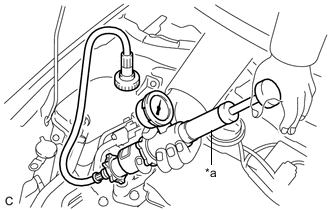
*a Radiator Cap Tester Fill the radiator reserve tank assembly with engine coolant, and then install a radiator cap tester.
-
Warm up the engine.
-
Pump the radiator cap tester to 143 kPa (1.5 kgf/cm2, 21 psi), and then check that the pressure does not drop.
-
If the pressure drops, check the hoses, radiator assembly and engine water pump assembly for leaks.
-
If there are no signs of external engine coolant leaks, check the heater core, cylinder block sub-assembly and cylinder head sub-assembly.
-
-
Remove the radiator cap tester.
-
Install the reserve tank cap.
-
-
INSPECT ENGINE COOLANT LEVEL IN RESERVOIR
-
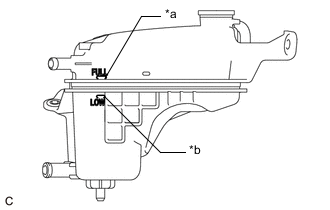
*a Full Line *b Low Line Check that the engine coolant level is between the low line and full line when the engine is cold.
If the engine coolant level is low, check for leaks and add engine coolant to the full line.
Note
Do not substitute plain water for engine coolant.
-
-
INSPECT ENGINE COOLANT QUALITY
CAUTION:
Do not remove the reserve tank cap while the engine and radiator assembly are still hot. Pressurized hot engine coolant and steam may be released and cause serious burns.
-
Remove the reserve tank cap.
-
Check that there are no excessive deposits of rust or scale around the reserve tank cap and water filler hole. Also, the engine coolant should be free of oil.
If excessively dirty, clean the engine coolant passage and replace the engine coolant.
-
Install the reserve tank cap.
-