SFI SYSTEM, Diagnostic DTC:P0443
| DTC Code | DTC Name |
|---|---|
| P0443 | Evaporative Emission Control System Purge Control Valve Circuit |
DESCRIPTION
To reduce hydrocarbon emissions, evaporated fuel from the fuel tank is routed through a charcoal canister to the intake manifold for combustion in the cylinders.
The ECM changes the duty signals to the purge VSV so that the intake amount of hydrocarbon emissions is appropriate for the driving conditions (engine load, engine speed, vehicle speed, etc.) after the engine is warmed up.
| DTC No. | DTC Detection Condition | Trouble Area |
|---|---|---|
| P0443 | The terminal voltage of the ECM output circuit does not correspond with the drive signals from the ECM to the purge VSV (1 trip detection logic). |
|
WIRING DIAGRAM
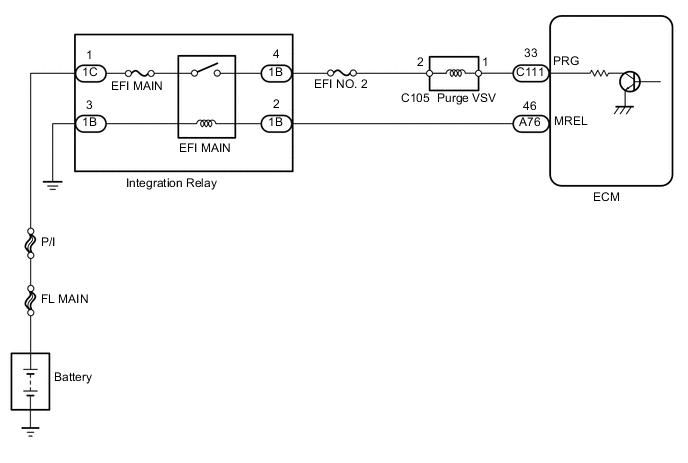
CAUTION / NOTICE / HINT
Note
Inspect the fuses for circuits related to this system before performing the following inspection procedure.
Tech Tips
Read freeze frame data using the GTS. The ECM records vehicle and driving condition information as freeze frame data the moment a DTC is stored. When troubleshooting, freeze frame data can help determine if the vehicle was moving or stationary, if the engine was warmed up or not, if the air fuel ratio was lean or rich, and other data from the time the malfunction occurred.
PROCEDURE
-
PERFORM ACTIVE TEST USING GTS (ACTIVATE THE PURGE VSV CONTROL)
-
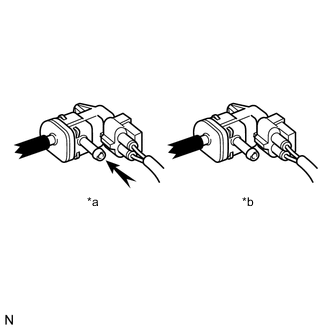
Text in Illustration *a VSV ON *b VSV OFF Connect the GTS to the DLC3.
-
Disconnect the vacuum hose of the purge VSV from the charcoal canister.
-
Start the engine.
-
Turn the GTS on.
-
Enter the following menus: Powertrain / Engine and ECT / Active Test / Activate the VSV for Evap Control.
-
When the purge VSV is operated using the GTS, check whether the disconnected hose applies suction to your finger.
OK GTS Operation Specified Condition VSV is ON Suction of air VSV is OFF No suction of air -
Reconnect the vacuum hose of the purge VSV to the charcoal canister.
OK 
CHECK FOR INTERMITTENT PROBLEMS Click here
NG 
-
-
INSPECT PURGE VSV
-
Inspect the purge VSV Click here.
NG
REPLACE PURGE VSV Click here
OK
-
-
INSPECT PURGE VSV (POWER SOURCE VOLTAGE)
-
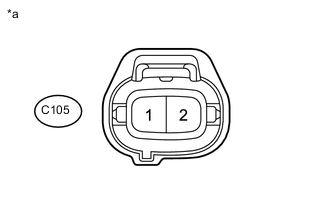
Text in Illustration *a Front view of wire harness connector
(to Purge VSV)
Disconnect the purge VSV connector.
-
Turn the ignition switch to ON.
-
Measure the voltage according to the value(s) in the table below.
Standard Voltage Tester Connection Switch Condition Specified Condition C105-2 - Body ground Ignition switch ON 11 to 14 V -
Reconnect the purge VSV connector.
NG 
CHECK HARNESS AND CONNECTOR (PURGE VSV - INTEGRATION RELAY) Click here
OK
-
-
CHECK HARNESS AND CONNECTOR (PURGE VSV - ECM)
-
Disconnect the purge VSV connector.
-
Disconnect the ECM connector.
-
Measure the resistance according to the value(s) in the table below.
Standard Resistance (Check for Open) Tester Connection Condition Specified Condition C105-1 - C111-33 (PRG) Always Below 1 Ω Standard Resistance (Check for Short) Tester Connection Condition Specified Condition C105-1 or C111-33 (PRG) - Body ground Always 10 kΩ or higher -
Reconnect the purge VSV connector.
-
Reconnect the ECM connector.
OK
REPLACE ECM Click here
NG
REPAIR OR REPLACE HARNESS OR CONNECTOR (PURGE VSV - ECM)
-
-
CHECK HARNESS AND CONNECTOR (PURGE VSV - INTEGRATION RELAY)
-
Disconnect the purge VSV connector.
-
Remove the integration relay (EFI MAIN relay) from the engine room No. 1 relay block and disconnect the integration relay connector.
-
Measure the resistance according to the value(s) in the table below.
Standard Resistance (Check for Open) Tester Connection Condition Specified Condition C105-2 - 1B-4 Always Below 1 Ω Standard Resistance (Check for Short) Tester Connection Condition Specified Condition C105-2 or 1B-4 - Body ground Always 10 kΩ or higher -
Reconnect the purge VSV connector.
-
Reinstall the integration relay.
OK
GO TO ECM POWER SOURCE CIRCUIT Click here
NG
REPAIR OR REPLACE HARNESS OR CONNECTOR (PURGE VSV - INTEGRATION RELAY)
-