ACTIVE HEIGHT CONTROL SUSPENSION SYSTEM DESCRIPTION
-
SYSTEM DESCRIPTION
-
Vehicle height auto-leveling function:
This function maintains a fixed vehicle height regardless of load conditions (occupants, cargo).
-
Vehicle speed sensing function:
-
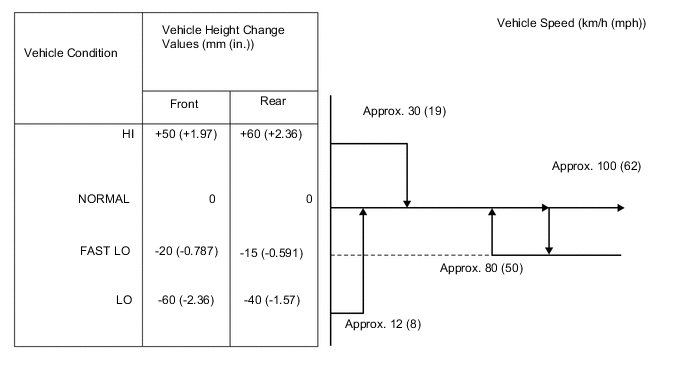
When the vehicle height is NORMAL and the vehicle speed is approximately 100 km/h (62 mph), the vehicle height automatically lowers to FAST LO. When the vehicle speed decreases to approximately 80 km/h (50 mph), the vehicle height automatically returns to NORMAL. When the vehicle height is HI, the vehicle height automatically returns to NORMAL at a vehicle speed of approximately 30 km/h (19 mph). When the vehicle height is LO, the vehicle height automatically returns to NORMAL at a vehicle speed of approximately 12 km/h (8 mph) or more.
-
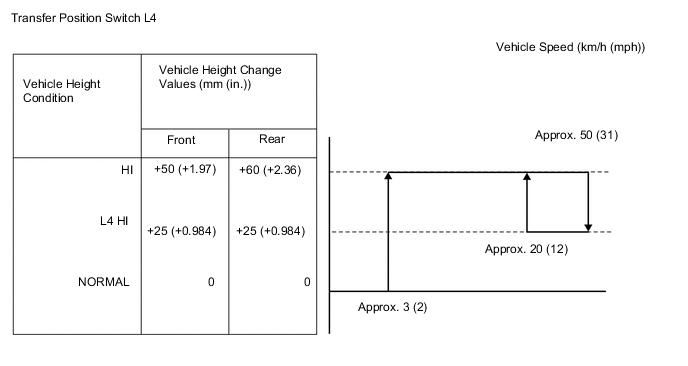
When the transfer position switch is set to L4, the vehicle height automatically changes to HI at a vehicle speed of approximately 3 km/h (2 mph). When the vehicle speed reaches approximately 50 km/h (31 mph), the vehicle height automatically lowers to L4 HI. When the vehicle speed decreases to approximately 20 km/h (12 mph), the vehicle height automatically rises to HI.
-
-
Extra-high vehicle height control:
-
When the transfer is in the L4 position and the vehicle height is HI, the vehicle height automatically rises +20 mm (+0.787 in.) from HI if the suspension control ECU determines the vehicle is stuck.
-
For vehicles with CRAWL (CRAWL control), when the transfer is in the L4 position, the vehicle height automatically rises +20 mm (+0.787 in.) from HI if the suspension control ECU receives information from the skid control ECU via CAN communication that CRAWL control is operating.
-
-
Easy access mode control:
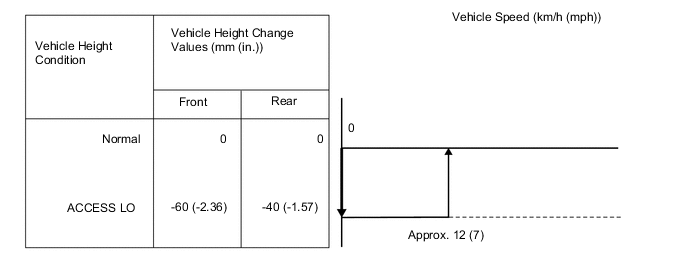
With the vehicle height NORMAL, vehicle height control not operating, the engine running, easy access mode on and the shift lever in P, when the engine switch is turned off, the vehicle height lowers to ACCESS LO. If the vehicle is driven with the vehicle height in ACCESS LO, when the vehicle speed reaches approximately 12 km/h (7 mph) or more, the vehicle height returns to normal.
-
Spring rate switching control (front only):
Located in the front suspension control valve.
-
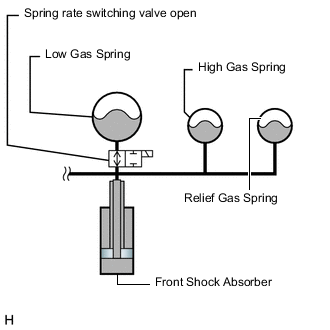
During normal driving, the low gas, high gas, and relief gas springs are used to maintain a low wheel rate with the spring rate switching valve open.
Tech Tips
Low Gas Spring: Front suspension control accumulator
High Gas Spring: Front No. 2 suspension control accumulator
Relief Gas Spring: Front No. 1 suspension control accumulator
-
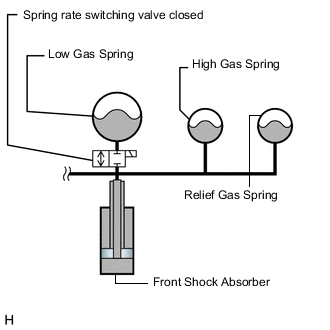
When the steering wheel is turned and a yaw rate is detected while the vehicle is driven at a speed of 30 km/h (19 mph) or more, or when the brake pedal is depressed while the vehicle speed is 50 km/h (31 mph) or more, the high gas and relief gas springs are used to maintain a high wheel rate with the spring rate switching valve closed.
Tech Tips
Low Gas Spring: Front suspension control accumulator
High Gas Spring: Front No. 2 suspension control accumulator
Relief Gas Spring: Front No. 1 suspension control accumulator
-
-
-
FUNCTION OF COMPONENTS
Component Function Sport S/S+ Switch (Integration Control and Panel Assembly) Selects the damping force (COMFORT/NORMAL/SPORT). Located in the integration control and panel. Height Control Switch (Integration Control and Panel Assembly) Selects the vehicle height (low/normal/high). Located in the integration control and panel. Height Control OFF Switch (Integration Control and Panel Assembly) Stops vehicle height control. However, when the vehicle is driven, vehicle height control automatically becomes enabled according to the vehicle speed (Vehicle height NORMAL: approximately 80 km/h (50 mph), vehicle height not NORMAL: approximately 30 km/h (19 mph)). Easy Access Mode Switch (Combination Switch Assembly) Turns access mode on/off. Height Control Sensors Detects the vehicle height and displacement volume of the suspension caused by unevenness of the road. Steering Angle Sensor (Spiral with Sensor Cable Sub-assembly) Detects the steering angle and steering rotation direction. Acceleration Sensors Detects the body vertical accelerated motion. Height Control Pump and Motor Creates the high oil pressure essential for vehicle height adjustment. No. 1 Height Control Valve Leveling valves: There is a leveling valve for each wheel (total of 4). They open and close the oil paths from the pump to the wheels according to suspension control ECU signals. Normally, they are close.
Gate valves: Used for centering of the piston inside the center cylinder (front gate valve and rear gate valve).
Accumulator valve: Used for accumulating pressure.
Pressure Sensor (Height Control Pump and Motor) Detects the fluid pressure. Located in the height control pump and motor assembly. Fluid Temperature Sensor (Height Control Pump and Motor) Detects the fluid temperature. Located in the height control pump and motor assembly. Damping Force Control Actuators
-
Located in the shock absorber valve. Changes the damping force. The damping force is set from 1 to 16 and becomes stiffer as the number increases.
-
When the transfer is in the L4 position, the damping force is fixed at 8.
Yaw Rate and Acceleration Sensor (Airbag Sensor Assembly) Detects the yaw rate and acceleration. Skid Control ECU (Master Cylinder Solenoid) Receives the signals of the stop light switch and speed sensor, and sends them to the suspension control ECU. ECM Sends engine speed information to the suspension control ECU. Suspension Control ECU
-
Controls the damping force and vehicle height according to the operation modes.
-
When a malfunction in the active height control suspension is detected, the driver is informed of the malfunction using the multi-information display.
-
When changed to the diagnostic mode, indicates any malfunction by DTCs.
-
Detects the rear body vertical accelerated motion.
Suspension Control Pump Accumulator When the vehicle height rises, the accumulated oil pressure is released to increase the speed at which the vehicle rises. Center Suspension Control Cylinder Mechanically operates to send and receive oil to and from the wheels according to the pressure balance of the 4 wheels. -
-
FAIL-SAFE FUNCTION
-
When the system is determined to be malfunctioning, the vehicle height is returned to NORMAL at a vehicle speed of 30 km/h (19 mph) only when possible.
-
Conditions when vehicle height control stops:
-
When the stop light switch is on, after operating for a few seconds, control stops. However, when the transfer is in the L4 position, control does not stop.
-
When the vehicle is driving on an uneven road and the vehicle height increases or decreases rapidly due to bumps, etc., control stops.
-
On an inclined road, when the inclination is approximately 20° front to back or approximately 17° side to side, control stops.
-
When the height control pump and motor continuously operates for approximately 85 seconds, control stops.
-
When the oil temperature is -30°C (-22°F) or less, or 100°C (212°F) or more, control stops.
-
-