TELEMATICS SYSTEM(w/ Telematics Transceiver) Emergency Call Switch Indicator Circuit
WIRING DIAGRAM
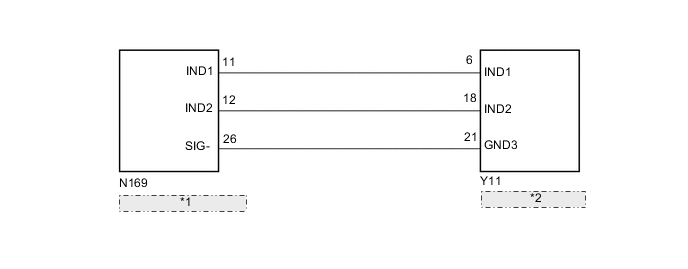
| *1 | Telematics Transceiver |
| *2 | Map Light Assembly |
CAUTION / NOTICE / HINT
Note
Depending on the parts that are replaced during vehicle inspection or maintenance, performing initialization, registration or calibration may be needed. Refer to Precaution for G-BOOK Click here.
PROCEDURE
-
CHECK HARNESS AND CONNECTOR (TELEMATICS TRANSCEIVER - MAP LIGHT ASSEMBLY)
-
Disconnect the N169 telematics transceiver connector.
-
Disconnect the Y11 map light assembly connector.
-
Measure the resistance according to the value(s) in the table below.
Standard Resistance Tester Connection Condition Specified Condition N169-11 (IND1) - Y11-6 (IND1) Always Below 1 Ω N169-12 (IND2) - Y11-18 (IND2) Always Below 1 Ω N169-26 (SIG-) - Y11-21 (GND3) Always Below 1 Ω N169-11 (IND1) - Body ground Always 10 kΩ or higher N169-12 (IND2) - Body ground Always 10 kΩ or higher N169-26 (SIG-) - Body ground Always 10 kΩ or higher
NG 
REPAIR OR REPLACE HARNESS OR CONNECTOR
OK 
-
-
INSPECT MAP LIGHT ASSEMBLY
-
Remove the map light assembly Click here.
-
Connect 2 dry-cell batteries in series.
-
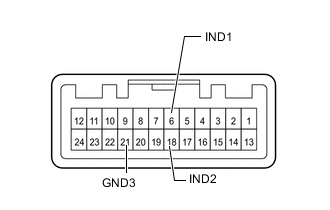
Connect a positive (+) lead from the batteries to terminal 6 (IND1) or 18 (IND2), and a negative (-) lead to terminal 21 (GND3) of the map light assembly connector.
-
Check if an emergency call switch indicator comes on.
OK The indicator (red) comes on when the positive (+) lead from the batteries is connected to terminal 6 (IND1) and the negative (-) lead is connected to terminal 21 (GND3). The indicator (green) comes on when the positive (+) lead from the batteries is connected to terminal 18 (IND2) and the negative (-) lead is connected to terminal 21 (GND3).
OK
REPLACE TELEMATICS TRANSCEIVER Click here
NG
REPLACE MAP LIGHT ASSEMBLY Click here
-