CANISTER(w/o Canister Pump Module) ON-VEHICLE INSPECTION
PROCEDURE
-
PERFORM PRELIMINARY INSPECTION
-
Check for clogs in the air filter (when not using the GTS).
-
Start the engine.
-
Warm up the engine.
-
Allow the engine to idle after the engine has warmed up.
-
After 15 minutes, open the fuel tank cap to discharge the pressure in the fuel tank.
-
Close the fuel tank cap and allow the engine to idle for 30 seconds.
-
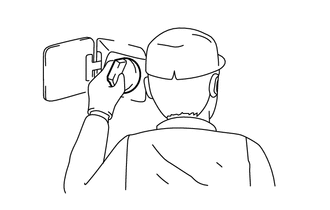
Open the fuel tank cap again and check for inhalation sounds.
OK No whooshing sounds (inhalation sound) are heard. Tech Tips
If gasoline is smelled and a whooshing sound (exhalation sound) is heard, positive pressure in the fuel tank is being discharged. This does not indicate a malfunction.
-
-
Check for clogs in the air filter (when using the GTS).
-
Connect the GTS to the DLC3.
-
Start the engine.
-
Turn the tester on.
-
Enter the following menus: Powertrain / Engine / Active Test / Activate the VSV for Evap Control.
-
Open the fuel tank cap to discharge the pressure in the fuel tank.
-
Perform the "Activate the VSV for Evap Control" Active Test while the engine is idling.
-
Close the fuel tank cap and allow the engine to idle for 30 seconds.
-
Open the fuel tank cap again and check for inhalation sounds.
Standard No whooshing sounds (inhalation sound) are heard. Tech Tips
If gasoline is smelled and a whooshing sound (exhalation sound) is heard, positive pressure in the fuel tank is being discharged. This does not indicate a malfunction.
-
-
-
INSPECT CHARCOAL CANISTER ASSEMBLY
Note
When performing inspections with parts installed on the vehicle, be sure to remove the fuel tank cap.
-
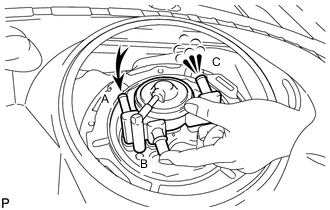
Inspect the airflow of the canister.
-
Close port B and check that air flows from port C when air is blown into port A.
-
-
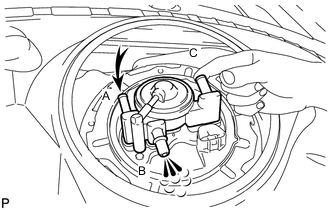
Inspect the check valve.
-
Close port C and check that air flows from port B when air is blown into port A.
-
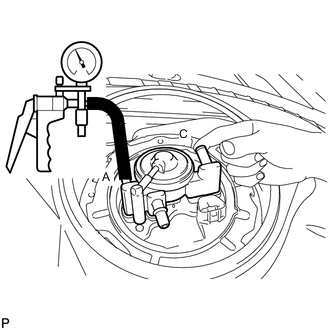
Close port C, and then, using a vacuum pump, apply vacuum to port A, and check whether the condition is normal.
OK Air does not flow.
-
-