СИСТЕМА SFI, Diagnostic DTC:P0017, P0019
| DTC Code | DTC Name |
|---|---|
| P0017 | Crankshaft Position - Camshaft Position Correlation (Bank 1 Sensor B) |
| P0019 | Crankshaft Position - Camshaft Position Correlation (Bank 2 Sensor B) |
DESCRIPTION
Refer to DTC P0013 Click here.
| DTC No. | DTC Detection Condition | Trouble Area |
|---|---|---|
| P0017 | Valve timing on bank 1 exhaust side is deviated for 60 seconds or more (2 trip detection logic) |
|
| P0019 | Valve timing on bank 2 exhaust side is deviated for 60 seconds or more (2 trip detection logic) |
|
MONITOR DESCRIPTION
These DTCs are output when a valve timing deviation condition is detected. While the vehicle is being driven or the engine is idling (after the battery terminals are reconnected), if a valve timing deviation is detected during the valve timing initialization operation, it is determined that a malfunction has occurred. If this condition is detected while driving, a DTC is output (2 trip detection logic). However, if the valve timing is deviated, the camshaft position sensor malfunction DTC P1340 may be output.
A DTC is output if the following occurs: 1) the engine is idled, and then the engine switch is turned off; and 2) the engine is started and the engine is idled.
CAUTION / NOTICE / HINT
Tech Tips
Read freeze frame data using the intelligent tester. Freeze frame data records the engine conditions when malfunctions are detected. When troubleshooting, freeze frame data can help determine if the vehicle was moving or stationary, if the engine was warmed up or not, if the air-fuel ratio was lean or rich, and other data from the time the malfunction occurred.
PROCEDURE
-
PERFORM ACTIVE TEST USING INTELLIGENT TESTER (VVT EXHAUST LINEAR (BANK 1) OR VVT EXHAUST LINEAR (BANK 2))
Tech Tips
If the VVT system can be operated through the Active Test, it can be determined that there is no problem in the VVT system.
-
Connect the intelligent tester to the DLC3.
-
Turn the engine switch on (IG) and turn the tester ON.
-
Start the engine and warm it up.
-
Engine is idling.
-
Enter the following menus: Powertrain / Engine / Active Test / Control the VVT Exhaust Linear (Bank 1) or Control the VVT Exhaust Linear (Bank 2).
-
Check the engine speed while operating the Oil Control Valve (OCV) using the tester.
OK Tester Operation Specified Condition 0% Normal engine speed 30% Engine idles roughly
NG 
INSPECT CAMSHAFT TIMING OIL CONTROL VALVE Click here
OK 
-
-
ADJUST VALVE TIMING
-
Adjust the valve timing Click here.
NEXT
CONFIRM WHETHER MALFUNCTION HAS BEEN SUCCESSFULLY REPAIRED Click here
-
-
INSPECT CAMSHAFT TIMING OIL CONTROL VALVE
-
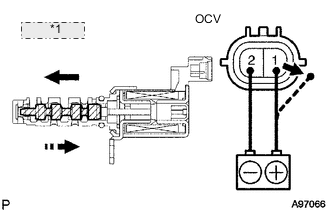
*1 Valve Moves Remove the OCV Click here.
-
Measure the resistance according to the value(s) in the table below.
Standard resistance Tester Connection Condition Specified Condition 1 - 2 20°C (68°F) 6.9 to 7.9 Ω -
Apply the positive battery voltage to terminal 1 and negative battery voltage to terminal 2. Check the valve operation.
OK Valve moves quickly.
NG 
REPLACE CAMSHAFT TIMING OIL CONTROL VALVE ASSEMBLY Click here
OK
-
-
REPLACE CAMSHAFT TIMING EXHAUST GEAR ASSEMBLY
-
Replace the camshaft timing exhaust gear assembly Click here.
NEXT
-
-
CONFIRM WHETHER MALFUNCTION HAS BEEN SUCCESSFULLY REPAIRED
-
To initialize the ECM's valve timing, disconnect the cable from the negative (-) battery terminal for 1 minute.
-
Connect the cable to the negative (-) battery terminal.
-
Connect the intelligent tester to the DLC3.
-
Switch the ECM from normal mode to check mode.
-
Start the engine and idle it for 5 minutes.
-
Drive the vehicle in an urban area for approximately 10 minutes.
-
Enter the following menus: Powertrain / Engine / DTC.
-
Read DTCs.
Result Display (DTC Output) Proceed to No output A Other DTCs B
A
END
B
GO TO DTC CHART Click here
-