AIR CONDITIONING SYSTEM(for Manual Air Conditioning System) PTC Heater Circuit
DESCRIPTION
PTC heater relays are closed in accordance with signals from the air conditioning amplifier assembly and power is supplied to the quick heater assembly installed on the radiator heater unit.
WIRING DIAGRAM
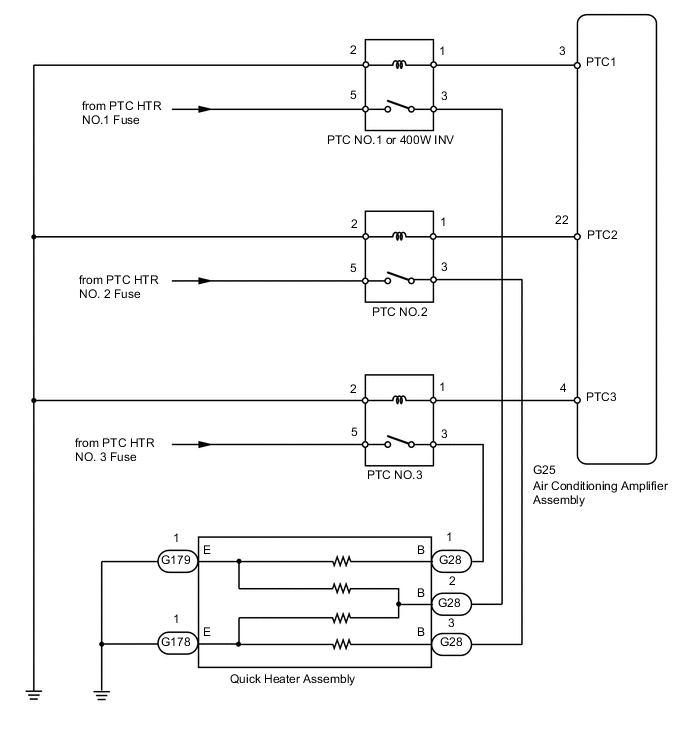
CAUTION / NOTICE / HINT
Note
Inspect the fuses for circuits related to this system before performing the following inspection procedure.
PROCEDURE
-
INSPECT PTC HEATER RELAY (PTC NO.1 OR 400W INV, PTC NO.2, PTC NO.3)
-
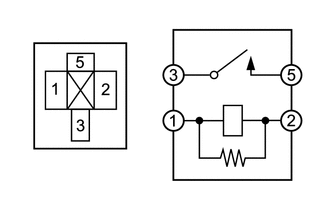
Remove the PTC NO.1 or 400W INV, PTC NO.2 and PTC NO.3 relays from the engine room No. 3 relay block.
-
Measure the resistance according to the value(s) in the table below.
Standard Resistance Tester Connection Condition Specified Condition 3 - 5 Battery voltage is not applied to terminals 1 and 2 10 kΩ or higher Battery voltage is applied to terminals 1 and 2 Below 1 Ω
NG 
REPLACE PTC HEATER RELAY (PTC NO.1 OR 400W INV, PTC NO.2, PTC NO.3)
OK 
-
-
CHECK AIR CONDITIONING AMPLIFIER ASSEMBLY
-
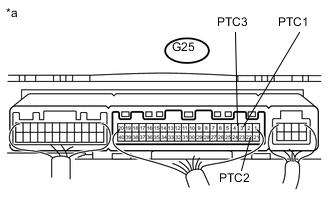
Text in Illustration *a Component with harness connected
(Air Conditioning Amplifier Assembly)
Remove the air conditioning amplifier assembly with its connectors still connected Click here.
-
Measure the voltage according to the value(s) in the table below.
Standard Voltage Tester Connection Condition Specified Condition G25-3 (PTC1) - Body ground
-
Engine running (1250 rpm or more)
-
Temperature setting MAX HOT
-
Outside temperature 10°C (50°F) or less
-
Engine coolant temperature 79°C (174°F) or less
-
Headlight dimmer switch off
-
Blower switch off
11 to 14 V G25-22 (PTC2) - Body ground
-
Engine running (1250 rpm or more)
-
Temperature setting MAX HOT
-
Outside temperature 10°C (50°F) or less
-
Engine coolant temperature 76°C (169°F) or less
-
Headlight dimmer switch off
-
Blower switch off
G25-4 (PTC3) - Body ground
-
Engine running (1250 rpm or more)
-
Temperature setting MAX HOT
-
Outside temperature 10°C (50°F) or less
-
Engine coolant temperature 73°C (163°F) or less
-
Headlight dimmer switch off
-
Blower switch off
G25-3 (PTC1) - Body ground
-
Engine running (1250 rpm or more)
-
Temperature setting MAX HOT
-
Outside temperature 10°C (50°F) or less
-
Engine coolant temperature 79°C (174°F) or less
-
Headlight dimmer switch off
-
Blower switch on
Below 1 V G25-22 (PTC2) - Body ground
-
Engine running (1250 rpm or more)
-
Temperature setting MAX HOT
-
Outside temperature 10°C (50°F) or less
-
Engine coolant temperature 76°C (169°F) or less
-
Headlight dimmer switch off
-
Blower switch on
G25-4 (PTC3) - Body ground
-
Engine running (1250 rpm or more)
-
Temperature setting MAX HOT
-
Outside temperature 10°C (50°F) or less
-
Engine coolant temperature 73°C (163°F) or less
-
Headlight dimmer switch off
-
Blower switch on
-
NG
PROCEED TO NEXT SUSPECTED AREA SHOWN IN PROBLEM SYMPTOMS TABLE Click here
OK
-
-
CHECK HARNESS AND CONNECTOR (ENGINE ROOM NO. 3 RELAY BLOCK - AIR CONDITIONING AMPLIFIER)
-
Remove the PTC heater relays from the engine room No. 3 relay block.
-
Disconnect the G25 amplifier connector.
-
Measure the resistance according to the value(s) in the table below.
Standard Resistance Tester Connection Condition Specified Condition PTC NO.1 or 400W INV relay terminal 1 - G25-3 (PTC1) Always Below 1 Ω PTC NO.2 relay terminal 1 - G25-22 (PTC2) PTC NO.3 relay terminal 1 - G25-4 (PTC3) PTC NO.1 or 400W INV relay terminal 1 - Body ground Always 10 kΩ or higher PTC NO.2 relay terminal 1 - Body ground PTC NO.3 relay terminal 1 - Body ground
NG
REPAIR OR REPLACE HARNESS OR CONNECTOR
OK
-
-
CHECK HARNESS AND CONNECTOR (ENGINE ROOM NO. 3 RELAY BLOCK - QUICK HEATER)
-
Remove the PTC heater relays from the engine room No. 3 relay block.
-
Disconnect the G28 quick heater connector.
-
Measure the resistance according to the value(s) in the table below.
Standard Resistance Tester Connection Condition Specified Condition PTC NO.1 or 400W INV relay terminal 3 - G28-2 (B) Always Below 1 Ω PTC NO.2 relay terminal 3 - G28-3 (B) PTC NO.3 relay terminal 3 - G28-1 (B) PTC NO.1 or 400W INV relay terminal 3 - Body ground Always 10 kΩ or higher PTC NO.2 relay terminal 3 - Body ground PTC NO.3 relay terminal 3 - Body ground
NG
REPAIR OR REPLACE HARNESS OR CONNECTOR
OK
-
-
CHECK HARNESS AND CONNECTOR (ENGINE ROOM NO. 3 RELAY BLOCK - BATTERY AND BODY GROUND)
-
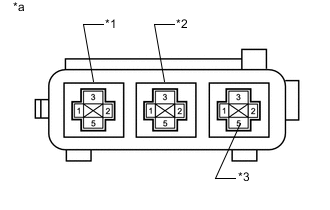
Text in Illustration *1 PTC NO.1 or 400W INV Relay *2 PTC NO.2 Relay *3 PTC NO.3 Relay *a Component without relay installed
(Engine Room No. 3 Relay Block)
Remove the PTC heater relays from the engine room No. 3 relay block.
-
Measure the voltage according to the value(s) in the table below.
Standard Voltage Tester Connection Condition Specified Condition PTC NO.1 or 400W INV relay terminal 5 - Body ground Always 11 to 14 V PTC NO.2 relay terminal 5 - Body ground PTC NO.3 relay terminal 5 - Body ground -
Measure the resistance according to the value(s) in the table below.
Standard Resistance Tester Connection Condition Specified Condition PTC NO.1 or 400W INV relay terminal 2 - Body ground Always Below 1 Ω PTC NO.2 relay terminal 2 - Body ground PTC NO.3 relay terminal 2 - Body ground
NG
REPAIR OR REPLACE HARNESS OR CONNECTOR
OK
-
-
INSPECT QUICK HEATER ASSEMBLY
-
Remove the quick heater assembly Click here.
-
Inspect the quick heater assembly Click here.
NG
REPLACE QUICK HEATER ASSEMBLY Click here
OK
-
-
CHECK HARNESS AND CONNECTOR (QUICK HEATER - BODY GROUND)
-
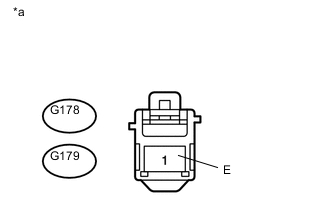
Text in Illustration *a Front view of wire harness connector
(to Quick Heater Assembly)
Disconnect the G178 and G179 heater connectors.
-
Measure the resistance according to the value(s) in the table below.
Standard Resistance Tester Connection Condition Specified Condition G178-1 (E) - Body ground Always Below 1 Ω G179-1 (E) - Body ground
OK
PROCEED TO NEXT SUSPECTED AREA SHOWN IN PROBLEM SYMPTOMS TABLE Click here
NG
REPAIR OR REPLACE HARNESS OR CONNECTOR
-