SUSPENSION CONTROL SYSTEM(w/ Air Suspension) ON-VEHICLE INSPECTION
PROCEDURE
-
INSPECT TIRES
-
ADJUST STANDARD VEHICLE HEIGHT
-
Release the parking brake and stabilize the suspension by bouncing the corners of the vehicle.
-
With the shift lever in N, settle the tires by moving the vehicle back and forth.
-
Start the engine.
-
Operate the height control switch to raise and then lower the vehicle height. Perform this operation twice.
Note
Be sure to release the parking brake and move the shift lever to N.
-
-
INSPECT VEHICLE HEIGHT
-
INSPECT VEHICLE HEIGHT SELECTION
-
ADJUST VEHICLE HEIGHT
Note
-
While adjusting vehicle height, do not put anyone or anything on or in the vehicle because doing so will affect vehicle height.
-
Height control sensors are installed on both the left and right sides. However, each side cannot be adjusted individually, as the left and right sides are not controlled independently.
-
Even if the height control sensor of only one side is adjusted, the vehicle height of both the left and right sides will change.
-
Suspend vehicle height control by pressing the height control switch.
-
Put the vehicle on a level surface.
-
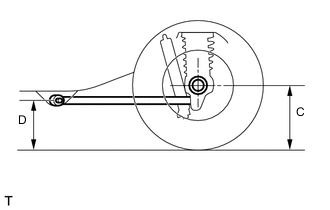
Measure the vehicle height (C - D measurement) on the right side and left side.
Standard vehicle height (See page Click here) Difference between right and left side 10 mm (0.394 in.) or less -
If the actual vehicle height differs from the vehicle height (C - D measurement), adjust it by jacking up the frame, etc. (Procedure "A").
-
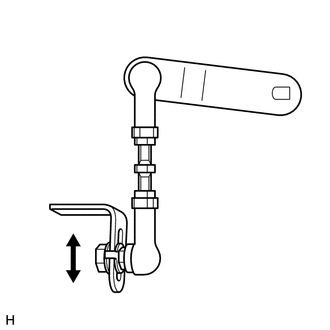
If the procedure "A" differs from the vehicle height (C - D measurement), adjust it by following the procedures below.
-
Loosen the nut.
-
Move the height control sensor link up and down along the slotted hole of the bracket.
-
Adjust the vehicle height to the vehicle height (C - D measurement) while checking the value on the intelligent tester or voltmeter.
Standard voltage 2.5 V Tech Tips
When adjusting with a TOYOTA electrical tester, check the terminal voltages of the suspension control ECU and adjust the length until the voltages meet the standard values.
RH Side 13 (SBR2) - 26 (SHRR) LH Side 14 (SBL2) - 24 (SHRL) 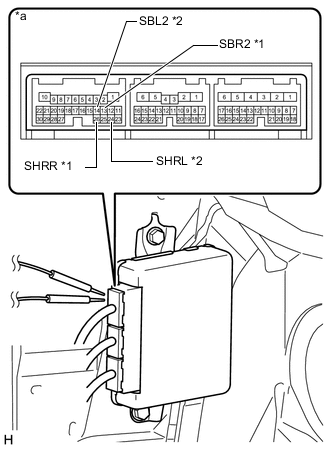
Text in Illustration *1 RH Side *2 LH Side *a Component with harness connected
(Suspension Control ECU)
-
Tighten the nut.
- Torque:
- 5.6 N*m { 57 kgf*cm, 50 in.*lbf }
-
-
If the vehicle height cannot be adjusted by performing procedure "A", adjust it again by following the procedures below.
-
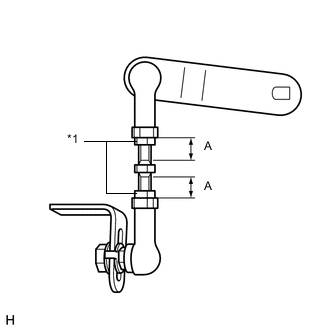
Text in Illustration *1 Lock Nut Loosen the 2 lock nuts of the height control sensor link.
-
Adjust the vehicle height to the vehicle height (C - D measurement) by turning the link while checking the value on the intelligent tester or the voltmeter.
Standard voltage 2.5 V -
Tighten the 2 lock nuts.
- Torque:
- 5.4 N*m { 55 kgf*cm, 48 in.*lbf }
-
-
Check that the lengths of the screw parts, labeled "A" in the illustration, are within the standard values.
Standard Length Item Specified Condition LH 6.0 to 12.5 mm (0.24 to 0.49 in.) RH 6.5 to 15.0 mm (0.26 to 0.59 in.) -
Change the vehicle height (from the normal position to the high position, and from the high position to the normal position).
-
Measure the vehicle height (C - D measurement) on the right and left side (Procedure "D").
-
Check if the vehicle height (C - D measurement) is within the specified range.
Tech Tips
If the values are outside the standard range, perform the procedures from procedure "A" to procedure "D" again.
-