ECD SYSTEM(w/ Urea SCR System), Diagnostic DTC:P2032, P2033
| DTC Code | DTC Name |
|---|---|
| P2032 | Exhaust Gas Temperature Sensor Circuit Low (Bank 1 Sensor 2) |
| P2033 | Exhaust Gas Temperature Sensor Circuit High (Bank 1 Sensor 2) |
DESCRIPTION
Refer to DTC P0545 Click here.
| DTC Detection Drive Pattern | DTC Detection Condition | Trouble Area |
|---|---|---|
| Idle the engine for 3 seconds or more after warming up the engine (the engine coolant temperature is 70°C (158°F) or higher), allowing 11 minutes to elapse after starting the engine and waiting for the exhaust gas temperature sensor to be 120°C (248°F) or more for 15 seconds. | No. 2 exhaust gas temperature sensor output voltage is below 0.2 V for 3 seconds or more when all conditions are met. (1 trip detection logic):
|
|
| DTC Detection Drive Pattern | DTC Detection Condition | Trouble Area |
|---|---|---|
| Idle the engine for 3 seconds or more after warming up the engine (the engine coolant temperature is 70°C (158°F) or higher), allowing 11 minutes to elapse after starting the engine and waiting for the exhaust gas temperature sensor to be 120°C (248°F) or more for 15 seconds. | No. 2 exhaust gas temperature sensor output voltage is higher than 4.95 V for 3 seconds or more when all conditions are met. (1 trip detection logic):
|
|
| DTC No. | Data List |
|---|---|
| P2032 P2033 |
Exhaust Temperature B1S2 |
Tech Tips
-
DTC P20CF (Exhaust fuel addition injector malfunction) may be stored if there is an open malfunction in an exhaust gas temperature sensor circuit.
-
Sensor 2 represents the sensor located upstream of the DPF catalytic converter.
-
When DTC P2032 or P2033 is output, check the exhaust gas temperature indicated by "Powertrain / Engine and ECT / Exhaust Temperature B1S2 using the GTS.
| Condition | Exhaust Temperature B1S2 | No. 2 Exhaust Gas Temperature Sensor Condition |
|---|---|---|
| Idling after warm-up | Constant at between 50 and 700°C (122 and 1292°F) | Normal |
| 0°C (32°F) | Open circuit | |
| 1000°C (1832°F) or higher | Short circuit |
MONITOR DESCRIPTION
The ECM constantly monitors the output voltages from the No. 2 exhaust gas temperature sensors in order to detect problems with the sensors. When the sensor output voltage deviates from the normal operating range (between 0.2 V and 4.95 V) for more than 3 seconds after the engine is warmed up, the ECM interprets this as malfunction of the sensor circuit and illuminates the MIL.
WIRING DIAGRAM
Refer to DTC P0545 Click here.
CAUTION / NOTICE / HINT
Note
After replacing the ECM, the new ECM needs registration (See page ) and initialization Click here.
Tech Tips
Read freeze frame data using the GTS. Freeze frame data records the engine condition when malfunctions are detected. When troubleshooting, freeze frame data can help determine if the vehicle was moving or stationary, if the engine was warmed up or not, and other data from the time the malfunction occurred.
PROCEDURE
-
READ VALUE USING GTS (EXHAUST TEMPERATURE B1S2)
-
Connect the GTS to the DLC3.
-
Turn the engine switch on (IG) and turn the GTS on.
-
Enter the following menus: Powertrain / Engine and ECT / Data List / Exhaust Temperature B1S2.
-
Read the value.
Standard Same as the actual exhaust gas temperature (50 to 700°C [122 to 1292°F] during idling after warm-up), and varies after an engine speed of 3000 rpm is maintained for 1 minute. Result Temperature Displayed Proceed to 0°C (32°F) (After warming up the engine) A 1000°C (1832°F) or higher B OK: Same as the actual exhaust gas temperature (50 to 700°C [122 to 1292°F] during idling after warm-up), and varies after maintaining an engine speed of 3000 rpm for 1 minute after accelerating the engine from idling to 3000 rpm C Tech Tips
-
If there is a short circuit, the GTS will indicate 0°C (32°F).
-
If there is an open circuit, the GTS will indicate 1000°C (1832°F) or higher.
-
B 
READ VALUE USING GTS (CHECK FOR SHORT IN WIRE HARNESS) Click here
C
CONFIRM WHETHER MALFUNCTION HAS BEEN SUCCESSFULLY REPAIRED Click here
A 
-
-
READ VALUE USING GTS (CHECK FOR OPEN IN WIRE HARNESS)
-
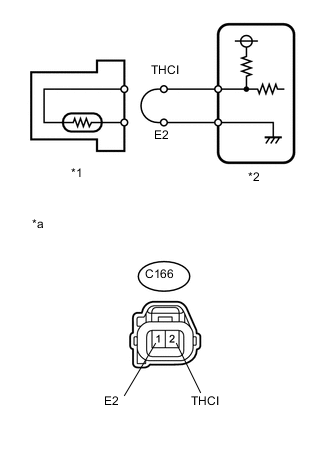
Text in Illustration *1 No. 2 Exhaust Gas Temperature Sensor *2 ECM *a Front view of wire harness connector
(to No. 2 Exhaust Gas Temperature Sensor)
Disconnect the No. 2 exhaust gas temperature sensor connector.
-
Connect terminals 1 (E2) and 2 (THCI) of the exhaust gas temperature sensor wire harness side connector.
-
Connect the GTS to the DLC3.
-
Turn the engine switch on (IG) and turn the GTS on.
-
Enter the following menus: Powertrain / Engine and ECT / Data List / Exhaust Temperature B1S2.
-
Read the value.
Standard 1000°C (1832°F) or higher -
Reconnect the No. 2 exhaust gas temperature sensor connector.
NG
CHECK HARNESS AND CONNECTOR (NO. 2 EXHAUST GAS TEMPERATURE SENSOR - ECM) Click here
OK
-
-
REPLACE NO. 2 EXHAUST GAS TEMPERATURE SENSOR
-
Replace the No. 2 exhaust gas temperature sensor Click here.
NEXT
CONFIRM WHETHER MALFUNCTION HAS BEEN SUCCESSFULLY REPAIRED Click here
-
-
CHECK HARNESS AND CONNECTOR (NO. 2 EXHAUST GAS TEMPERATURE SENSOR - ECM)
-
Disconnect the No. 2 exhaust gas temperature sensor connector.
-
Disconnect the ECM connector.
-
Measure the resistance according to the value(s) in the table below.
Standard Resistance Tester Connection Condition Specified Condition C166-1 (E2) - C149-24 (ETCI) Always Below 1 Ω C166-2 (THCI) - C149-25 (THCI) Always Below 1 Ω -
Reconnect the No. 2 exhaust gas temperature sensor connector.
-
Reconnect the ECM connector.
NG
REPAIR OR REPLACE HARNESS OR CONNECTOR Click here
OK
-
-
REPLACE ECM
-
Replace the ECM Click here.
NEXT
CONFIRM WHETHER MALFUNCTION HAS BEEN SUCCESSFULLY REPAIRED Click here
-
-
READ VALUE USING GTS (CHECK FOR SHORT IN WIRE HARNESS)
-
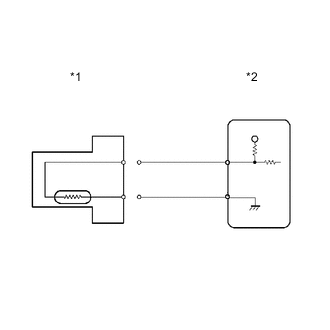
Text in Illustration *1 No. 2 Exhaust Gas Temperature Sensor *2 ECM Disconnect the No. 2 exhaust gas temperature sensor connector.
-
Connect the GTS to the DLC3.
-
Turn the engine switch on (IG) and turn the GTS on.
-
Enter the following menus: Powertrain / Engine and ECT / Data List / Exhaust Temperature B1S2.
-
Read the value.
Standard 0°C (32°F) -
Reconnect the No. 2 exhaust gas temperature sensor connector.
NG
CHECK HARNESS AND CONNECTOR (NO. 2 EXHAUST GAS TEMPERATURE SENSOR - ECM) Click here
OK
-
-
REPLACE NO. 2 EXHAUST GAS TEMPERATURE SENSOR
-
Replace the No. 2 exhaust gas temperature sensor Click here.
NEXT
CONFIRM WHETHER MALFUNCTION HAS BEEN SUCCESSFULLY REPAIRED Click here
-
-
CHECK HARNESS AND CONNECTOR (NO. 2 EXHAUST GAS TEMPERATURE SENSOR - ECM)
-
Disconnect the No. 2 exhaust gas temperature sensor connector.
-
Disconnect the ECM connector.
-
Measure the resistance according to the value(s) in the table below.
Standard Resistance Tester Connection Condition Specified Condition C166-2 (THCI) or C149-25 (THCI) - Body ground and other terminals Always 10 kΩ or higher -
Reconnect the No. 2 exhaust gas temperature sensor connector.
-
Reconnect the ECM connector.
NG
REPAIR OR REPLACE HARNESS OR CONNECTOR Click here
OK
-
-
REPLACE ECM
-
Replace the ECM Click here.
NEXT
CONFIRM WHETHER MALFUNCTION HAS BEEN SUCCESSFULLY REPAIRED Click here
-
-
REPAIR OR REPLACE HARNESS OR CONNECTOR
-
Repair or replace the harness or connector.
NEXT
-
-
CONFIRM WHETHER MALFUNCTION HAS BEEN SUCCESSFULLY REPAIRED
-
Connect the GTS to the DLC3.
-
Clear the DTCs Click here.
-
Start the engine.
-
Idle the engine for 3 seconds or more after warming up the engine (the engine coolant temperature is 70°C (158°F) or higher), allowing 11 minutes to elapse after starting the engine and waiting for the exhaust gas temperature sensor to be 120°C (248°F) or more for 15 seconds.
-
Enter the following menus: Powertrain / Engine and ECT / Trouble Codes.
-
Confirm that the DTC is not output again.
NEXT 
END
-