ECD SYSTEM(w/ Urea SCR System), Diagnostic DTC:P0488
| DTC Code | DTC Name |
|---|---|
| P0488 | Exhaust Gas Recirculation Throttle Position Control Range / Performance |
DESCRIPTION
The ECM opens and closes the throttle valve using a DC motor type actuator. Due to the opening and closing of the valve, the exhaust gas recirculation volume can be properly controlled. Also, engine vibration and noise will be reduced by closing the valve when the engine is stopped.
Although the DTC title says "Exhaust Gas Recirculation Throttle Position Control Range / Performance", this DTC indicates that the throttle valve is malfunctioning.
| DTC Detection Drive Pattern | DTC Detection Condition | Trouble Area |
|---|---|---|
| Perform the following repeatedly for 1 minute: gradually raise the engine speed to 3000 rpm from idling over approximately 10 seconds, and then release the accelerator pedal to return to an idling state. | The throttle actuator activation duty is more than specified value for 60 seconds. (1 trip detection logic) |
|
| DTC No. | Data List |
|---|---|
| P0488 |
|
| Condition | Throttle Valve Position |
|---|---|
| Moment when accelerator pedal is depressed further or released at 3000 rpm | Throttle valve opening angle varies smoothly |
MONITOR DESCRIPTION
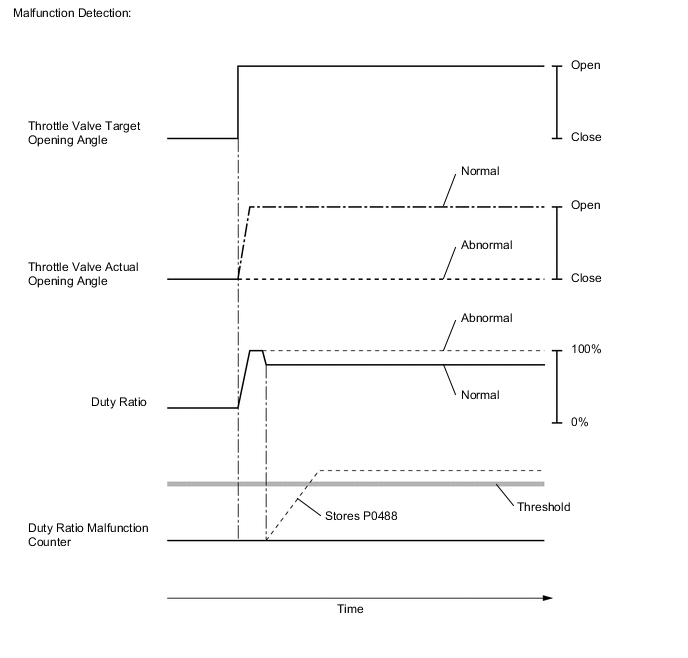
The ECM opens and closes the throttle valve by adjusting the current flowing to the DC motor with a duty ratio. If the throttle valve does not move smoothly or is stuck, the duty ratio used during valve movement control increases or decreases greatly. The ECM will determine that the throttle valve is malfunctioning and illuminate the MIL.
WIRING DIAGRAM
Refer to DTC P0122 Click here.
CAUTION / NOTICE / HINT
Note
-
When cleaning the diesel throttle body assembly, use a piece of cloth soaked with cleaning solvent. Spraying solvent directly onto these parts or soaking the parts in solvent may damage the parts.
-
After replacing the ECM, the new ECM needs registration (See page ) and initialization Click here.
Tech Tips
-
Read freeze frame data using the GTS. Freeze frame data records the engine condition when malfunctions are detected. When troubleshooting, freeze frame data can help determine if the vehicle was moving or stationary, if the engine was warmed up or not, and other data from the time the malfunction occurred.
PROCEDURE
-
PERFORM ACTIVE TEST USING GTS (DIESEL THROTTLE TARGET ANGLE)
-
Connect the GTS to the DLC3.
-
Turn the engine switch on (IG) and turn the GTS on.
-
Enter the following menus: Powertrain / Engine and ECT / Active Test / Diesel Throttle Target Angle / Data List / Primary / Actual Throttle Position.
-
When changing the Active Test continuously value to 10, 30, 60, 90, 60, 30 and 10%, check that Actual Throttle Position smoothly changes to the set opening angle.
OK Value smoothly changes to set opening angle.
NG 
CHECK FOR DEPOSIT (DIESEL THROTTLE BODY ASSEMBLY) Click here
OK 
-
-
CHECK FOR DEPOSIT (DIESEL THROTTLE BODY ASSEMBLY)
-
Visually check for deposits in the diesel throttle body assembly. If there are deposits, clean the diesel throttle body assembly.
Note
-
When cleaning the diesel throttle body assembly, use a piece of cloth soaked with cleaning solvent. Spraying solvent directly onto these parts or soaking the parts in solvent may damage the parts.
-
Extreme care must be taken to prevent the removed deposits from falling into the engine unit during cleaning.
-
NEXT
-
-
INSPECT DIESEL THROTTLE BODY ASSEMBLY (THROTTLE VALVE MOVEMENT)
-
Using your finger, move the throttle valve from the fully open position to the fully closed position and check that it moves smoothly.
OK Throttle valve moves smoothly. Note
Take care not to damage the throttle valve or valve housing.
NG
REPLACE DIESEL THROTTLE BODY ASSEMBLY Click here
OK
-
-
CONFIRM WHETHER MALFUNCTION HAS BEEN SUCCESSFULLY REPAIRED
-
Start the engine and warm it up.
-
Connect the GTS to the DLC3.
-
Turn the GTS on.
-
Take a snapshot with the GTS.
-
Enter the following menus: Powertrain / Engine and ECT / Active Test / Diesel Throttle Target Angle / Data List / Primary / Actual Throttle Position.
Tech Tips
The movement of the throttle valve can be determined by performing the following inspection.
-
When changing the Active Test value continuously to 10, 30, 60, 90, 60, 30 and 10%, check that Actual Throttle Position smoothly changes to the set opening angle.
OK Value smoothly changes to set opening angle. -
Perform the following repeatedly for 1 minute: gradually raise the engine speed to 3000 rpm from an idling over approximately 10 seconds, and then release the accelerator pedal to return to an idling state.
-
Enter the following menus: Powertrain / Engine and ECT / Trouble Codes.
-
Read the DTCs.
OK DTC is not output.
OK 
END
NG
REPLACE ECM Click here
-
-
CHECK FOR DEPOSIT (DIESEL THROTTLE BODY ASSEMBLY)
-
Visually check for deposits in the diesel throttle body assembly. If there are deposits, clean the diesel throttle body assembly.
Note
-
When cleaning the diesel throttle body assembly, use a piece of cloth soaked with cleaning solvent. Spraying solvent directly onto these parts or soaking the parts in solvent may damage the parts.
-
Extreme care must be taken to prevent the removed deposits from falling into the engine unit during cleaning.
-
NEXT
-
-
INSPECT DIESEL THROTTLE BODY ASSEMBLY (THROTTLE VALVE MOVEMENT)
-
Using your finger, move the throttle valve from the fully open position to the fully closed position and check that it moves smoothly.
OK Throttle valve moves smoothly. Note
Take care not to damage the throttle valve or valve housing.
NG
REPLACE DIESEL THROTTLE BODY ASSEMBLY Click here
OK
-
-
CHECK HARNESS AND CONNECTOR (DIESEL THROTTLE BODY ASSEMBLY - ECM)
-
Disconnect the diesel throttle body assembly connector.
-
Disconnect the ECM connector.
-
Measure the resistance according to the value(s) in the table below.
Standard Resistance Tester Connection Condition Specified Condition r5-5 (VC) - C151-29 (VCVL) Always Below 1 Ω r5-6 (VTA) - C151-21 (VLU) Always Below 1 Ω r5-3 (E2) - C151-20 (EVLU) Always Below 1 Ω r5-2 (M+) - C152-6 (M+) Always Below 1 Ω r5-1 (M-) - C152-5 (M-) Always Below 1 Ω r5-5 (VC) or C151-29 (VCVL) - Body ground and other terminals Always 10 kΩ or higher r5-6 (VTA) or C151-21 (VLU) - Body ground and other terminals Always 10 kΩ or higher r5-3 (E2) or C151-20 (EVLU) - Body ground and other terminals Always 10 kΩ or higher r5-2 (M+) or C152-6 (M+) - Body ground and other terminals Always 10 kΩ or higher r5-1 (M-) or C152-5 (M-) - Body ground and other terminals Always 10 kΩ or higher -
Reconnect the throttle control motor connector.
-
Reconnect the ECM connector.
OK
REPLACE DIESEL THROTTLE BODY ASSEMBLY Click here
NG
-
-
REPAIR OR REPLACE HARNESS OR CONNECTOR
-
Repair or replace the harness or connector.
NEXT
CHECK WHETHER DTC OUTPUT RECURS Click here
-
-
REPLACE DIESEL THROTTLE BODY ASSEMBLY
-
Replace the diesel throttle body assembly Click here.
NEXT
CHECK WHETHER DTC OUTPUT RECURS Click here
-
-
REPLACE ECM
-
Replace the ECM Click here.
NEXT
-
-
CHECK WHETHER DTC OUTPUT RECURS
-
Start the engine and warm it up.
-
Turn the engine switch on (IG) and turn the GTS on.
-
Take a snapshot with the GTS.
-
Enter the following menus: Powertrain / Engine and ECT / Active Test / Diesel Throttle Target Angle / Data List / Primary / Actual Throttle Position.
Tech Tips
The movement of the throttle valve can be determined by performing the following inspection.
-
When changing the Active Test value continuously to 10, 30, 60, 90, 60, 30 and 10%, check that Actual Throttle Position smoothly changes to the set opening angle.
OK Value smoothly changes to set opening angle. -
Perform the following repeatedly for 1 minute: gradually raise the engine speed to 3000 rpm from an idling over approximately 10 seconds, and then release the accelerator pedal to return to an idling state.
-
Enter the following menus: Powertrain / Engine and ECT / Trouble Codes.
-
Confirm that the DTC is not output.
NEXT
END
-