CANISTER INSPECTION

PROCEDURE
-
INSPECT CANISTER (for Single Tank Type)
-
Visually check the canister for cracks or damage.
If cracks or damage is found, replace the canister.
-
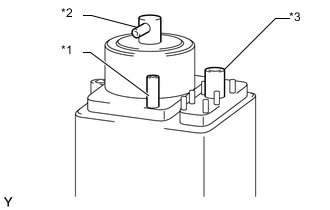
Text in Illustration *1 Port A *2 Port B *3 Port C Using SST, inspect the canister.
- SST
- 09992-00242
OK Measurement Condition Specified Condition Ports B and C closed, vacuum applied to port A [1.96 kPa (15 mmHg, 0.579 in.Hg)] No leak Port C closed, vacuum applied to port A [1.96 kPa (15 mmHg, 0.579 in.Hg)] Air flows from port B Port C closed, air blow into port A [4.71 kPa (0.05 kgf/cm2, 0.7 psi)]
Air flows from port B Air blow into port A [4.71 kPa (0.05 kgf/cm2, 0.7 psi)]
Air flows from both ports B and C If the result is not as specified, replace the canister.
-
-
INSPECT CANISTER (for Double Tank Type)
-
Visually check the canister for cracks or damage.
If cracks or damage is found, replace the canister.
-
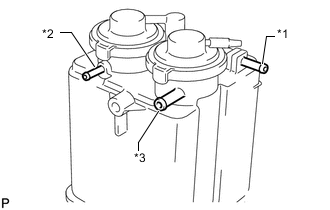
Text in Illustration *1 Port A *2 Port B *3 Port C Using SST, inspect the canister.
- SST
- 09992-00242
OK Measurement Condition Specified Condition Ports B and C closed, vacuum applied to port A [1.96 kPa (15 mmHg, 0.579 in.Hg)] No leak Port C closed, air blow into port A [4.71 kPa (0.05 kgf/cm2, 0.7 psi)]
Air flows from port B Port C closed, air blow into port B [4.71 kPa (0.05 kgf/cm2, 0.7 psi)]
Air flows from port A Air blow into port A [4.71 kPa (0.05 kgf/cm2, 0.7 psi)]
Air flows from both ports B and C If the result is not as specified, replace the canister.
-