HYBRID CONTROL SYSTEM Generator High-voltage Circuit
DESCRIPTION
The cause of this malfunction may be the generator high-voltage circuit.
Check the generator internal resistance and the connection condition of the high-voltage line between the inverter and generator to check whether there is an open or short circuit.
| Area | Inspection | Step |
|---|---|---|
| Generator cable connection check | Check for the connection condition of the cable from the inverter to the generator. | 1, 3 |
| Generator or generator cable | Check the generator (including cable) internal resistance and the insulation resistance with body ground to check for an open or short circuit. | 2 |
| Generator cable | Check the generator cable internal resistance and the insulation resistance with body ground to check for an open or short circuit. | 4 |
WIRING DIAGRAM
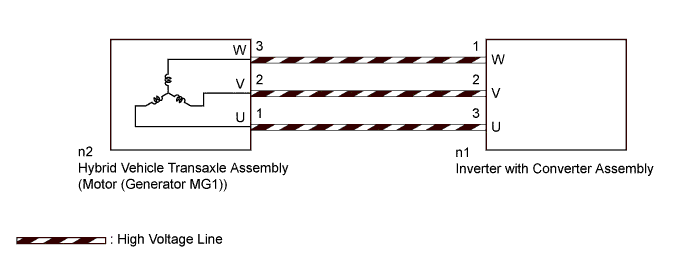
INSPECTION PROCEDURE
This step is referenced from the procedures for each DTC.
If the inspection results below are normal, perform the next procedure for the referenced DTC.
CAUTION:
-
Before inspecting the high-voltage system or disconnecting the low voltage connector of the inverter with converter assembly, take safety precautions such as wearing insulated gloves and removing the service plug grip to prevent electrical shocks. After removing the service plug grip, put it in your pocket to prevent other technicians from accidentally reconnecting it while you are working on the high-voltage system.
-
After removing the service plug grip, wait for at least 10 minutes before touching any of the high-voltage connectors or terminals. After waiting for 10 minutes, check the voltage at the terminals in the inspection point in the inverter with converter assembly. The voltage should be 0 V before beginning work Click here.
Tech Tips
Waiting for at least 10 minutes is required to discharge the high-voltage capacitor inside the inverter with converter assembly.
Note
After turning the power switch off, waiting time may be required before disconnecting the cable from the negative (-) auxiliary battery terminal. Therefore, make sure to read the disconnecting the cable from the negative (-) auxiliary battery terminal notices before proceeding with work Click here.
PROCEDURE
-
CHECK INVERTER WITH CONVERTER ASSEMBLY (GENERATOR CABLE CONNECTION CONDITION)
CAUTION:
Be sure to wear insulated gloves.
-
Check that the service plug grip is not installed.
Note
After removing the service plug grip, do not turn the power switch on (READY), unless instructed by the repair manual because this may cause a malfunction.
-
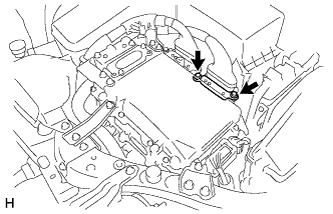
Remove the upper inverter cover (generator cable side) from the inverter with converter assembly.
-
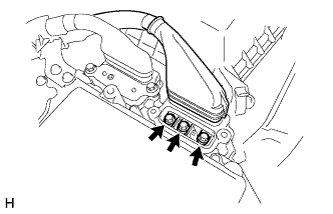
Check that the bolts for the generator cable are tightened to the specified torque, the generator cable is connected securely, and there are no contact problems.
Specified Condition T=8.0 N*m (82 kgf*cm, 71 in.*lbf) Note
Make sure that the tightening torque of the bolt is between 6.4 and 9.6 N*m (65 and 98 kgf*cm, 57 and 85 in.*lbf).
-
Disconnect the generator cable from the inverter with converter assembly.
-
Check for arc marks at the terminals for the generator cable.
Result Result Proceed to The terminals are connected securely and there are no contact problems. There are no arc marks. A The terminals are not connected securely and there is a contact problem. There are arc marks. B The terminals are not connected securely and there is a contact problem. There are no arc marks. C The terminals are connected securely and there are no contact problems. There are arc marks. B -
Reconnect the generator cable to the inverter with converter assembly.
-
Install the upper inverter cover.
B 
REPLACE MALFUNCTIONING PARTS
C
CONNECT SECURELY
A 
-
-
CHECK HYBRID VEHICLE TRANSAXLE ASSEMBLY (GENERATOR (MG1))
CAUTION:
Be sure to wear insulated gloves.
-
Check that the service plug grip is not installed.
Note
After removing the service plug grip, do not turn the power switch on (READY), unless instructed by the repair manual because this may cause a malfunction.
-
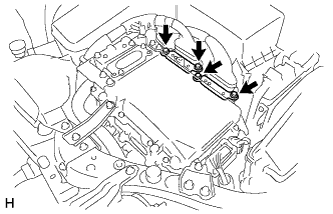
Remove the upper inverter cover (generator cable side) and upper inverter cover (motor cable side) from the inverter with converter assembly.
-
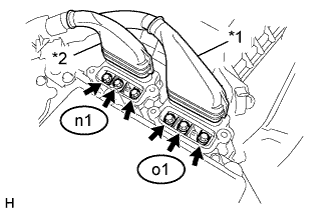
Text in Illustration *1 Generator Cable *2 Motor Cable Disconnect the generator cable and motor cable from the inverter with converter assembly.
-
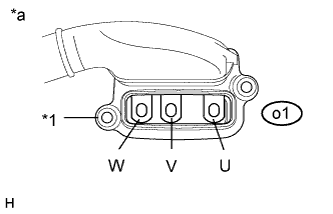
Text in Illustration *1 Shield Ground *a Generator Cable
(Inverter with Converter Assembly Side)
Check generator (MG1) for an interphase short using a milliohmmeter.
-
Using a milliohmmeter, measure the resistance according to the value(s) in the table below.
Tech Tips
If the generator (MG1) temperature is high, the resistance will vary greatly from the specification. Therefore, measure the resistance at least 8 hours after the vehicle is stopped.
Standard Resistance Tester Connection Switch Condition Specified Condition o1-1 (W) - o1-3 (U) Power switch off 59.1 to 67.5 mΩ o1-2 (V) - o1-1 (W) Power switch off 59.1 to 67.5 mΩ o1-3 (U) - o1-2 (V) Power switch off 62.1 to 70.5 mΩ Tech Tips
To correct the variation of the measured resistance due to temperature, use the following formula to calculate the resistance at 20°C (68° F).
-
R20 = Rt / {1 + 0.00393 X (T - 20)}
The calculation is based on the following:
-
R20: Resistance at 20°C (68° F) (mΩ)
-
Rt: Measured resistance (mΩ)
-
T: Temperature when the resistance is measured (°C)
-
-
-
When checking for a short circuit between generator phases without using a milliohmmeter.
Note
The generator generates current when wheels are rotated by hand. Before performing the inspection, wrap the generator cable terminals with insulation tape.
Tech Tips
A short circuit between the generator phases can be checked simply without using a milliohmmeter.
-
Connect the cable to the negative (-) auxiliary battery terminal.
-
Turn the power switch on (IG).
Note
Turning the power switch on (IG) with the service plug grip removed causes other DTCs to be stored. Clear the DTCs after performing this inspection.
-
Move the shift lever to N.
-
Lift up the vehicle.
-
Rotate the front wheels in the same direction simultaneously by hand.
Standard Front wheels rotate smoothly (No short circuit between phases) Tech Tips
If a short circuit exists between the generator phases, the front wheels do not rotate smoothly (some resistance is felt).
-
Lower the vehicle.
-
Move the shift lever to P.
-
Turn the power switch off.
-
Disconnect the cable from the negative (-) auxiliary battery terminal.
-
-
Using a megohmmeter set to 500 V, measure the resistance according to the value(s) in the table below.
Note
Be sure to set the megohmmeter to 500 V when performing this test. Using a setting higher than 500 V can result in damage to the component being inspected.
Standard Resistance Tester Connection Switch Condition Specified Condition o1-1 (W) - Body ground and shield ground Power switch off 100 MΩ or higher o1-2 (V) - Body ground and shield ground Power switch off 100 MΩ or higher o1-3 (U) - Body ground and shield ground Power switch off 100 MΩ or higher -
Measure the resistance according to the value(s) in the table below.
Tech Tips
Perform this procedure only when checking for a short circuit between generator phases without using a milliohmmeter.
Standard Resistance Tester Connection Switch Condition Specified Condition o1-2 (V) - o1-3 (W) Power switch off Below 1 Ω o1-1 (U) - o1-2 (V) Power switch off Below 1 Ω -
Reconnect the generator cable and motor cable.
-
Install the upper inverter cover (generator cable side) and upper inverter cover (motor cable side).
NG 
CHECK HYBRID VEHICLE TRANSAXLE ASSEMBLY (GENERATOR CABLE CONNECTION CONDITION) Click here
OK 
GENERATOR HIGH-VOLTAGE CIRCUIT NORMAL (PERFORM NEXT STEP FOR REFERENCED DTC)
-
-
CHECK HYBRID VEHICLE TRANSAXLE ASSEMBLY (GENERATOR CABLE CONNECTION CONDITION)
CAUTION:
Be sure to wear insulated gloves.
-
Check that the service plug grip is not installed.
Note
After removing the service plug grip, do not turn the power switch on (READY), unless instructed by the repair manual because this may cause a malfunction.
-
Remove the inverter with converter assembly Click here.
-
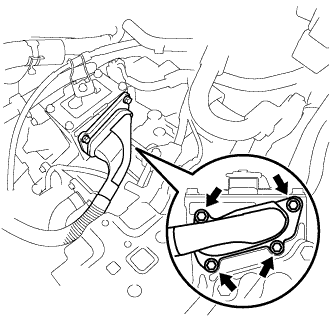
Check that the bolts for the generator cable are tightened to the specified torque, the generator cable is connected securely, and there are no contact problems.
Specified Condition T=8.5 N*m (87 kgf*cm, 75 in.*lbf) Note
Make sure that the tightening torque of the bolt is between 6.4 and 10.5 N*m (65 and 107 kgf*cm, 5 and 8 ft.*lbf).
-
Disconnect the generator cable from the hybrid vehicle transaxle assembly.
-
Check for arc marks at the terminals for the generator cable.
Result Result Proceed to The terminals are connected securely and there are no contact problems. There are no arc marks. A The terminals are not connected securely and there is a contact problem. There are arc marks. B The terminals are not connected securely and there is a contact problem. There are no arc marks. C The terminals are connected securely and there are no contact problems. There are arc marks. B -
Reconnect the generator cable to the hybrid vehicle transaxle assembly.
-
Install the inverter with converter assembly.
B
REPLACE MALFUNCTIONING PARTS
C
CONNECT SECURELY
A
-
-
CHECK GENERATOR CABLE
CAUTION:
Be sure to wear insulated gloves.
-
Check that the service plug grip is not installed.
Note
After removing the service plug grip, do not turn the power switch on (READY), unless instructed by the repair manual because this may cause a malfunction.
-
Remove the generator cable Click here.
-
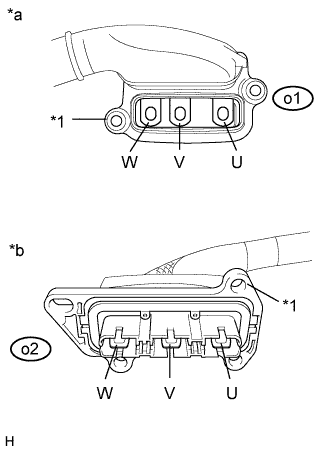
Text in Illustration *1 Shield ground *a Generator Cable
(Inverter with Converter Assembly Side)
*b Generator Cable
(Hybrid Vehicle Transaxle Assembly Side)
Using a megohmmeter set to 500 V, measure the resistance according to the value(s) in the table below.
Note
Be sure to set the megohmmeter to 500 V when performing this test. Using a setting higher than 500 V can result in damage to the component being inspected.
Standard Resistance Tester Connection Switch Condition Specified Condition o1-1 (W) - Body ground and shield ground Power switch off 100 MΩ or higher o1-2 (V) - Body ground and shield ground Power switch off 100 MΩ or higher o1-3 (U) - Body ground and shield ground Power switch off 100 MΩ or higher Note
Wrap the terminal of the generator cable with insulating tape to prevent them from coming into contact with body ground
-
Measure the resistance according to the value(s) in the table below.
Standard Resistance Tester Connection Switch Condition Specified Condition o1-1 (W) - o2-1 (W) Power switch off Below 1 Ω o1-2 (V) - o2-2 (V) Power switch off Below 1 Ω o1-3 (U) - o2-3 (U) Power switch off Below 1 Ω o1-1 (W) - o2-3 (U) Power switch off 100 MΩ or higher o1-2 (V) - o2-1 (W) Power switch off 100 MΩ or higher o1-3 (U) - o2-2 (V) Power switch off 100 MΩ or higher -
Install the generator cable.
Result Result Proceed to OK (When Not Using the Engine Support Bridge) A OK (When Using the Engine Support Bridge) B NG C
B
REPLACE HYBRID VEHICLE TRANSAXLE ASSEMBLY (When Using the Engine Support Bridge) Click here
C
REPLACE GENERATOR CABLE Click here
A
REPLACE HYBRID VEHICLE TRANSAXLE ASSEMBLY (When Not Using the Engine Support Bridge) Click here
-