HYBRID CONTROL SYSTEM, Diagnostic DTC:P3004-800, P3004-801

| DTC Code | DTC Name |
|---|---|
| P3004-800 | High Voltage Power Resource |
| P3004-801 | High Voltage Power Resource |
DTC SUMMARY
MALFUNCTION DESCRIPTIONThe power management control ECU monitors the high-voltage wiring between the HV battery and inverter with converter assembly and detects a short circuit malfunction or high-voltage system operation malfunction.
The cause of this malfunction may be one of the following:
-
Battery current sensor (IB) circuit malfunction
-
Battery current sensor (IB) malfunction
-
Motor generator control ECU (MG ECU) malfunction
-
Communication (wire harness) malfunction
-
High voltage system malfunction
-
HV battery malfunction
-
Hybrid battery junction block assembly malfunction
-
Inverter with converter assembly malfunction
-
Air conditioner system malfunction
-
High-voltage wire harness malfunction
-
High-voltage connector or connection malfunction
-
Low-voltage circuit (12 V) malfunction
-
Power management control ECU malfunction
-
Low voltage wire harness malfunction
-
Low voltage connector malfunction
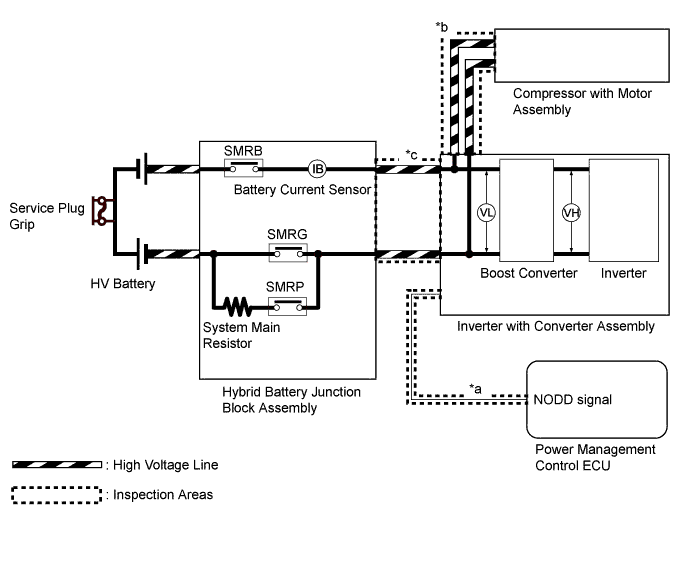
| System Diagram Range | Inspection Content | Reason | Inspection Step |
|---|---|---|---|
| *a | Check wire harness connector connection condition between power management control ECU and inverter with converter assembly | Check that DCDC can be cut off during precharge.
|
2, 3 , 4 |
| *b | Check high-voltage wiring connection condition of the air conditioner compressor with motor assembly | Check for short circuit | 5, 7 |
| *c | Check hybrid battery junction block assembly | Check for short circuit | 6, 9 |
DESCRIPTION
Refer to the description for DTC P0AE6-225 Click here.
| DTC No. | INF Code | DTC Detection Condition | Trouble Area |
|---|---|---|---|
| P3004 | 800 | High-voltage circuit malfunctions between the HV battery and inverter with converter assembly. Excessive overcurrent occurs during precharge (time from when SMRP turns on until SMRG turns on). (1 trip detection logic) |
|
| 801 | High-voltage circuit malfunctions between the HV battery and inverter with converter assembly. Minimal overcurrent occurs during precharge (time from when SMRP turns on until when SMRG turns on). (1 trip detection logic) |
| DTC No. | Data List |
|---|---|
| P3004-800 |
|
| P3004-801 |
The following items can be helpful when performing repairs:
Data List
-
VL-Voltage before Boosting
-
Power Resource IB
-
Ready Signal
WIRING DIAGRAM
-
Refer to the wiring diagram for DTC P0A08-264 Click here.
-
Refer to the wiring diagram for DTC P0AA6-526 Click here.
INSPECTION PROCEDURE
CAUTION:
-
Before inspecting the high-voltage system or disconnecting the low voltage connector of the inverter with converter assembly, take safety precautions such as wearing insulated gloves and removing the service plug grip to prevent electrical shocks. After removing the service plug grip, put it in your pocket to prevent other technicians from accidentally reconnecting it while you are working on the high-voltage system.
-
After removing the service plug grip, wait for at least 10 minutes before touching any of the high-voltage connectors or terminals. After waiting for 10 minutes, check the voltage at the terminals in the inspection point in the inverter with converter assembly. The voltage should be 0 V before beginning work Click here.
Tech Tips
Waiting for at least 10 minutes is required to discharge the high-voltage capacitor inside the inverter with converter assembly.
Note
-
After turning the power switch off, waiting time may be required before disconnecting the cable from the negative (-) auxiliary battery terminal. Therefore, make sure to read the disconnecting the cable from the negative (-) auxiliary battery terminal notices before proceeding with work Click here.
-
If P3004-800 or P3004-801 are output, do not repeatedly turn the power switch on (READY), off.
Tech Tips
After the repair, clear the DTCs, perform the following procedure and check that the same DTC (including pending DTC) is not output.
-
Turn the power switch off and wait for 30 seconds or more.
-
Turn the power switch on (READY) and wait for 30 seconds or more.
PROCEDURE
-
CHECK DTC OUTPUT (HYBRID CONTROL)
-
Connect the Techstream to the DLC3.
-
Turn the power switch on (IG).
-
Enter the following menus: Powertrain / Hybrid Control / Trouble Codes.
-
Check if DTCs are output.
Result Result Proceed to P3004-800 or P3004-801 only is output, or DTCs except the ones in the tables below are also output. A Any of the DTCs in table 1 below are also output. B Any of the DTCs in table 2 below are also output. C Table 1 Relevant DTC P0A09-265 DC / DC Converter Status Circuit Low Input P0A10-263 DC / DC Converter Status Circuit High Input P0A94-172, 553, 554, 555, 556, 557 DC / DC Converter Performance Table 2 Malfunction Content Relevant DTC Microcomputer malfunction P0AFC-123 Hybrid Battery Pack Sensor Module Power source circuit malfunction P0ABF-123 Hybrid Battery Pack Current Sensor Circuit Communication system malfunction U029A-123 Lost Communication with Hybrid Battery Pack Sensor Module Sensor and actuator circuit malfunction P0AC0-123 Hybrid Battery Pack Current Sensor Circuit Range / Performance P0AC1-123 Hybrid Battery Pack Current Sensor Circuit Low P0AC2-123 Hybrid Battery Pack Current Sensor Circuit High P0B3D-123 Hybrid Battery Voltage Sensor "A" Circuit Low P0B42-123 Hybrid Battery Voltage Sensor "B" Circuit Low P0B47-123 Hybrid Battery Voltage Sensor "C" Circuit Low P0B4C-123 Hybrid Battery Voltage Sensor "D" Circuit Low P0B51-123 Hybrid Battery Voltage Sensor "E" Circuit Low P0B56-123 Hybrid Battery Voltage Sensor "F" Circuit Low P0B5B-123 Hybrid Battery Voltage Sensor "G" Circuit Low P0B60-123 Hybrid Battery Voltage Sensor "H" Circuit Low P0B65-123 Hybrid Battery Voltage Sensor "I" Circuit Low P0B6A-123 Hybrid Battery Voltage Sensor "J" Circuit Low P0B6F-123 Hybrid Battery Voltage Sensor "K" Circuit Low P0B74-123 Hybrid Battery Voltage Sensor "L" Circuit Low P0B79-123 Hybrid Battery Voltage Sensor "M" Circuit Low P0B7E-123 Hybrid Battery Voltage Sensor "N" Circuit Low P0B83-123 Hybrid Battery Voltage Sensor "O" Circuit Low P0B88-123 Hybrid Battery Voltage Sensor "P" Circuit Low P0B8D-123 Hybrid Battery Voltage Sensor "Q" Circuit Low P0B92-123 Hybrid Battery Voltage Sensor "R" Circuit Low P308A-123 Hybrid Battery Voltage Sensor All Circuits Low Tech Tips
-
P3004-800 or P3004-801 may be output as a result of the malfunction indicated by the DTCs above.
-
The chart above is listed in inspection order of priority.
-
Check DTCs that are output at the same time by following the listed order. (The main cause of the malfunction can be determined without performing unnecessary inspections.)
-
-
Turn the power switch off.
B 
GO TO DTC CHART (HYBRID CONTROL SYSTEM) Click here
C
GO TO DTC CHART (HYBRID BATTERY SYSTEM) Click here
A 
-
-
CHECK CONNECTOR CONNECTION CONDITION (POWER MANAGEMENT CONTROL ECU CONNECTOR)
-
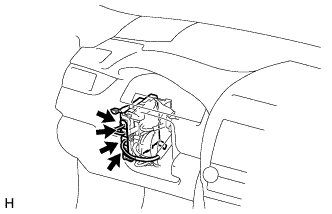
Check the connector connections and contact pressure of the relevant terminals for the power management control ECU connectors Click here.
OK The connectors are connected securely and there are no contact pressure problems.
NG
CONNECT SECURELY
OK
-
-
CHECK CONNECTOR CONNECTION CONDITION (INVERTER WITH CONVERTER ASSEMBLY CONNECTOR)
CAUTION:
Be sure to wear insulated gloves.
-
Check that the service plug grip is not installed.
Note
After removing the service plug grip, do not turn the power switch on (READY), unless instructed by the repair manual because this may cause a malfunction.
-
Check the connection condition of the low voltage connector of the inverter with converter assembly and the contact pressure of each terminal. Check the terminals for deformation, and check the connector for water ingress and foreign matter Click here.
Note
Before disconnecting the connector, confirm that it is properly connected by checking that the locking claws are engaged and that the connector does not pull out.
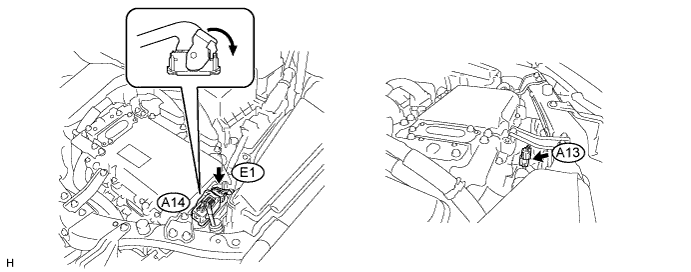
OK - The connector is connected securely. - The terminals are not deformed and are connected securely. - No water or foreign matter in the connector. Result Result Proceed to OK A NG (The connector is not connected securely.) B NG (The terminals are not making secure contact or are deformed, or water or foreign matter exists in the connector.) C Tech Tips
When connecting the connector, insert it with the locking lever in the raised position. Rotate the lever downward and make sure that the connector is pulled into its socket. When the locking lever is in its fully closed position, a click will be heard as its locking claws engage. After the click is heard, pull up on the connector to confirm that it is properly connected.
B
CONNECT SECURELY
C
REPAIR OR REPLACE HARNESS OR CONNECTOR
A
-
-
CHECK HARNESS AND CONNECTOR (INVERTER WITH CONVERTER ASSEMBLY - POWER MANAGEMENT CONTROL ECU)
CAUTION:
Be sure to wear insulated gloves.
-
Check that the service plug grip is not installed.
Note
After removing the service plug grip, do not turn the power switch on (READY), unless instructed by the repair manual because this may cause a malfunction.
-
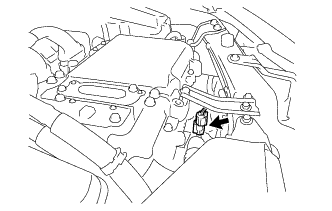
Disconnect the A13 inverter with converter assembly connector.
-
Disconnect the A38 power management control ECU connector.
-
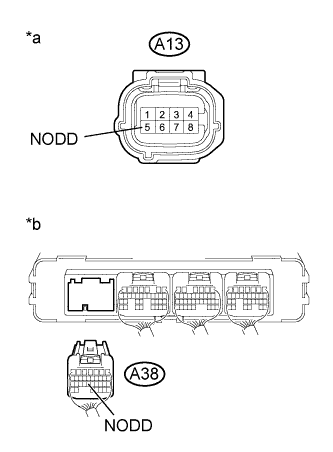
Text in Illustration *a Front view of wire harness connector
(to Inverter with Converter Assembly)
*b Rear view of wire harness connector
(to Power Management Control ECU)
Measure the resistance according to the value(s) in the table below.
Standard Resistance (Check for Open) Tester Connection Switch Condition Specified Condition A13-5 (NODD) - A38-23 (NODD) Power switch off Below 1 Ω Standard Resistance (Check for Short) Tester Connection Switch Condition Specified Condition A13-5 (NODD) or A38-23 (NODD) - Body ground and other terminals Power switch off 10 kΩ or higher -
Reconnect the A38 power management control ECU connector.
-
Reconnect the A13 inverter with converter assembly connector.
NG
REPAIR OR REPLACE HARNESS OR CONNECTOR
OK
-
-
CHECK POWER MANAGEMENT CONTROL ECU (NODD)
CAUTION:
Be sure to wear insulated gloves.
-
Check that the service plug grip is not installed.
Note
After removing the service plug grip, do not turn the power switch on (READY), unless instructed by the repair manual because this may cause a malfunction.
-
Connect the cable to the negative (-) auxiliary battery terminal.
-
Turn the power switch on (IG).
-
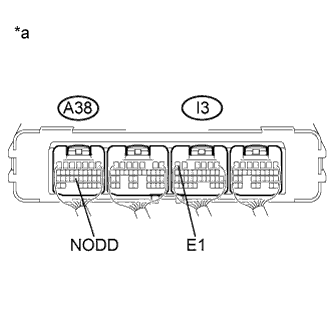
Text in Illustration *a Component with harness connected
(Power Management Control ECU)
Measure the voltage according to the value(s) in the table below.
Standard Voltage Tester Connection Condition Specified Condition A38-23 (NODD) - I3-6 (E1) Power switch on (IG) Less than 1.5 V -
Turn the power switch off.
-
Disconnect the cable from the negative (-) auxiliary battery terminal.
NG
REPLACE POWER MANAGEMENT CONTROL ECU Click here
OK
-
-
CHECK COMPRESSOR WITH MOTOR ASSEMBLY
CAUTION:
Be sure to wear insulated gloves.
-
Check that the service plug grip is not installed.
Note
After removing the service plug grip, do not turn the power switch on (READY), unless instructed by the repair manual because this may cause a malfunction.
-
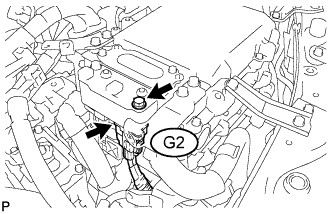
Disconnect connector G2 of the No. 4 engine wire (air conditioning harness) from the inverter with converter assembly.
-
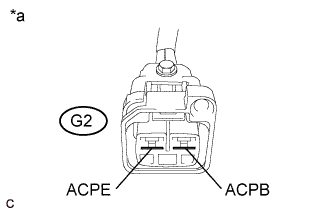
Text in Illustration *a Front view of No. 4 engine wire (Air Conditioning Harness) connector
(to Inverter with Converter Assembly)
Measure the resistance according to the value(s) in the table below.
Standard Resistance Tester Connection
(Tester Probe Polarity)
Switch Condition Specified Condition G2-1 (ACPE) (Negative probe) - G2-2 (ACPB) (Positive probe) Power switch off 100 kΩ or higher Note
-
Do not use a megohmmeter.
-
Read the resistance after the value has stabilized.
Tech Tips
The polarities of the tester probes may differ depending on the tester. Use the current output probe of the tester as the positive probe for this measurement. To determine the polarity, use another voltmeter to confirm the current output probe of the tester. When measuring the output of the tester, the voltmeter positive probe indicates the tester current output probe.
-
-
Connect the No. 4 engine wire (air conditioning harness) to the inverter with converter assembly.
NG 
CHECK NO. 4 ENGINE WIRE Click here
OK
-
-
CHECK NO. 4 FLOOR WIRE
CAUTION:
Be sure to wear insulated gloves.
-
Check that the service plug grip is not installed.
Note
After removing the service plug grip, do not turn the power switch on (READY), unless instructed by the repair manual because this may cause a malfunction.
-
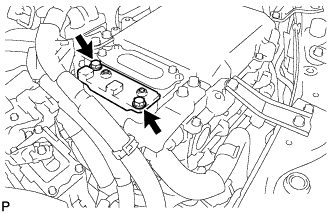
Remove the connector cover assembly from the inverter with converter assembly.
-
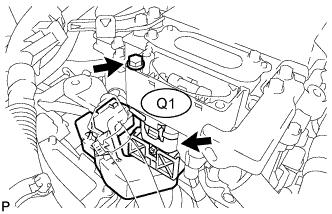
Disconnect connector Q1 of the No. 4 floor wire from the inverter with converter assembly.
-
Remove the No. 4 hybrid battery shield panel Click here.
-
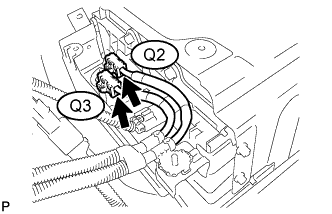
Measure the resistance according to the value(s) in the table below.
Standard Resistance Tester Connection Switch Condition Specified Condition Q2-1 (CBI) - Q3-1 (CEI) Power switch off 10 kΩ or higher -
Install the No. 4 hybrid battery shield panel.
-
Connect the No. 4 floor wire.
-
Install the connector cover assembly.
NG
CHECK HYBRID BATTERY JUNCTION BLOCK ASSEMBLY Click here
OK 
REPLACE INVERTER WITH CONVERTER ASSEMBLY Click here
-
-
CHECK NO. 4 ENGINE WIRE
CAUTION:
Be sure to wear insulated gloves.
-
Check that the service plug grip is not installed.
Note
After removing the service plug grip, do not turn the power switch on (READY), unless instructed by the repair manual because this may cause a malfunction.
-
Disconnect connector G2 of the No. 4 engine wire (air conditioning harness) from the inverter with converter assembly.
-
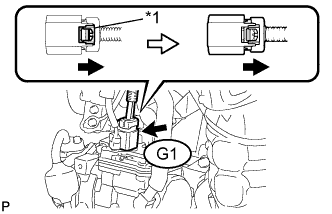
Text in Illustration *1 Green Lock Disconnect connector G1 of the No. 4 engine wire (air conditioning harness) from the compressor with motor assembly.
-
Text in Illustration *a Front view of No. 4 engine wire (Air Conditioning Harness) connector
(to Inverter with Converter Assembly)
Measure the resistance according to the value(s) in the table below.
Standard Resistance Tester Connection Switch Condition Specified Condition G2-1 (ACPE) - G2-2 (ACPB) Power switch off 10 kΩ or higher -
Connect the No. 4 engine wire (air conditioning harness) to the compressor with motor assembly.
-
Connect the No. 4 engine wire (air conditioning harness) to the inverter with converter assembly.
NG
REPLACE NO. 4 ENGINE WIRE
OK
REPLACE COMPRESSOR WITH MOTOR ASSEMBLY Click here
-
-
CHECK HYBRID BATTERY JUNCTION BLOCK ASSEMBLY
CAUTION:
Be sure to wear insulated gloves.
-
Check that the service plug grip is not installed.
Note
After removing the service plug grip, do not turn the power switch on (READY), unless instructed by the repair manual because this may cause a malfunction.
-
Remove the No. 4 hybrid battery shield panel Click here.
-
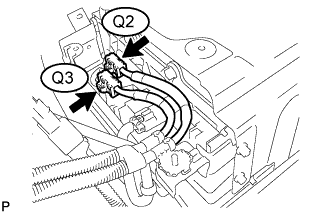
Disconnect connector Q2 and connector Q3 of the No. 4 floor wire from the hybrid battery junction block assembly.
-
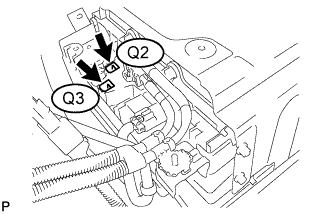
Measure the resistance according to the value(s) in the table below.
Standard Resistance Tester Connection Switch Condition Specified Condition Q3-1 (CEI) - Q2-1 (CBI) Power switch off 10 kΩ or higher -
Connect the No. 4 floor wire.
-
Install the No. 4 hybrid battery shield panel.
NG
REPLACE HYBRID BATTERY JUNCTION BLOCK ASSEMBLY Click here
OK
REPLACE NO. 4 FLOOR WIRE Click here
-