AIRBAG SYSTEM, Diagnostic DTC:B1810/53, B1811/53, B1812/53, B1813/53

| DTC Code | DTC Name |
|---|---|
| B1810/53 | Short in Driver Side Squib 2nd Step Circuit |
| B1811/53 | Open in Driver Side Squib 2nd Step Circuit |
| B1812/53 | Short to GND in Driver Side Squib 2nd Step Circuit |
| B1813/53 | Short to B+ in Driver Side Squib 2nd Step Circuit |
DESCRIPTION
The driver side squib 2nd step circuit consists of the airbag sensor assembly, spiral cable with sensor sub-assembly and horn button assembly.
The airbag sensor assembly uses this circuit to deploy the airbag when deployment conditions are met.
These DTCs are stored when a malfunction is detected in the driver side squib 2nd step circuit.
| DTC No. | DTC Detection Condition | Trouble Area |
|---|---|---|
| B1810/53 |
|
|
| B1811/53 |
|
|
| B1812/53 |
|
|
| B1813/53 |
|
WIRING DIAGRAM
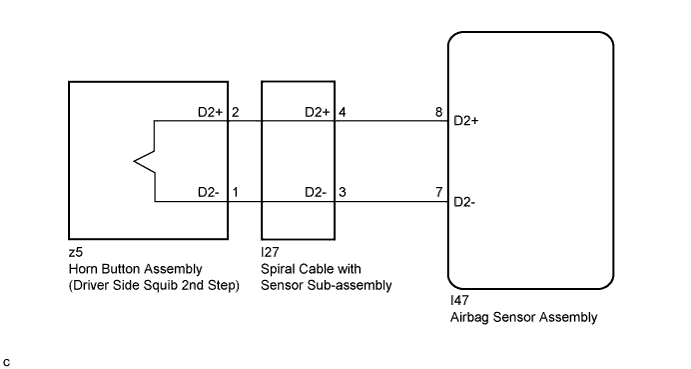
INSPECTION PROCEDURE
Note
After turning the ignition switch off, waiting time may be required before disconnecting the cable from the negative (-) battery terminal. Therefore, make sure to read the disconnecting the cable from the negative (-) battery terminal notices before proceeding with work Click here.
Tech Tips
-
Perform the simulation method by selecting check mode (Signal Check) using the Techstream Click here.
-
After selecting check mode (Signal Check), perform the simulation method by wiggling each connector of the airbag system or driving the vehicle on a city road or rough road Click here.
PROCEDURE
-
CHECK CONNECTORS
-
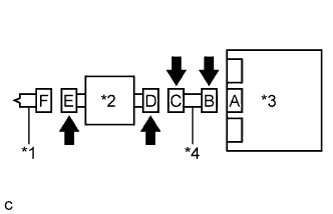
Text in Illustration *1 Horn Button Assembly *2 Spiral Cable with Sensor Sub-assembly *3 Airbag Sensor Assembly *4 Instrument Panel Wire Turn the ignition switch off.
-
Disconnect the cable from the negative (-) battery terminal.
CAUTION:
Wait at least 90 seconds after disconnecting the cable from the negative (-) battery terminal to disable the SRS system.
-
Check that the connectors are properly connected to the horn button assembly, spiral cable with sensor sub-assembly and airbag sensor assembly.
OK The connectors are properly connected. Tech Tips
If the connectors are not connected securely, reconnect the connectors and proceed to the next inspection.
-
Disconnect the connectors from the horn button assembly, spiral cable with sensor sub-assembly and airbag sensor assembly.
-
Check that the terminals of the connectors are not damaged.
OK The terminals are not deformed or damaged. -
Check that the spiral cable with sensor sub-assembly connector (on the horn button assembly side) is not damaged.
OK The lock button is not disengaged, or the claw of the lock is not deformed or damaged. -
Check that the short springs for the instrument panel wire and spiral cable with sensor sub-assembly with the activation prevention mechanism are not deformed or damaged.
OK The short springs are not deformed or damaged.
NG 
REPLACE WIRE HARNESS
OK 
-
-
CHECK HORN BUTTON ASSEMBLY (DRIVER SIDE SQUIB 2ND STEP)
-
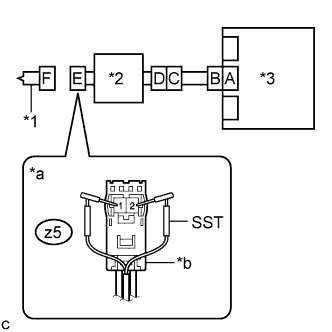
Text in Illustration *1 Horn Button Assembly *2 Spiral Cable with Sensor Sub-assembly *3 Airbag Sensor Assembly *a Front view of wire harness connector
(to Horn Button Assembly)
*b Color: Black Connect the instrument panel wire to the airbag sensor assembly and spiral cable with sensor sub-assembly.
-
Connect SST (resistance 2.1 Ω) to connector E (black connector).
CAUTION:
Never connect the tester to the horn button assembly (driver side squib 2nd step) for measurement, as this may lead to a serious injury due to airbag deployment.
Note
-
Do not forcibly insert SST into the terminals of the connector when connecting it.
-
Insert SST straight into the terminals of the connector.
- SST
- 09843-18061
-
-
Connect the cable to the negative (-) battery terminal.
-
Clear the DTCs stored in memory Click here.
-
Turn the ignition switch off.
-
Turn the ignition switch to ON, and wait for at least 60 seconds.
-
Check for DTCs Click here.
OK DTC B1810/53, B1811/53, B1812/53 or B1813/53 is not output. Tech Tips
Codes other than DTCs B1810/53, B1811/53, B1812/53 and B1813/53 may be output at this time, but they are not related to this check.
-
Turn the ignition switch off.
-
Disconnect the cable from the negative (-) battery terminal.
CAUTION:
Wait at least 90 seconds after disconnecting the cable from the negative (-) battery terminal to disable the SRS system.
-
Disconnect SST from connector E.
NG 
CHECK DRIVER SIDE SQUIB 2ND STEP CIRCUIT Click here
OK 
REPLACE HORN BUTTON ASSEMBLY Click here
-
-
CHECK DRIVER SIDE SQUIB 2ND STEP CIRCUIT
-
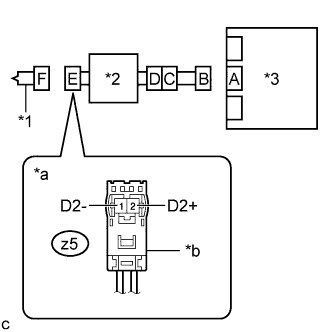
Text in Illustration *1 Horn Button Assembly *2 Spiral Cable with Sensor Sub-assembly *3 Airbag Sensor Assembly *a Front view of wire harness connector
(to Horn Button Assembly)
*b Color: Black Disconnect the instrument panel wire from the airbag sensor assembly.
-
Check for a short to B+ in the circuit.
-
Connect the cable to the negative (-) battery terminal.
-
Turn the ignition switch to ON.
-
Measure the voltage according to the value(s) in the table below.
Standard Voltage Tester Connection Condition Specified Condition z5-2 (D2+) - Body ground Ignition switch ON Below 1 V z5-1 (D2-) - Body ground Ignition switch ON Below 1 V -
Turn the ignition switch off.
-
Disconnect the cable from the negative (-) battery terminal.
CAUTION:
Wait at least 90 seconds after disconnecting the cable from the negative (-) battery terminal to disable the SRS system.
-
-
Check for an open in the circuit.
-
Measure the resistance according to the value(s) in the table below.
Standard Resistance Tester Connection Condition Specified Condition z5-2 (D2+) - z5-1 (D2-) Always Below 1 Ω
-
-
Check for a short to ground in the circuit.
-
Measure the resistance according to the value(s) in the table below.
Standard Resistance Tester Connection Condition Specified Condition z5-2 (D2+) - Body ground Always 1 MΩ or higher z5-1 (D2-) - Body ground Always 1 MΩ or higher
-
-
Check for a short in the circuit.
-
Release the activation prevention mechanism built into connector B Click here.
-
Measure the resistance according to the value(s) in the table below.
Standard Resistance Tester Connection Condition Specified Condition z5-2 (D2+) - z5-1 (D2-) Always 1 MΩ or higher -
Restore the released activation prevention mechanism of connector B to the original condition.
-
NG
CHECK INSTRUMENT PANEL WIRE Click here
OK
-
-
CHECK DTC
-
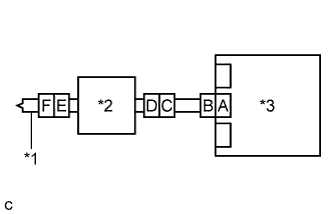
Text in Illustration *1 Horn Button Assembly *2 Spiral Cable with Sensor Sub-assembly *3 Airbag Sensor Assembly Connect the connectors to the horn button assembly and airbag sensor assembly.
-
Connect the cable to the negative (-) battery terminal.
-
Clear the DTCs stored in memory Click here.
-
Turn the ignition switch off.
-
Turn the ignition switch to ON, and wait for at least 60 seconds.
-
Check for DTCs Click here.
OK DTC B1810/53, B1811/53, B1812/53 or B1813/53 is not output. Tech Tips
Codes other than DTCs B1810/53, B1811/53, B1812/53 and B1813/53 may be output at this time, but they are not related to this check.
NG
REPLACE AIRBAG SENSOR ASSEMBLY Click here
OK
USE SIMULATION METHOD TO CHECK Click here
-
-
CHECK INSTRUMENT PANEL WIRE
-
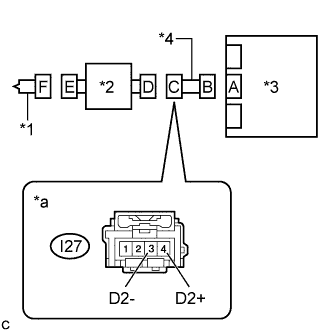
Text in Illustration *1 Horn Button Assembly *2 Spiral Cable with Sensor Sub-assembly *3 Airbag Sensor Assembly *4 Instrument Panel Wire *a Front view of wire harness connector
(to Spiral Cable with Sensor Sub-assembly)
Disconnect the instrument panel wire from spiral cable with sensor sub-assembly.
-
Check for a short to B+ in the circuit.
-
Connect the cable to the negative (-) battery terminal.
-
Turn the ignition switch to ON.
-
Measure the voltage according to the value(s) in the table below.
Standard Voltage Tester Connection Condition Specified Condition I27-4 (D2+) - Body ground Ignition switch ON Below 1 V I27-3 (D2-) - Body ground Ignition switch ON Below 1 V -
Turn the ignition switch off.
-
Disconnect the cable from the negative (-) battery terminal.
CAUTION:
Wait at least 90 seconds after disconnecting the cable from the negative (-) battery terminal to disable the SRS system.
-
-
Check for an open in the circuit.
-
Measure the resistance according to the value(s) in the table below.
Standard Resistance Tester Connection Condition Specified Condition I27-4 (D2+) - I27-3 (D2-) Always Below 1 Ω
-
-
Check for a short to ground in the circuit.
-
Measure the resistance according to the value(s) in the table below.
Standard Resistance Tester Connection Condition Specified Condition I27-4 (D2+) - Body ground Always 1 MΩ or higher I27-3 (D2-) - Body ground Always 1 MΩ or higher
-
-
Check for a short in the circuit.
-
Release the activation prevention mechanism built into connector B Click here.
-
Measure the resistance according to the value(s) in the table below.
Standard Resistance Tester Connection Condition Specified Condition I27-4 (D2+) - I27-3 (D2-) Always 1 MΩ or higher -
Restore the released activation prevention mechanism of connector B to the original condition.
-
NG
REPLACE INSTRUMENT PANEL WIRE
OK
-
-
CHECK SPIRAL CABLE WITH SENSOR SUB-ASSEMBLY
-
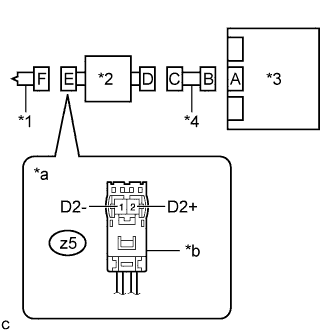
Text in Illustration *1 Horn Button Assembly *2 Spiral Cable with Sensor Sub-assembly *3 Airbag Sensor Assembly *4 Instrument Panel Wire *a Front view of wire harness connector
(to Horn Button Assembly)
*b Color: Black Check for a short to B+ in the circuit.
-
Connect the cable to the negative (-) battery terminal.
-
Turn the ignition switch to ON.
-
Measure the voltage according to the value(s) in the table below.
Standard Voltage Tester Connection Condition Specified Condition z5-2 (D2+) - Body ground Ignition switch ON Below 1 V z5-1 (D2-) - Body ground Ignition switch ON Below 1 V -
Turn the ignition switch off.
-
Disconnect the cable from the negative (-) battery terminal.
CAUTION:
Wait at least 90 seconds after disconnecting the cable from the negative (-) battery terminal to disable the SRS system.
-
-
Check for an open in the circuit.
-
Measure the resistance according to the value(s) in the table below.
Standard Resistance Tester Connection Condition Specified Condition z5-2 (D2+) - z5-1 (D2-) Always Below 1 Ω
-
-
Check for a short to ground in the circuit.
-
Measure the resistance according to the value(s) in the table below.
Standard Resistance Tester Connection Condition Specified Condition z5-2 (D2+) - Body ground Always 1 MΩ or higher z5-1 (D2-) - Body ground Always 1 MΩ or higher
-
-
Check for a short in the circuit.
-
Release the activation prevention mechanism built into connector D Click here.
-
Measure the resistance according to the value(s) in the table below.
Standard Resistance Tester Connection Condition Specified Condition z5-2 (D2+) - z5-1 (D2-) Always 1 MΩ or higher -
Restore the released activation prevention mechanism of connector D to the original condition.
-
NG
REPLACE SPIRAL CABLE WITH SENSOR SUB-ASSEMBLY Click here
OK
USE SIMULATION METHOD TO CHECK Click here
-