SFI SYSTEM Air Intake Control Circuit
DESCRIPTION
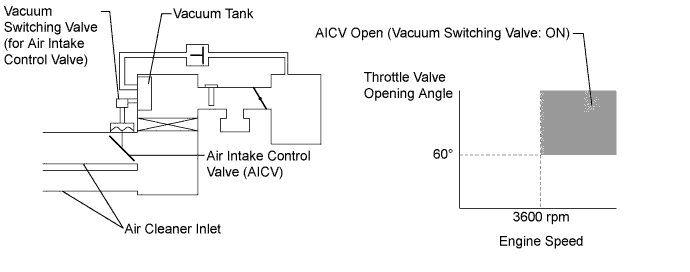
The air cleaner is equipped with 2 inlets, one of which is opened or closed by the air intake control valve. This system reduces intake noise and increases engine power at low-to-high engine speed ranges.
When the engine is operating in the low-to-mid speed range, this control operates the air intake control valve to close one of the air cleaner inlets. When the engine speed is higher than 3600 rpm and the opening angle of the throttle valve is more than 60°, the ECM activates the vacuum switching valve (for air intake control valve) and opens the air intake control valve.
WIRING DIAGRAM
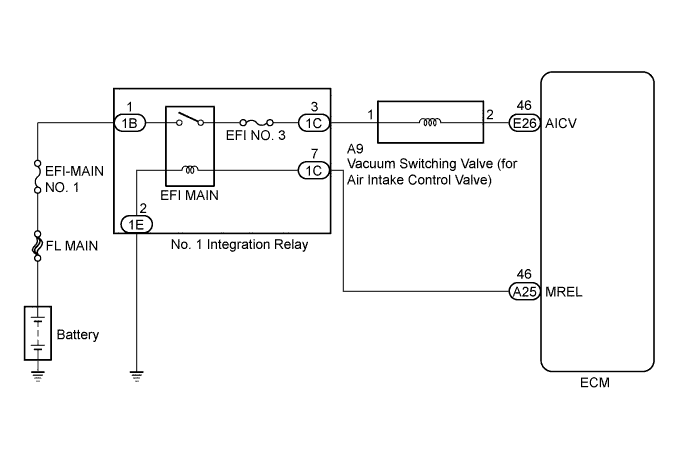
INSPECTION PROCEDURE
Note
Inspect the fuses for circuits related to this system before performing the following inspection procedure.
PROCEDURE
-
PERFORM ACTIVE TEST USING TECHSTREAM (ACTIVATE THE VSV FOR AICS)
-
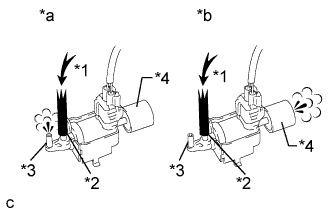
Text in Illustration *1 Air *2 Port E *3 Port F *4 Air Filter *a Vacuum Switching Valve is On *b Vacuum Switching Valve is Off Disconnect the vacuum hose (Port F) from the vacuum switching valve (for air intake control valve).
-
Connect the Techstream to the DLC3.
-
Start the engine.
-
Turn the Techstream on.
-
Enter the following menus: Powertrain / Engine / Active Test / Activate the VSV for AICS.
-
Check the operation of the vacuum switching valve (for air intake control valve) when the vacuum switching valve (for air intake control valve) is operated using the Techstream.
Standard Techstream Operation Specified Condition ON Air from port E flows out through port F OFF Air from port E flows out through the air filter
NG 
INSPECT VACUUM SWITCHING VALVE (FOR AIR INTAKE CONTROL VALVE) Click here
OK 
PROCEED TO NEXT SUSPECTED AREA SHOWN IN PROBLEM SYMPTOMS TABLE Click here
-
-
INSPECT VACUUM SWITCHING VALVE (FOR AIR INTAKE CONTROL VALVE)
-
Inspect the vacuum switching valve for air intake control valve Click here.
NG 
REPLACE VACUUM SWITCHING VALVE (FOR AIR INTAKE CONTROL VALVE) Click here
OK 
-
-
CHECK TERMINAL VOLTAGE (POWER SOURCE OF VACUUM SWITCHING VALVE (FOR AIR INTAKE CONTROL VALVE))
-
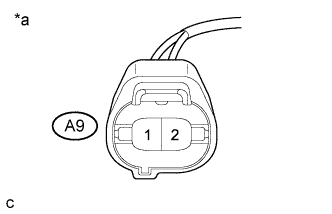
Text in Illustration *a Front view of wire harness connector
(to Vacuum Switching Valve (for Air Intake Control Valve))
Disconnect the vacuum switching valve (for air intake control valve) connector.
-
Turn the engine switch on (IG).
-
Measure the voltage according to the value(s) in the table below.
Standard Voltage Tester Connection Switch Condition Specified Condition A9-1 - Body ground Engine switch on (IG) 11 to 14 V
NG
CHECK HARNESS AND CONNECTOR (NO. 1 INTEGRATION RELAY - VACUUM SWITCHING VALVE (FOR AIR INTAKE CONTROL VALVE)) Click here
OK
-
-
CHECK HARNESS AND CONNECTOR (VACUUM SWITCHING VALVE (FOR AIR INTAKE CONTROL VALVE) - ECM)
-
Disconnect the vacuum switching valve (for air intake control valve) connector.
-
Disconnect the ECM connector.
-
Measure the resistance according to the value(s) in the table below.
Standard Resistance Tester Connection Condition Specified Condition A9-2 - E26-46 (AICV) Always Below 1 Ω A9-2 or E26-46 (AICV) - Body ground Always 10 kΩ or higher
NG
REPAIR OR REPLACE HARNESS OR CONNECTOR
OK
-
-
INSPECT AIR CLEANER CAP SUB-ASSEMBLY (VACUUM SURGE TANK)
-
Inspect the vacuum surge tank Click here.
NG
REPAIR OR REPLACE AIR CLEANER CAP SUB-ASSEMBLY
OK
-
-
CHECK VACUUM HOSES (VACUUM SWITCHING VALVE (FOR AIR INTAKE CONTROL VALVE) - AIR CLEANER CAP - AIR INTAKE CONTROL VALVE)
-
Check the vacuum hoses between vacuum switching valve (for air intake control valve), air cleaner cap sub-assembly and air intake control valve Click here.
NG
REPAIR OR REPLACE VACUUM HOSE
OK
REPLACE ECM Click here
-
-
CHECK HARNESS AND CONNECTOR (NO. 1 INTEGRATION RELAY - VACUUM SWITCHING VALVE (FOR AIR INTAKE CONTROL VALVE))
-
Remove the No. 1 integration relay from the engine room relay block and junction block assembly.
-
Disconnect the vacuum switching valve (for air intake control valve) connector.
-
Measure the resistance according to the value(s) in the table below.
Standard Resistance Tester Connection Condition Specified Condition 1C-3 - A9-1 Always Below 1 Ω 1C-3 or A9-1 - Body ground Always 10 kΩ or higher
NG
REPAIR OR REPLACE HARNESS OR CONNECTOR
OK
GO TO ECM POWER SOURCE CIRCUIT Click here
-