SFI SYSTEM, Diagnostic DTC:P219A, P219C, P219D, P219E, P219F

| DTC Code | DTC Name |
|---|---|
| P219A | Bank 1 Air-Fuel Ratio Imbalance |
| P219C | Cylinder 1 Air-Fuel Ratio Imbalance |
| P219D | Cylinder 2 Air-Fuel Ratio Imbalance |
| P219E | Cylinder 3 Air-Fuel Ratio Imbalance |
| P219F | Cylinder 4 Air-Fuel Ratio Imbalance |
DESCRIPTION
Refer to DTC P0300 Click here.
Refer to DTC P2195 Click here.
| DTC No. | DTC Detection Condition | Trouble Area |
|---|---|---|
| P219A | The difference in air fuel ratios between the cylinders exceeds the threshold (2 trip detection logic). |
|
| P219C | The difference in air fuel ratios between the cylinders exceeds the threshold (2 trip detection logic). |
|
| P219D | The difference in air fuel ratios between the cylinders exceeds the threshold (2 trip detection logic). |
|
| P219E | The difference in air fuel ratios between the cylinders exceeds the threshold (2 trip detection logic). |
|
| P219F | The difference in air fuel ratios between the cylinders exceeds the threshold (2 trip detection logic). |
|
MONITOR DESCRIPTION
Fuel System Air Fuel Ratio Cylinder Imbalance MonitorThe ECM uses the air fuel ratio sensor and crankshaft position sensor to monitor the difference in air fuel ratios between the cylinders caused by differences in injection volume between the cylinders, leakage in the intake or exhaust system, etc.
When the air fuel ratios of the cylinders are lean or rich with respect to each other, the ECM determines that a problem is present and stores a DTC.
Air Fuel Ratio Sensor Monitoring Method: P219A is stored primarily when a rich side imbalance is detected.When the system detects a difference in the air fuel ratios between the cylinders due to fluctuation in the air fuel ratio sensor output over 1 engine cycle (2 crankshaft revolutions), the system determines that there is a problem.
Crankshaft Position Sensor Monitoring Method: P219C, P219D, P219E and/or P219F are stored primarily when a lean side imbalance is detected.The system monitors the engine speed variation and when the variation becomes large, the system determines that there is a difference in the air fuel ratios between the cylinders, which it determines to be a problem.
MONITOR STRATEGY
| Related DTCs | P219A: Air fuel ratio cylinder imbalance monitor (bank 1) P219C: Air fuel ratio cylinder imbalance monitor (cylinder 1) P219D: Air fuel ratio cylinder imbalance monitor (cylinder 2) P219E: Air fuel ratio cylinder imbalance monitor (cylinder 3) P219F: Air fuel ratio cylinder imbalance monitor (cylinder 4) |
| Required Sensors/Components (Main) | Air fuel ratio sensor, Crankshaft position sensor |
| Required Sensors/Components (Related) | Mass air flow meter sub-assembly, Engine coolant temperature sensor, Vehicle speed sensor |
| Frequency of Operation | Once per driving cycle |
| Duration | 10 seconds: P219A 30 seconds: Others |
| MIL Operation | 2 driving cycles |
| Sequence of Operation | None |
TYPICAL ENABLING CONDITIONS
| Monitor runs whenever the following DTCs are not stored | P0010 (VVT oil control valve) P0011 (VVT system - advance) P0012 (VVT system - retard) P0013 (Exhaust VVT oil control valve) P0014 (Exhaust VVT system - advance) P0015 (Exhaust VVT system - retard) P0016 (VVT system - misalignment) P0017 (Exhaust VVT system - misalignment) P0031, P0032, P101D (Air fuel ratio sensor heater) P0102, P0103 (Mass air flow meter) P0115, P0117, P0118 (Engine coolant temperature sensor) P0120, P0121, P0122, P0123, P0220, P0222, P0223, P2135 (Throttle position sensor) P0125 (Insufficient coolant temperature for closed loop fuel control) P0335 (Crankshaft position sensor) P0340, P0342, P0343 (Camshaft position sensor) P0351 - P0354 (Igniter) P0365, P0367, P0368 (Exhaust camshaft position sensor) P0500 (Vehicle speed sensor) |
| Monitor runs whenever following DTCs are not present | None |
| Air fuel ratio sensor status | Activated |
| Engine speed | 1600 rpm or higher, and less than 2400 rpm |
| Engine coolant temperature | 75°C (167°F) or higher |
| Atmospheric pressure | 76 kPa(abs) [570 mmHg(abs)] or higher |
| Fuel system status | Closed loop |
| Engine load | 47% or more, and less than 70% |
| Vehicle speed | Less than 3 km/h (1.875 mph) |
| Engine speed | 500 rpm or higher, and less than 1000 rpm |
| Engine coolant temperature | 75°C (167°F) or higher |
| Air fuel ratio sensor status | Activated |
| Fuel system status | Closed loop |
| Battery voltage | 11 V or higher |
TYPICAL MALFUNCTION THRESHOLDS
| Air fuel ratio sensor monitoring method criteria (rich side imbalance) | 0.1475 or more |
| Crankshaft position sensor monitoring method criteria (lean side imbalance) | 1 or more |
MONITOR RESULT
Refer to Checking Monitor Status Click here.
CONFIRMATION DRIVING PATTERN
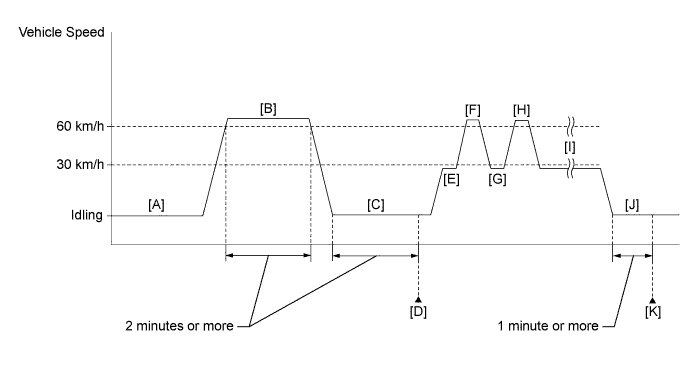
-
Connect the Techstream to the DLC3.
-
Turn the ignition switch to ON.
-
Turn the Techstream on.
-
Start the engine and warm it up until the engine coolant temperature reaches 75°C (167°F) or higher [A].
Tech Tips
The A/C switch and all accessory switches should be off and the shift lever should be in P or N.
-
Clear the DTCs (even if no DTCs are stored, perform the clear DTC procedure).
-
Drive the vehicle at 60 km/h (37 mph) or higher for 2 minutes or more [B].
CAUTION:
When performing the confirmation driving pattern, obey all speed limits and traffic laws.
Tech Tips
It is acceptable to turn electrical loads on while driving.
-
Idle the engine for 2 minutes or more [C].
Tech Tips
The A/C switch and all accessory switches should be off and the shift lever should be in P or N.
-
Enter the following menus: Powertrain / Engine / Trouble Codes [D].
-
Read the pending DTCs.
Tech Tips
-
If a pending DTC is output, the system is malfunctioning.
-
If a pending DTC is not output, perform the following procedure.
-
-
Drive the vehicle at less than 30 km/h (19 mph) for 5 seconds or more [E].
CAUTION:
When performing the confirmation driving pattern, obey all speed limits and traffic laws.
-
Accelerate the vehicle from 30 to 60 km/h (19 to 37 mph) over a period of approximately 10 to 20 seconds.
CAUTION:
When performing the confirmation driving pattern, obey all speed limits and traffic laws.
Tech Tips
Refer to the values of mass air flow and engine speed in Typical Enabling Conditions before accelerating the vehicle from 30 to 60 km/h (19 to 37 mph).
-
Drive the vehicle at 60 km/h (37 mph) or more for 5 seconds or more [F].
CAUTION:
When performing the confirmation driving pattern, obey all speed limits and traffic laws.
-
Drive the vehicle at less than 30 km/h (19 mph) for 5 seconds or more [G].
CAUTION:
When performing the confirmation driving pattern, obey all speed limits and traffic laws.
-
Accelerate the vehicle from 30 to 60 km/h (19 to 37 mph) over a period of approximately 10 to 20 seconds.
CAUTION:
When performing the confirmation driving pattern, obey all speed limits and traffic laws.
Tech Tips
Refer to the values of mass air flow and engine speed in Typical Enabling Conditions before accelerating the vehicle from 30 to 60 km/h (19 to 37 mph).
-
Drive the vehicle at 60 km/h (37 mph) or more for 5 seconds or more [H].
CAUTION:
When performing the confirmation driving pattern, obey all speed limits and traffic laws.
-
Repeat steps [G] and [H] above at least 2 times [I].
-
Idle the engine for 1 minute or more [J].
Tech Tips
The A/C switch and all accessory switches should be off and the shift lever should be in P or N.
-
Enter the following menus: Powertrain / Engine / Trouble Codes [K].
-
Read the pending DTCs.
Tech Tips
-
If a pending DTC is output, the system is malfunctioning.
-
If a pending DTC is not output, perform the following procedure.
-
-
Enter the following menus: Powertrain / Engine / Utility / All Readiness.
-
Input the DTC: P219A, P219C, P219D, P219E or P219F.
-
Check the DTC judgment result.
Techstream Display Description NORMAL
-
DTC judgment completed
-
System normal
ABNORMAL
-
DTC judgment completed
-
System abnormal
INCOMPLETE
-
DTC judgment not completed
-
Perform driving pattern after confirming DTC enabling conditions
N/A
-
Unable to perform DTC judgment
-
Number of DTCs which do not fulfill DTC preconditions has reached ECU memory limit
Tech Tips
-
If the judgment result shows NORMAL, the system is normal.
-
If the judgment result shows ABNORMAL, the system has a malfunction.
-
If the judgment result shows INCOMPLETE or N/A, perform the following procedure.
-
-
If no pending DTC is output, perform a universal trip and check for permanent DTCs Click here.
Tech Tips
-
If a permanent DTC is output, the system is malfunctioning.
-
If no permanent DTC is output, the system is normal.
-
WIRING DIAGRAM
Refer to Fuel Injector Circuit Click here.
INSPECTION PROCEDURE
Tech Tips
-
Read freeze frame data using the Techstream. Freeze frame data records the engine condition when malfunctions are detected. When troubleshooting, freeze frame data can help determine if the vehicle was moving or stationary, if the engine was warmed up or not, if the air-fuel ratio was lean or rich, and other data from the time the malfunction occurred.
-
When any air-fuel ratio imbalance is detected, the ECM will perform air-fuel ratio feedback control to make the air-fuel ratio close to the stoichiometric level. This may result in an air-fuel ratio imbalance of normal cylinders and DTCs may be stored.
-
Sensor 1 refers to the sensor closest to the engine assembly.
-
Sensor 2 refers to the sensor farthest away from the engine assembly.
PROCEDURE
-
CHECK ANY OTHER DTCS OUTPUT
-
Connect the Techstream to the DLC3.
-
Turn the ignition switch to ON.
-
Turn the Techstream on.
-
Enter the following menus: Powertrain / Engine / Trouble Codes.
-
Read DTCs.
Result Result Proceed to DTC P219A, P219C, P219D, P219E and/or P219F is output A DTC P219A, P219C, P219D, P219E and/or P219F and other DTCs are output B Tech Tips
If any DTCs other than P219A, P219C, P219D, P219E and/or P219F are output, troubleshoot those DTCs first.
B 
GO TO DTC CHART Click here
A 
-
-
READ VALUE USING TECHSTREAM (FREEZE FRAME DATA)
-
Connect the Techstream to the DLC3.
-
Turn the ignition switch to ON.
-
Using the Techstream, confirm the vehicle conditions recorded in the freeze frame data which were present when the DTC was stored Click here.
-
Vehicle Speed
-
Engine Speed
-
Calculate Load
-
Accelerator Idle Position
-
Short FT #1, #2
-
Long FT #1, #2
-
Cylinder #1 Misfire Count to Cylinder #4 Misfire Count
Freeze Frame Data Item for DTC P219A, P219C, P219D, P219E and/or P219F:
Tech Tips
When the sum of Short FT and Long FT is positive, the engine is running lean, and when the sum is negative, the engine is running rich.
Air Fuel Ratio Sensor Monitoring Method (P219A) Crankshaft Position Sensor Monitoring Method (P219C, P219D, P219E and P219F) Note DTCs are output DTC is output (Only one DTC relating to a single cylinder is output) Malfunctioning of cylinders detected by Crankshaft Position Sensor Monitoring Method is primarily suspected DTCs are output DTCs are output (Multiple DTCs relating to multiple cylinders are output) Malfunctioning of cylinders except ones detected by Crankshaft Position Sensor Monitoring Method is primarily suspected.* DTCs are not output DTCs are output Malfunctioning of cylinders detected by Crankshaft Position Sensor Monitoring Method is primarily suspected. DTCs are output DTCs are not output Malfunctioning of the bank detected by Air Fuel Ratio Sensor Monitoring Method is primarily suspected *: When any air-fuel ratio imbalance is detected, the ECM will perform air-fuel ratio feedback control to make the air-fuel ratio close to the stoichiometric level. This may result in an air-fuel ratio imbalance of normal cylinders and DTCs may be stored.
-
NEXT
-
-
READ DTC OUTPUT
-
Connect the Techstream to the DLC3.
-
Turn the ignition switch to ON.
-
Turn the Techstream on.
-
Drive the vehicle in accordance with the driving pattern described in Confirmation Driving Pattern.
Tech Tips
-
If any misfire count ("Cylinder #1 Misfire Count" to "Cylinder #4 Misfire Count) increases while idling or driving the vehicle, proceed to step 6.
-
Perform inspections while focusing on the cylinder whose misfire count has increased.
-
-
Enter the following menus: Powertrain / Engine / Trouble Codes.
-
Read the DTCs.
Result Result Proceed to P219A is output A DTC P219A, and P219C, P219D, P219E or P219F is output B DTC P219C, P219D, P219E and/or P219F is output
B 
CHECK INTAKE SYSTEM Click here
A
-
-
PERFORM ACTIVE TEST USING TECHSTREAM (CONTROL THE INJECTION VOLUME)
-
Connect the Techstream to the DLC3.
-
Turn the ignition switch to ON.
-
Turn the Techstream on.
-
Warm up the engine.
Tech Tips
The A/C switch and all accessory switches should be off and the shift lever should be in P or N.
-
Enter the following menus: Powertrain / Engine / Active Test / Control the Injection Volume / Data List / Cylinder #1 to #4 Misfire Count.
Tech Tips
When the "Control the Injection Volume" Active Test is selected (injection volume is 0%), if a misfire count increases, proceed to step 6 (Check Intake System).
-
Perform the Control the Injection Volume operation with the engine idling.
-
Check the misfire counts ("Cylinder #1 Misfire Count" to "Cylinder #4 Misfire Count") while decreasing the injection volume in 5% increments.
Note
Do not decrease the injection volume by more than 20%.
Result The cylinder whose misfire count has not increased can be assumed to be running rich. Therefore, perform inspections while focusing on that cylinder.
NEXT
-
-
CHECK FOR EXHAUST GAS LEAK
-
Check for exhaust gas leaks.
OK No exhaust gas leaks. Tech Tips
Perform "Inspection After Repair" after repairing or replacing the exhaust system Click here.
NG
REPAIR OR REPLACE EXHAUST SYSTEM
OK
-
-
CHECK INTAKE SYSTEM
-
Check the intake system for vacuum leaks Click here.
OK No leaks in intake system. Tech Tips
Perform "Inspection After Repair" after repairing or replacing the intake system Click here.
NG
REPAIR OR REPLACE INTAKE SYSTEM
OK
-
-
INSPECT SPARK PLUG
-
Inspect the spark plug of the cylinder causing the imbalance Click here.
Tech Tips
Perform "Inspection After Repair" after replacing the spark plug Click here.
NG
REPLACE SPARK PLUG Click here
OK
-
-
CHECK FOR SPARK (SPARK TEST)
-
Perform a spark test Click here.
Tech Tips
-
If the result of the spark test is normal, proceed to the next step.
-
Perform "Inspection After Repair" after repairing or replacing the ignition system Click here.
-
NEXT
-
-
CHECK CYLINDER COMPRESSION PRESSURE
-
Measure the cylinder compression pressure of the misfiring cylinder Click here.
Tech Tips
Perform "Inspection After Repair" after repairing or replacing the engine assembly Click here.
NG
CHECK ENGINE TO DETERMINE CAUSE OF LOW COMPRESSION
OK
-
-
CHECK TERMINAL VOLTAGE (POWER SOURCE OF FUEL INJECTOR)
-
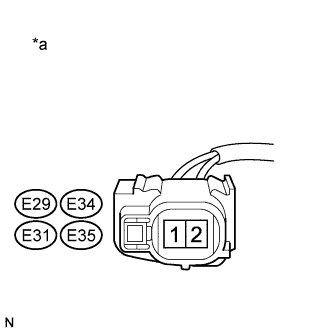
Text in Illustration *a Front view of wire harness connector
(to Fuel Injector Assembly)
Disconnect the fuel injector assembly connectors.
-
Turn the ignition switch to ON.
-
Measure the voltage according to the value(s) in the table below.
Standard Voltage Tester Connection Switch Condition Specified Condition E29-1 - Body ground Ignition switch ON 11 to 14 V E34-1 - Body ground Ignition switch ON 11 to 14 V E31-1 - Body ground Ignition switch ON 11 to 14 V E35-1 - Body ground Ignition switch ON 11 to 14 V
NG
GO TO FUEL INJECTOR CIRCUIT Click here
OK
-
-
CHECK FUEL INJECTOR ASSEMBLY OF CYLINDER CAUSING IMBALANCE
-
Check the fuel injector injection [whether fuel volume is high or low, and whether injection pattern is poor] Click here.
Tech Tips
Perform "Inspection After Repair" after replacing the fuel injector assembly Click here.
NG
REPLACE FUEL INJECTOR ASSEMBLY Click here
OK
-
-
CHECK FOR CAUSE OF FAILURE
-
If the case of the problem has not been found even after performing the troubleshooting procedure, perform the inspection below.
-
Check the intake valve for deposits.
Tech Tips
As the DTC may have been stored due to deposits on the intake valve, remove the cylinder head and check the intake valve remove the cylinder head and check the intake valve.
NEXT
-
-
CONFIRM WHETHER MALFUNCTION HAS BEEN SUCCESSFULLY REPAIRED
-
Connect the Techstream to the DLC3.
-
Turn the ignition switch to ON.
-
Turn the Techstream on.
-
Clear the DTCs.
-
Turn the ignition switch off and wait for at least 30 seconds.
-
Turn the ignition switch to ON.
-
Turn the Techstream on.
-
Drive the vehicle in accordance with the driving pattern described in Confirmation Driving Pattern.
-
Enter the following menus: Powertrain / Engine / Trouble Codes.
-
Check for DTCs.
Result DTCs are not output.
NEXT 
END
-