AIRBAG SYSTEM, Diagnostic DTC:B1810/53, B1811/53, B1812/53, B1813/53

| DTC Code | DTC Name |
|---|---|
| B1810/53 | Short in Driver Side Squib 2nd Step Circuit |
| B1811/53 | Open in Driver Side Squib 2nd Step Circuit |
| B1812/53 | Short to GND in Driver Side Squib 2nd Step Circuit |
| B1813/53 | Short to B+ in Driver Side Squib 2nd Step Circuit |
DESCRIPTION
The driver side squib 2nd step circuit consists of the center airbag sensor, the spiral cable, and the steering pad.
The circuit instructs the SRS to deploy when deployment conditions are met.
These DTCs are stored when a malfunction is detected in the driver side squib 2nd step circuit.
| DTC Code | DTC Detection Condition | Trouble Area |
|---|---|---|
| B1810/53 | When one of the following conditions is met:
|
|
| B1811/53 | When one of the following conditions is met:
|
|
| B1812/53 | When one of the following conditions is met:
|
|
| B1813/53 | When one of the following conditions is met:
|
|
WIRING DIAGRAM
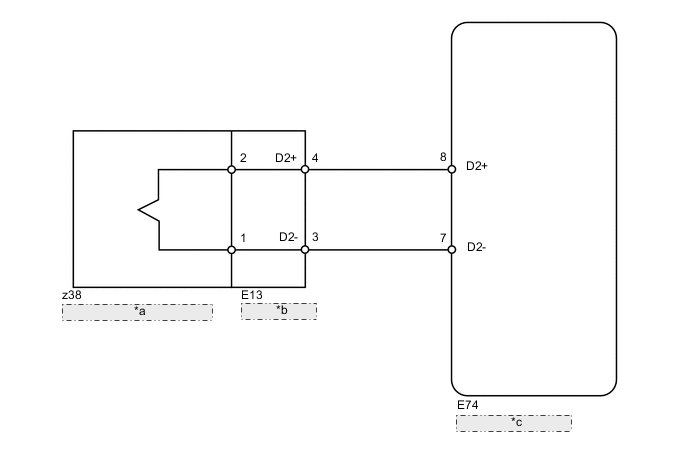
| *a | Driver Side Squib 2nd Step |
| *b | Spiral Cable |
| *c | Center Airbag Sensor |
CAUTION / NOTICE / HINT
Note
-
After turning the ignition switch off, waiting time may be required before disconnecting the cable from the battery terminal. Therefore, make sure to read the disconnecting the cable from the battery terminal notice before proceeding with work Click here.
-
When disconnecting the cable, some systems need to be initialized after the cable is reconnected Click here.
Tech Tips
To perform the simulation method, enter the check mode (signal check) with the intelligent tester (See page ), and then wiggle each connector of the airbag system or drive the vehicle on various type of road Click here.
PROCEDURE
-
CHECK STEERING PAD (DRIVER SIDE SQUIB 2ND STEP)
-
Turn the ignition switch off.
-
Disconnect the cable from the negative (-) battery terminal, and wait for at least 90 seconds.
-
Disconnect the connectors from the steering pad.
-
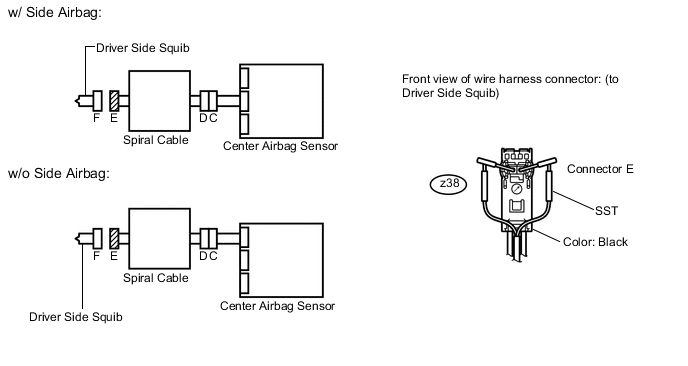
Connect the white wire side of SST (resistance: 2.1 Ω) to connector E (black connector).
CAUTION:
Never connect the tester to the steering pad (driver side squib 2nd step) for measurement, as this may lead to a serious injury due to airbag deployment.
Note
-
Do not forcibly insert SST into the terminals of the connector when connecting SST.
-
Insert SST straight into the terminals of the connector.
- SST
- 09843-18061
-
-
Connect the cable to the negative (-) battery terminal, and wait for at least 2 seconds.
-
Turn the ignition switch to ON, and wait for at least 60 seconds.
-
Clear the DTCs Click here.
-
Turn the ignition switch off.
-
Turn the ignition switch to ON, and wait for at least 60 seconds.
-
Check for DTCs Click here.
OK DTC B1810, B1811, B1812 or B1813 is not output. Tech Tips
Codes other than DTC B1810, B1811, B1812 and B1813 may be output at this time, but they are not related to this check.
OK 
REPLACE STEERING PAD Click here
NG 
-
-
CHECK CONNECTOR
-
Turn the ignition switch off.
-
Disconnect the cable from the negative (-) battery terminal, and wait for at least 90 seconds.
-
Disconnect SST from connector E.
-
Check that the spiral cable connectors (on the steering pad side) are not damaged.
OK The lock button is not disengaged, and the claw of the lock is not deformed or damaged.
NG
REPLACE SPIRAL CABLE Click here
OK
-
-
CHECK DRIVER SIDE SQUIB 2ND STEP CIRCUIT
-
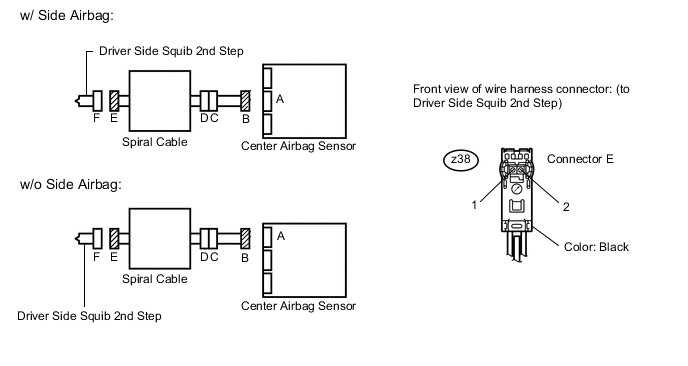
Disconnect the connectors from the center airbag sensor.
-
Connect the cable to the negative (-) battery terminal, and wait for at least 2 seconds.
-
Measure the voltage according to the value(s) in the table below.
Standard Voltage Tester Connection Switch Condition Specified Condition z38-1 - Body ground Ignition switch ON Below 1 V z38-2 - Body ground Ignition switch ON Below 1 V -
Turn the ignition switch off.
-
Disconnect the cable from the negative (-) battery terminal, and wait for at least 90 seconds.
-
Measure the resistance according to the value(s) in the table below.
Standard Resistance Tester Connection Condition Specified Condition z38-1 - z38-2 Always Below 1 Ω -
Release the activation prevention mechanism built into connector B Click here.
-
Measure the resistance according to the value(s) in the table below.
Standard Resistance Tester Connection Condition Specified Condition z38-1 - z38-2 Always 1 MΩ or higher z38-1 - Body ground Always 1 MΩ or higher z38-2 - Body ground Always 1 MΩ or higher
NG 
CHECK INSTRUMENT PANEL WIRE (CENTER AIRBAG SENSOR - SPIRAL CABLE) Click here
OK
-
-
CHECK CENTER AIRBAG SENSOR
-
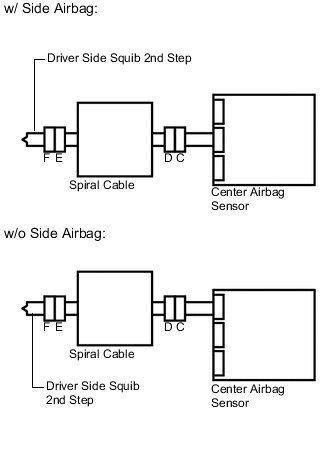
Connect the connectors to the steering pad and the center airbag sensor.
-
Connect the cable to the negative (-) battery terminal, and wait for at least 2 seconds.
-
Turn the ignition switch to ON, and wait for at least 60 seconds.
-
Clear the DTCs Click here.
-
Turn the ignition switch off.
-
Turn the ignition switch to ON, and wait for at least 60 seconds.
-
Check for DTCs Click here.
OK DTC B1810, B1811, B1812 or B1813 is not output. Tech Tips
Codes other than DTC B1810, B1811, B1812 and B1813 may be output at this time, but they are not related to this check.
OK
USE SIMULATION METHOD TO CHECK Click here
NG
REPLACE CENTER AIRBAG SENSOR ASSEMBLY Click here
-
-
CHECK INSTRUMENT PANEL WIRE (CENTER AIRBAG SENSOR - SPIRAL CABLE)
-
Restore the released activation prevention mechanism of connector B to its original condition.
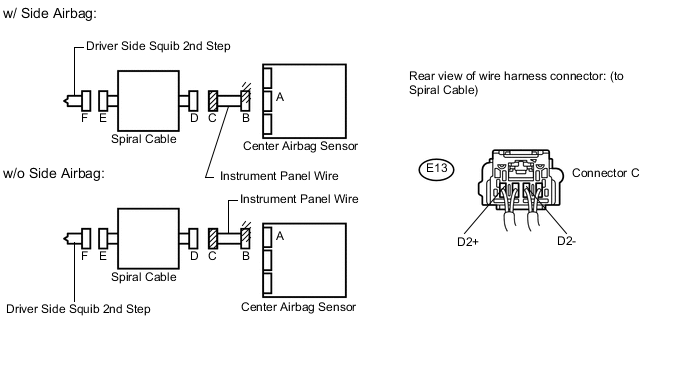
-
Disconnect the instrument panel wire connector from the spiral cable.
-
Connect the cable to the negative (-) battery terminal, and wait for at least 2 seconds.
-
Measure the voltage according to the value(s) in the table below.
Standard Voltage Tester Connection Switch Condition Specified Condition E13-4 (D2+) - Body ground Ignition switch ON Below 1 V E13-3 (D2-) - Body ground Ignition switch ON Below 1 V -
Turn the ignition switch off.
-
Disconnect the cable from the negative (-) battery terminal, and wait for at least 90 seconds.
-
Measure the resistance according to the value(s) in the table below.
Standard Resistance Tester Connection Condition Specified Condition E13-4 (D2+) - E13-3 (D2-) Always Below 1 Ω -
Release the activation prevention mechanism built into connector B Click here.
-
Measure the resistance according to the value(s) in the table below.
Standard Resistance Tester Connection Condition Specified Condition E13-4 (D2+) - E13-3 (D2-) Always 1 MΩ or higher E13-4 (D2+) - Body ground Always 1 MΩ or higher E13-3 (D2-) - Body ground Always 1 MΩ or higher
OK
REPLACE SPIRAL CABLE Click here
NG
REPLACE INSTRUMENT PANEL WIRE
-