VEHICLE STABILITY CONTROL SYSTEM, Diagnostic DTC:C1434
| DTC Code | DTC Name |
|---|---|
| C1434 | Steering Angle Sensor Output Malfunction |
DESCRIPTION
Steering angle sensor (spiral with sensor cable sub-assembly) signals are sent to the skid control ECU (master cylinder solenoid) via the CAN communication system. When there is a malfunction in the CAN communication system, it is detected by the steering angle sensor zero point malfunction diagnostic function.
| DTC Code | DTC Detection Condition | Trouble Area |
|---|---|---|
| C1434 | An error in communication between the skid control ECU and the steering angle sensor, or an abnormal steering angle sensor zero point. |
|
-
*: w/ VGRS System
WIRING DIAGRAM
Refer to DTC C1432 Click here.
CAUTION / NOTICE / HINT
Note
-
Do not remove the steering angle sensor from the spiral with sensor cable sub-assembly.
-
When replacing the steering angle sensor (spiral with sensor cable sub-assembly), confirm that the replacement part is of the correct specification.
-
Inspect the fuses for circuits related to this system before performing the following inspection procedure.
Tech Tips
When any of the speed sensors or the yaw rate and acceleration sensor (airbag sensor assembly) has trouble, DTCs for the steering angle sensor (spiral with sensor cable sub-assembly) may be stored even when the steering angle sensor (spiral with sensor cable sub-assembly) is normal. When DTCs for the speed sensors or yaw rate and acceleration sensor (airbag sensor assembly) are output together with DTCs for the steering angle sensor (spiral with sensor cable sub-assembly), inspect and repair the speed sensor and yaw rate and acceleration sensor (airbag sensor assembly) first, and then inspect and repair the steering angle sensor (spiral with sensor cable sub-assembly).
PROCEDURE
-
CHECK DTC
-
Clear the DTCs Click here.
-
Turn the ignition switch off.
-
Turn the ignition switch to ON again and check that no CAN communication system DTC is output Click here.
-
Start the engine.
-
Drive the vehicle at a speed of 35 km/h (22 mph) and turn the steering wheel to the right and left, and then check that no speed sensor or yaw rate and acceleration sensor (airbag sensor assembly) DTCs are output Click here.
Result Result Proceed to No CAN communication system, speed sensor, or yaw rate and acceleration sensor (airbag sensor assembly) DTCs are output A CAN communication system DTC is output B Speed sensor or yaw rate and acceleration sensor (airbag sensor assembly) DTC is output C Tech Tips
-
For the CAN COMMUNICATION SYSTEM (HOW TO PROCEED WITH TROUBLESHOOTING), refer to the following:
-
for LHD (with Central Gateway ECU): Click here
-
for LHD (without Central Gateway ECU): Click here
-
for RHD (with Central Gateway ECU): Click here
-
for RHD (without Central Gateway ECU): Click here
-
If there is a malfunction in any of the speed sensors or the yaw rate and acceleration sensor (airbag sensor assembly), an abnormal value may be output although the steering angle sensor (spiral with sensor cable sub-assembly) is normal.
-
If speed sensor and yaw rate and acceleration sensor (airbag sensor assembly) DTCs are output simultaneously, repair these two sensors first, and then inspect the steering angle sensor (spiral with sensor cable sub-assembly).
-
B 
GO TO CAN COMMUNICATION SYSTEM (HOW TO PROCEED WITH TROUBLESHOOTING)
C
REPAIR CIRCUIT INDICATED BY OUTPUT DTC Click here
A 
-
-
CHECK HARNESS AND CONNECTOR (IG/ESS TERMINAL)
-
Turn the ignition switch off.
-
Make sure that there is no looseness in the locking part and connecting part of the connectors.
-
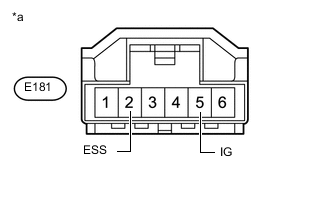
Text in Illustration *a Front view of wire harness connector
(to Steering Angle Sensor [Spiral with Sensor Cable Sub-assembly])
w/o Entry and Start System:
Disconnect the steering angle sensor (spiral with sensor cable sub-assembly) connector.
-
Measure the voltage according to the value(s) in the table below.
Standard Voltage Tester Connection Switch Condition Specified Condition E181-5 (IG) - Body ground Ignition switch ON 11 to 14 V -
Measure the resistance according to the value(s) in the table below.
Standard Resistance Tester Connection Condition Specified Condition E181-2 (ESS) - Body ground Always Below 1 Ω -
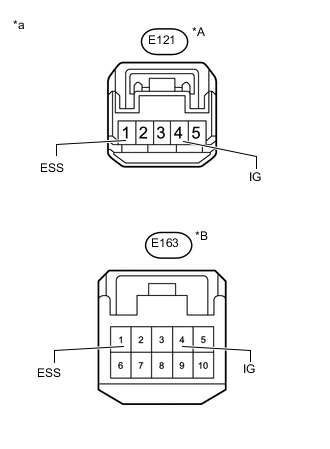
Text in Illustration *A w/o VGRS System *B w/ VGRS System *a Front view of wire harness connector
(to Steering Angle Sensor [Spiral with Sensor Cable Sub-assembly])
w/ Entry and Start System:
Disconnect the steering angle sensor (spiral with sensor cable sub-assembly) connector.
-
Measure the voltage according to the value(s) in the table below.
Standard Voltage w/o VGRS System: Tester Connection Switch Condition Specified Condition E121-4 (IG) - Body ground Ignition switch ON 11 to 14 V w/ VGRS System: Tester Connection Switch Condition Specified Condition E163-4 (IG) - Body ground Ignition switch ON 11 to 14 V -
Measure the resistance according to the value(s) in the table below.
Standard Resistance w/o VGRS System: Tester Connection Condition Specified Condition E121-1 (ESS) - Body ground Always Below 1 Ω w/ VGRS System: Tester Connection Condition Specified Condition E163-1 (ESS) - Body ground Always Below 1 Ω
NG
REPAIR OR REPLACE HARNESS OR CONNECTOR
OK
-
-
CHECK HARNESS AND CONNECTOR (BAT TERMINAL)
-
Turn the ignition switch off.
-
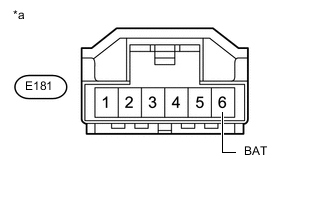
Text in Illustration *a Front view of wire harness connector
(to Steering Angle Sensor [Spiral with Sensor Cable Sub-assembly])
w/o Entry and Start System:
Disconnect the steering angle sensor (spiral with sensor cable sub-assembly) connector.
-
Measure the voltage according to the value(s) in the table below.
Standard Voltage Tester Connection Condition Specified Condition E181-6 (BAT) - Body ground Always 11 to 14 V -
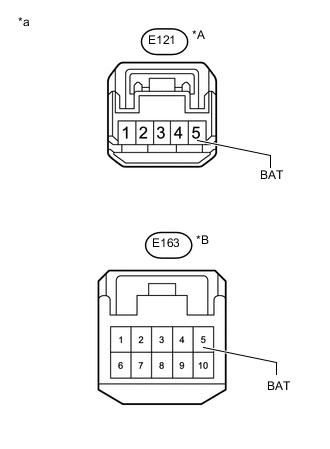
Text in Illustration *A w/o VGRS System *B w/ VGRS System *a Front view of wire harness connector
(to Steering Angle Sensor [Spiral with Sensor Cable Sub-assembly])
w/ Entry and Start System:
Disconnect the steering angle sensor (spiral with sensor cable sub-assembly) connector.
-
Measure the voltage according to the value(s) in the table below.
Standard Voltage w/o VGRS System: Tester Connection Condition Specified Condition E121-5 (BAT) - Body ground Always 11 to 14 V w/ VGRS System: Tester Connection Condition Specified Condition E163-5 (BAT) - Body ground Always 11 to 14 V Result Result Proceed to OK A NG (w/ VGRS System) B NG (w/o VGRS System) C
A
REPLACE SPIRAL WITH SENSOR CABLE SUB-ASSEMBLY Click here
C
REPAIR OR REPLACE HARNESS OR CONNECTOR
B
-
-
CHECK HARNESS AND CONNECTOR (+BI TERMINAL)
-
Turn the ignition switch off.
-
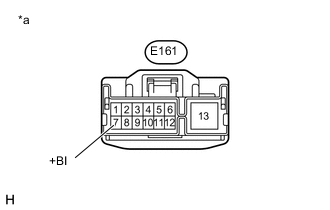
Text in Illustration *a Front view of wire harness connector
(to VGRS ECU [Steering Control ECU])
Disconnect the VGRS ECU (steering control ECU) connector.
-
Measure the voltage according to the value(s) in the table below.
Standard Voltage Tester Connection Condition Specified Condition E161-7 (+BI) - Body ground Always 11 to 14 V
NG
REPAIR OR REPLACE HARNESS OR CONNECTOR
OK
-
-
CHECK HARNESS AND CONNECTOR (SPIRAL WITH SENSOR CABLE SUB-ASSEMBLY - STEERING CONTROL ECU)
-
Turn the ignition switch off.
-
Disconnect the E163 steering angle sensor (spiral with sensor cable sub-assembly) connector.
-
Disconnect the E161 VGRS ECU (steering control ECU) connector.
-
Measure the resistance according to the value(s) in the table below.
Standard Resistance Tester Connection Condition Specified Condition E163-5 (BAT) - E161-1 (+BO) Always Below 1 Ω E163-5 (BAT) or E161-1 (+BO) - Body ground Always 10 kΩ or higher Result Result Proceed to NG A OK (for LHD) B OK (for RHD) C
A
REPAIR OR REPLACE HARNESS OR CONNECTOR
B
REPLACE STEERING CONTROL ECU Click here
C
REPLACE STEERING CONTROL ECU Click here
-