CYLINDER HEAD INSPECTION

PROCEDURE
-
INSPECT CAMSHAFT OIL CLEARANCE
-
Clean the bearing caps, camshaft housing and camshaft journals.
-
Place the camshafts on the camshaft housing.
-
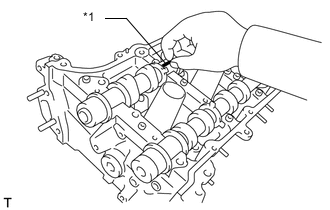
Text in Illustration *1 Plastigage Lay a strip of Plastigage across each of the camshaft journals.
-
Install the camshaft bearing caps Click here.
Note
Do not turn the camshaft.
-
Install the camshaft housing Click here.
Note
Do not turn the camshaft.
-
Remove the camshaft bearing caps Click here.
-
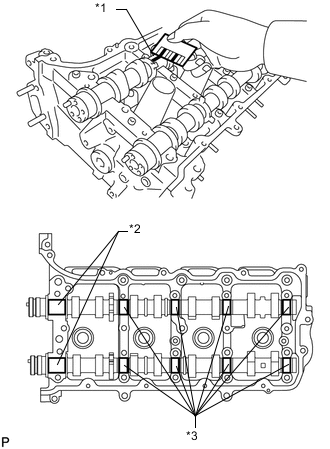
Text in Illustration *1 Plastigage *2 No. 1 Journal *3 Other Journals Measure the Plastigage at its widest point.
Standard Oil Clearance Item Specified Condition No. 1 journal 0.030 to 0.065 mm (0.00118 to 0.00256 in.) Other journals 0.025 to 0.062 mm (0.000984 to 0.00244 in.) Maximum Oil Clearance Item Specified Condition No. 1 journal 0.10 mm (0.00394 in.) Other journals 0.09 mm (0.00354 in.) If the oil clearance is more than the maximum, replace the camshaft. If necessary, replace the camshaft housing sub-assembly.
-
-
INSPECT CAMSHAFT THRUST CLEARANCE
-
Install the camshafts Click here.
-
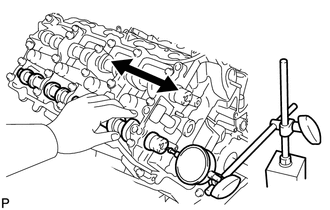
Using a dial indicator, measure the thrust clearance while moving the camshaft back and forth.
Standard thrust clearance 0.08 to 0.135 mm (0.00315 to 0.00531 in.) Maximum thrust clearance 0.15 mm (0.00591 in.) If the thrust clearance is more than the maximum, replace the camshaft housing. If the thrust surface is damaged, replace the camshaft sub-assembly.
-
Perform the inspection above for each camshaft.
-
-
INSPECT COMPRESSION SPRING
Tech Tips
The shape of the inner compression spring determines whether the valve spring type described here is A or B.
-
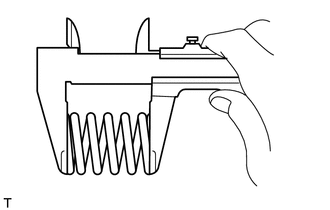
Using a vernier caliper, measure the free length of the compression spring.
Standard free length Type Specified Condition Valve Spring Type A 49.69 to 53.19 mm (1.96 to 2.09 in.) Valve Spring Type B 49.38 to 53.38 mm (1.94 to 2.10 in.) If the free length is not as specified, replace the compression spring.
-
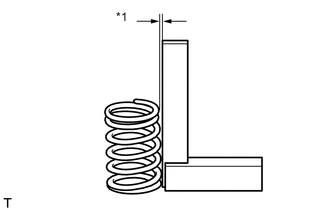
Text in Illustration *1 Deviation Valve Spring Type A:
-
Using a steel square, measure the deviation of the inner compression spring.
Maximum deviation 1.0 mm (0.0394 in.) Maximum angle (reference) 2° If the deviation is greater than the maximum, replace the spring.
-
-
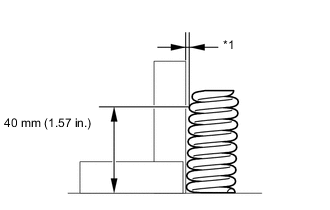
Text in Illustration *1 Deviation Valve Spring Type B:
-
Using a steel square, measure the deviation of the inner compression spring.
Maximum deviation 1.0 mm (0.0394 in.) Maximum angle (reference) 2° If the deviation is greater than the maximum, replace the spring.
-
-
-
INSPECT INTAKE VALVE
-
Using a micrometer, measure the diameter of the valve stem.
Standard valve stem diameter 5.470 to 5.485 mm (0.215 to 0.216 in.) -
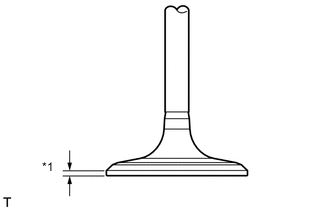
Text in Illustration *1 Margin Thickness Using a vernier caliper, measure the valve head margin thickness.
Standard margin thickness 1.25 mm (0.0492 in.) Minimum margin thickness 0.50 mm (0.0197 in.) If the margin thickness is less than the minimum, replace the intake valve.
-
Using a vernier caliper, measure the valve overall length.
Standard overall length 105.85 mm (4.17 in.) Minimum overall length 105.35 mm (4.15 in.) If the overall length is less than the minimum, replace the intake valve.
-
-
INSPECT EXHAUST VALVE
-
Using a micrometer, measure the diameter of the valve stem.
Standard valve stem diameter 5.465 to 5.480 mm (0.215 to 0.216 in.) -
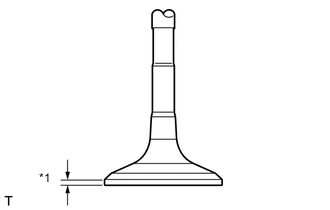
Text in Illustration *1 Margin Thickness Using a vernier caliper, measure the valve head margin thickness.
Standard margin thickness 1.4 mm (0.0551 in.) Minimum margin thickness 0.50 mm (0.0197 in.) If the margin thickness is less than the minimum, replace the exhaust valve.
-
Using a vernier caliper, measure the valve overall length.
Standard overall length 110.40 mm (4.35 in.) Minimum overall length 109.90 mm (4.33 in.) If the overall length is less than the minimum, replace the exhaust valve.
-
-
INSPECT VALVE GUIDE BUSH OIL CLEARANCE
-
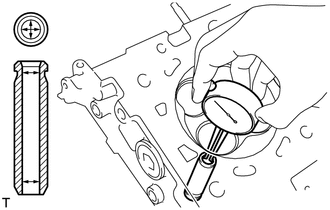
Using a caliper gauge, measure the inside diameter of the valve guide bush.
Standard bush inside diameter 5.51 to 5.53 mm (0.217 to 0.218 in.) -
Subtract the valve stem diameter measurement from the valve guide bush inside diameter measurement.
Standard Oil Clearance Item Specified Condition Intake 0.025 to 0.060 mm (0.000984 to 0.00236 in.) Exhaust 0.030 to 0.065 mm (0.00118 to 0.00256 in.) Maximum Oil Clearance Item Specified Condition Intake 0.08 mm (0.00315 in.) Exhaust 0.10 mm (0.00394 in.) If the oil clearance is more than the maximum, replace the valve and valve guide bush.
-
-
INSPECT INTAKE VALVE SEAT
-
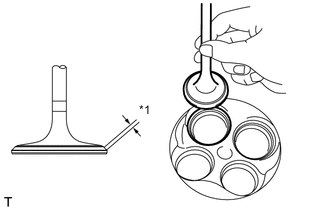
Text in Illustration *1 Width Apply a light coat of Prussian blue to the valve face.
-
Lightly press the valve face against the intake valve seat.
Tech Tips
Do not rotate the valve while pressing the valve.
-
Check the valve face and intake valve seat.
-
Check that the contact surfaces of the valve seat and valve face are in the middle area of their respective surfaces, with the width between 1.1 to 1.5 mm (0.0433 to 0.0591 in.).
If not, correct the intake valve seat.
-
Check that the contact surfaces of the intake valve seat and valve face are even around the entire intake valve seat.
If not, correct the intake valve seat.
-
-
-
INSPECT EXHAUST VALVE SEAT
-
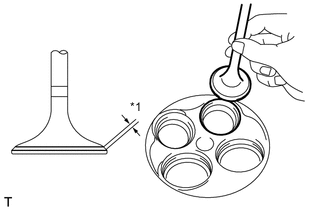
Text in Illustration *1 Width Apply a light coat of Prussian blue to the valve face.
-
Lightly press the valve face against the exhaust valve seat.
Tech Tips
Do not rotate the valve while pressing the valve.
-
Check the valve face and exhaust valve seat.
-
Check that the contact surfaces of the exhaust valve seat and valve face are in the middle area of their respective surfaces, with the width between 1.1 to 1.5 mm (0.0433 to 0.0591 in.).
If not, correct the exhaust valve seat.
-
Check that the contact surfaces of the exhaust valve seat and valve face are even around the entire exhaust valve seat.
If not, correct the exhaust valve seat.
-
-
-
INSPECT CYLINDER HEAD SUB-ASSEMBLY
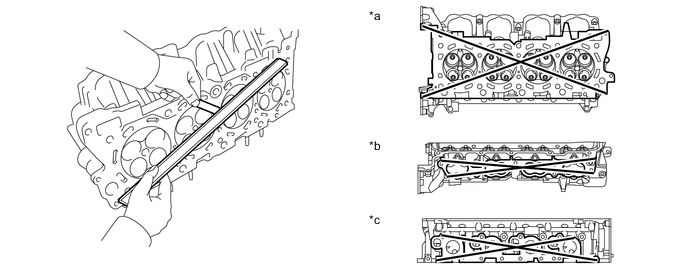
-
Using a precision straightedge and feeler gauge, measure the warpage of the contact surfaces of the cylinder block and manifold.
Standard Warpage Item Specified Condition Cylinder block side 0.05 mm (0.00197 in.) Intake manifold side 0.08 mm (0.00315 in.) Exhaust manifold side 0.05 mm (0.00197 in.) Maximum warpage 0.10 mm (0.00394 in.) Text in Illustration *a for Cylinder Block Side *b for Intake Manifold Side *c for Exhaust Manifold Side If the warpage is more than the maximum, replace the cylinder head sub-assembly.
-
Using a dye penetrant, check the intake ports, exhaust ports and cylinder head surface for cracks.
If cracked, replace the cylinder head sub-assembly.
-