PROCEDURE
- Click here
INSPECT IGNITION TIMING
Note:
-
Turn all electrical systems off.
-
Perform the inspection when the cooling fan motor is turned off.
-
Warm up the engine.
-
When using the GTS:
-
Connect the GTS to the DLC3.
-
Enter the following menus: Powertrain / Engine and ECT / Data List / All Data / IGN Advance.
Standard ignition timing 7 to 24° BTDC @ idle (transmission in neutral and A/C switch off) Tip:Refer to the GTS operator's manual for further details.
-
Check that the ignition timing advances immediately when the engine speed is increased.
-
Disconnect the GTS from the DLC3.
-
-
When not using the GTS:
-
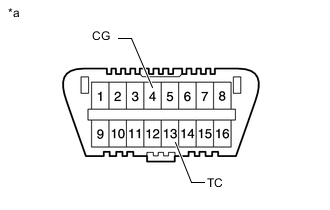
Using SST, connect terminals 13 (TC) and 4 (CG) of the DLC3.
09843-18040 Table 1. Text in Illustration *a Front view of DLC3 Note:Be sure not to improperly connect the terminals. This may damage the engine.
-
Connect the tester probe of a timing light to the wire of the ignition coil connector for the No. 1 cylinder.
Note:Use a timing light that detects primary signals.
-
Inspect the ignition timing during idling.
Standard ignition timing 8 to 12° BTDC @ idle (transmission in neutral and A/C switch off) -
Remove SST from the DLC3.
-
Inspect the ignition timing during idling.
Standard ignition timing 7 to 24° BTDC @ idle (transmission in neutral and A/C switch off) -
Disconnect the timing light from the engine.
-
-
- Click here
INSPECT ENGINE IDLE SPEED
Note:
-
Turn all the electrical systems off.
-
Perform the inspection when the cooling fan motor is turned off.
-
Warm up the engine.
-
When using the GTS:
-
Connect the GTS to the DLC3.
-
Enter the following menus: Powertrain / Engine and ECT / Data List / All Data / Engine Speed.
Standard idle speed 650 to 750 rpm (transmission in neutral and A/C switch off) Tip:Refer to the GTS operator's manual for further details.
-
Disconnect the GTS from the DLC3.
-
-
When not using the GTS:
-
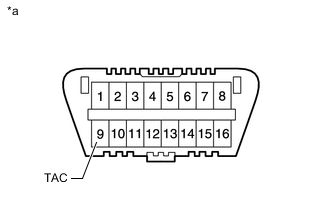
Connect SST to terminal 9 (TAC) of the DLC3.
09843-18030 Table 2. Text in Illustration *a Front view of DLC3 Note:Be sure not to improperly connect SST. This may damage the engine.
-
Race the engine at 2500 rpm for approximately 90 seconds.
-
Inspect the engine idle speed.
Standard idle speed 650 to 750 rpm (transmission in neutral and A/C switch off)
-
-
- Click here
INSPECT COMPRESSION
-
Warm up and stop the engine.
-
Check for DTCs (Click here).
-
Remove the 8 spark plugs (Click here).
-
Disconnect the 8 fuel injector connectors.
-
Inspect the cylinder compression pressure.
-
Insert a compression gauge into the spark plug hole. (Procedure A)
-
While cranking the engine, measure the compression pressure. (Procedure B)
Standard compression pressure 1300 kPa (13.3 kgf/cm2, 189 psi) or higher Minimum pressure 1000 kPa (10.2 kgf/cm2, 145 psi) Difference between each cylinder 100 kPa (1.0 kgf/cm2, 15 psi) or less Tip:
-
Use a fully-charged battery so that the engine speed can be increased to 250 rpm or more.
-
Measure the compression in as short a time as possible.
-
-
If the cylinder compression is low, pour a small amount of engine oil into the cylinder through the spark plug hole and repeat procedures A and B for cylinders with low compression.
Tip:
-
If adding oil increases the compression, the piston rings and/or cylinder bore may be worn or damaged.
-
If pressure stays low, a valve may be stuck or seated improperly, or there may be leakage from the gasket.
-
-
Repeat procedures A and B for each cylinder.
-
-
Connect the 8 injector connectors.
-
Install the 8 spark plugs (Click here).
-
Clear the DTCs (Click here).
-
- Click here
INSPECT CO/HC
Tip:This check is to determine whether or not the idle CO/HC concentration complies with regulations.
-
Start the engine.
-
Run the engine at 2500 rpm for approximately 180 seconds.
-
Insert the CO/HC meter testing probe at least 40 cm (1.31 ft) into the tailpipe during idling.
-
Immediately check the CO/HC concentration during idling and/or at 2500 rpm.
Tip:When carrying out the 2 tests (idling and 2500 rpm), the measurement procedures are prescribed by applicable local regulations.
-
If the CO/HC concentration does not comply with regulations, perform troubleshooting in the order given below.
-
Check the air fuel ratio sensor operation (See page ) and heated oxygen sensor operation (Click here).
-
Refer to the table below for possible causes, and then inspect and correct the corresponding causes if necessary.
CO HC Symptom Causes Normal High Rough idling
-
Faulty ignition:
-
-
Incorrect timing
-
Plugs are contaminated or shorted, or plug gaps are incorrect
-
-
Leaky intake and exhaust valves
-
Leaky cylinders
Low High Rough idling
(Fluctuating HC reading)
-
Vacuum leaks:
-
-
PCV hoses
-
Intake manifold
-
Throttle body
-
-
Lean mixture causing misfire
High High Rough idle
(Black smoke from exhaust)
-
Restricted air filter
-
Plugged PCV valve
-
Faulty SFI system:
-
-
Faulty pressure regulator
-
Defective engine coolant temperature sensor
-
Faulty mass air flow meter
-
Faulty ECM
-
Faulty injectors
-
Faulty throttle position sensor
-
-
-
-