AUDIO AND VISUAL SYSTEM USB Audio System Recognition/Play Error
WIRING DIAGRAM
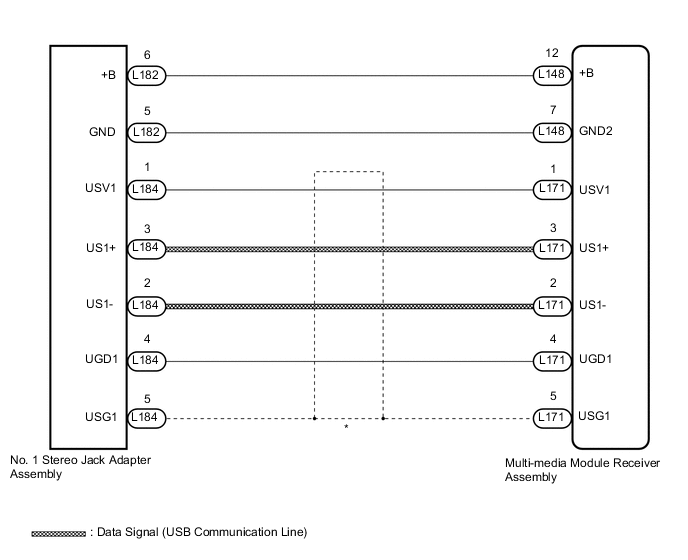
CAUTION / NOTICE / HINT
Tech Tips
-
When a large amount of data is in a USB device, it may take a while before play begins.
-
When using a USB device, files that are copy protected or encrypted due to copyright reasons cannot be played.
-
When files are not played in the sorted order, perform the following procedure before inspection.
-
Add numbers in front of the file names.
-
Put the files in a folder and copy the folder data to the USB device.
PROCEDURE
-
CHECK USB DEVICE OR "iPod"
-
Disconnect the USB device or "iPod" from the No. 1 stereo jack adapter assembly.
-
Check if playable files are present on the USB device or "iPod".
Tech Tips
Refer to System Description for playable files Click here.
-
Check if the USB device is a compatible format or "iPod" is a compatible version.
Tech Tips
Refer to System Description for compatible formats and versions Click here.
Result Result Proceed to No playable files exist, or incompatible device format or version. A Playable files exist, and compatible device format or version. B
A 
USB DEVICE FORMAT WAS INCOMPATIBLE, "iPod" VERSION WAS INCOMPATIBLE, OR NO PLAYABLE FILES PRESENT
B 
-
-
CHECK HARNESS AND CONNECTOR (MULTI-MEDIA MODULE RECEIVER ASSEMBLY - NO. 1 STEREO JACK ADAPTER ASSEMBLY)
-
Disconnect the L148 and L171 multi-media module receiver assembly connectors.
-
Disconnect the L182 and L184 No. 1 stereo jack adapter assembly connectors.
-
Measure the resistance according to the value(s) in the table below.
Standard Resistance Tester Connection Condition Specified Condition L148-7 (GND2) - L182-5 (GND) Always Below 1 Ω L148-12 (+B) - L182-6 (+B) Always Below 1 Ω L171-1 (USV1) - L184-1 (USV1) Always Below 1 Ω L171-2 (US1-) - L184-2 (US1-) Always Below 1 Ω L171-3 (US1+) - L184-3 (US1+) Always Below 1 Ω L171-4 (UGD1) - L184-4 (UGD1) Always Below 1 Ω L171-5 (USG1) - L184-5 (USG1) Always Below 1 Ω L148-7 (GND2) or L182-5 (GND) - Body ground Always 10 kΩ or higher L148-12 (+B) or L182-6 (+B) - Body ground Always 10 kΩ or higher L171-1 (USV1) or L184-1 (USV1) - Body ground Always 10 kΩ or higher L171-2 (US1-) or L184-2 (US1-) - Body ground Always 10 kΩ or higher L171-3 (US1+) or L184-3 (US1+) - Body ground Always 10 kΩ or higher L171-4 (UGD1) or L184-4 (UGD1) - Body ground Always 10 kΩ or higher L171-5 (USG1) or L184-5 (USG1) - Body ground Always 10 kΩ or higher
NG
REPAIR OR REPLACE HARNESS OR CONNECTOR
OK
-
-
CHECK MULTI-MEDIA MODULE RECEIVER ASSEMBLY
-
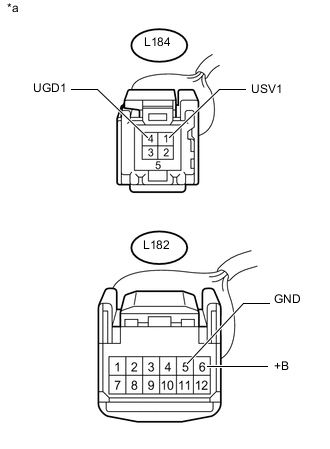
Text in Illustration *a Front view of wire harness connector
(to No. 1 Stereo Jack Adapter Assembly)
Reconnect the L146 and L171 multi-media module receiver assembly connectors.
-
Measure the voltage according to the value(s) in the table below.
Standard Voltage Tester Connection Condition Specified Condition L182-6 (+B) - L182-5 (GND) Engine switch on (ACC) 11 to 14 V L184-1 (USV1) - L184-4 (UGD1) Engine switch on (ACC) 4.5 to 5.5 V
NG
REPLACE MULTI-MEDIA MODULE RECEIVER ASSEMBLY Click here
OK
-
-
FORMAT USB DEVICE OR RESTORE "iPod" AND RECHECK
-
Delete all files in the USB device or "iPod" and format/restore it.
-
Save the data again and check if it can be played on the in-vehicle device.
Note
Formatting a USB device or restoring an "iPod" erases all music on the device.
Ensure that backup music data is available before performing this operation.
OK Malfunction disappears.
OK
END
NG
-
-
REPLACE USB DEVICE OR "iPod"
-
Turn the engine switch off.
Tech Tips
When this malfunction occurs, it is necessary to turn off the engine switch to make it possible for the vehicle to recognize a new device when it is connected.
-
Turn the engine switch on (ACC).
-
Connect a known good USB device or "iPod" to the No. 1 stereo jack adapter assembly.
Tech Tips
-
If the malfunction occurred when a USB device was in use, use another USB device for the inspection. If the malfunction occurred when an "iPod" was in use, use another "iPod" for the inspection.
-
Refer to System Description for compatible formats and versions Click here.
-
NEXT
-
-
CHECK USB DEVICE OR "iPod"
-
Check if the USB device or "iPod" is recognized by the multi-media module receiver assembly, or if information such as track, artist and album names is displayed on the screen.
OK USB device or "iPod" is recognized or track information such as track, artist and album names is displayed.
OK
USB DEVICE OR "iPod" WAS INCOMPATIBLE OR DEFECTIVE
NG
PROCEED TO NEXT SUSPECTED AREA SHOWN IN PROBLEM SYMPTOMS TABLE Click here
-