SFI SYSTEM FREEZE FRAME DATA
-
DESCRIPTION
-
The ECM records vehicle and driving condition information as freeze frame data the moment a DTC is stored. When troubleshooting, freeze frame data can be helpful in determining whether the vehicle was moving or stationary, whether the engine was warmed up or not, whether the air-fuel ratio was lean or rich, as well as other data recorded at the time of a malfunction.
Tech Tips
If it is impossible to replicate the problem even though a DTC is detected, confirm the freeze frame data.
-
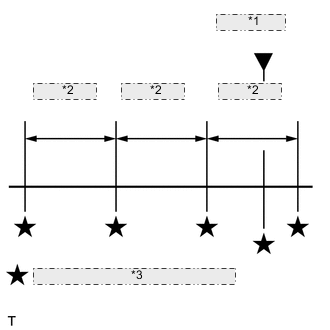
*1 DTC was set. *2 0.5 seconds *3 Freeze frame data which can be read The ECM records engine conditions in the form of freeze frame data every 0.5 seconds. Using the intelligent tester, five separate sets of freeze frame data, including the data values at the time when the DTC was set, can be checked.
-
3 data sets before the DTC was set.
-
1 data set when the DTC was set.
-
1 data set after the DTC was set.
-
These data sets can be used to simulate the condition of the vehicle around the time of the occurrence of the malfunction. The data may assist in identifying the cause of the malfunction, and in judging whether it was temporary or not.
-
-
LIST OF FREEZE FRAME DATA
LABEL
(Tester Display)
Measurement Item Diagnostic Note Vehicle Speed Vehicle speed Speed indicated on speedometer Engine Speed Engine speed - Calculate Load Calculated load Load calculated by ECM Vehicle Load Vehicle load Load percentage in terms of maximum intake air flow amount MAF Sensor 1 Supported Status of the MAF Sensor 1 Supported - MAF Sensor 1 Mass air flow volume (bank 1) If value approximately 0.0 gm/sec.:
-
Mass air flow meter (bank 1) power source circuit open or shorted
-
VG circuit open or shorted
If value 160.0 gm/sec. or more:
-
E2G circuit open
MAF Sensor 2 Supported Status of the MAF Sensor 2 Supported - MAF Sensor 2 Mass air flow volume (bank 2) If value approximately 0.0 gm/sec.:
-
Mass air flow meter (bank 2) power source circuit open or shorted
-
VGR circuit open or shorted
If value 160.0 gm/sec. or more:
-
EVGR circuit open
Atmosphere Pressure Atmospheric pressure - Coolant Temp Engine coolant temperature If value -40°C (-40°F), sensor circuit open
If value 140°C (258°F), sensor circuit shorted
Intake Air Temp B1S1 Supported Status of the Intake Air Temp B1S1 Supported - Intake Air Temp B1S1 Intake air temperature (bank 1 sensor 1) If value -40°C (-40°F), sensor circuit open
If value 140°C (258°F), sensor circuit shorted
Intake Air Temp B1S2 Supported Status of the Intake Air Temp B1S2 Supported - Intake Air Temp B1S2 Intake air temperature (bank 1 sensor 2) If value -40°C (-40°F), sensor circuit open
If value 140°C (258°F), sensor circuit shorted
Intake Air Temp B1S3 Supported Status of the Intake Air Temp B1S3 Supported - Intake Air Temp B1S3 Intake air temperature (bank 1 sensor 3) If value -40°C (-40°F), sensor circuit open
If value 140°C (258°F), sensor circuit shorted
Intake Air Temp B2S1 Supported Status of the Intake Air Temp B2S1 Supported - Intake Air Temp B2S1 Intake air temperature (bank 2 sensor 1) If value -40°C (-40°F), sensor circuit open
If value 140°C (258°F), sensor circuit shorted
Intake Air Temp B2S2 Supported Status of the Intake Air Temp B2S2 Supported - Intake Air Temp B2S2 Intake air temperature (bank 2 sensor 2) If value -40°C (-40°F), sensor circuit open
If value 140°C (258°F), sensor circuit shorted
Intake Air Temp B2S3 Supported Status of the Intake Air Temp B2S3 Supported - Intake Air Temp B2S3 Intake air temperature (bank 2 sensor 3) If value -40°C (-40°F), sensor circuit open
If value 140°C (258°F), sensor circuit shorted
Engine Run Time Accumulated engine running time - Initial Engine Coolant Temp Initial engine coolant temperature - Initial Intake Air Temp Initial intake air temperature - Battery Voltage Battery voltage - Glow Indicator Supported Glow indicator supported - Glow Indicator Glow indicator - Accel Sens. No.1 Volt % Accelerator Pedal Position (APP) No. 1 - Accel Sens. No.2 Volt % APP No. 2 - Throttle Sensor Volt % Absolute throttle position sensor Read value with engine switch on (IG) (Do not start engine) Throttle Sensor #2 Volt % Absolute throttle position sensor #2 Read value with engine switch on (IG) (Do not start engine) Throttle Sensor Position Throttle position sensor - Throttle Motor DUTY Throttle actuator duty - Throttle Position Throttle position For use when engine stall, starting problems or rough idle is present ISC Flow Flow rate calculated using information from each sensor For use when engine stall, starting problems or rough idle is present ISC Position Requested opening amount calculated using ISC control For use when engine stall, starting problems or rough idle is present ISC Feedback Value ISC feedback compensation amount For use when engine stall, starting problems or rough idle is present ISC Learning Value ISC learned compensation amount For use when engine stall, starting problems or rough idle is present Electric Load Feedback Val Compensation flow rate according to electrical load For use when engine stall, starting problems or rough idle is present Air Conditioner FB Val Compensation flow rate according to air conditioner load For use when engine stall, starting problems or rough idle is present PS Feedback Val Compensation flow rate according to power steering load For use when engine stall, starting problems or rough idle is present Low Revolution Control Low engine speed control operation state For use when engine stall, starting problems or rough idle is present Neutral Control Neutral control operation state For use when engine stall, starting problems or rough idle is present N Range Status Judgment for shift lever N position For use when engine stall, starting problems or rough idle is present Eng Stall Control FB Flow Intake air compensation flow rate For use when engine stall, starting problems or rough idle is present Deposit Loss Flow Flow loss due to deposits For use when engine stall, starting problems or rough idle is present Fuel Press Fuel pressure - Injector (Port) Port injector - Injection Volum (Cylinder 1) Injection volume - Fuel Pump Speed Control F/PMP relay status - Fuel Pump/Speed Status Fuel pump/speed status - Fuel Pressure Target Value Target fuel pressure - Fuel Pump Duty (D4) Fuel pump duty (D4) (bank 1) - Fuel Pump2 Duty (D4) Fuel pump duty (D4) (bank 2) - HP FP Discharge Rate High pressure fuel pump discharge rate (bank 1) - HP FP Discharge Rate 2 High pressure fuel pump discharge rate (bank 2) - Injection Way Injection mode - Injection Switching Status Prohibition of changing D-4S injection method - Injection Timing (D4) Injection timing (D4) - Injection Time (D4) Injection time (D4) - Current Fuel Type Type Current fuel type Identifying the current fuel type: Gasoline EVAP (Purge) VSV EVAP purge VSV duty ratio - Evap Purge Flow Purge flow - Purge Destiny Learn Value Purge density learned value - EVAP Purge VSV Purge VSV VSV for EVAP controlled by ECM (ground side duty control) Purge Cut VSV Duty Purge cut VSV duty - Target Air-Fuel Ratio Target air-fuel ratio - AF Lambda B1S1 Fuel trim at A/F sensor (bank 1 sensor 1) - AF Lambda B2S1 Fuel trim at A/F sensor (bank 2 sensor 1) - AF FT B1S1 Fuel trim at A/F sensor (bank 1 sensor 1) - AF FT B2S1 Fuel trim at A/F sensor (bank 2 sensor 1) - AFS Voltage B1S1 A/F sensor output voltage (bank 1 sensor 1) Performing Control the Injection Volume or Control the Injection Volume for A/F sensor function of Active Test enables technician to check output voltage of sensor AFS Voltage B2S1 A/F sensor output voltage (bank 2 sensor 1) Performing Control the Injection Volume or Control the Injection Volume for A/F sensor function of Active Test enables technician to check output voltage of sensor AFS Current B1S1 A/F sensor output current (bank 1 sensor 1) Performing Control the Injection Volume or Control the Injection Volume for A/F sensor function of Active Test enables technician to check output voltage of sensor AFS Current B2S1 A/F sensor output current (bank 2 sensor 1) Performing Control the Injection Volume or Control the Injection Volume for A/F sensor function of Active Test enables technician to check output voltage of sensor A/F Heater Duty #1 A/F heater duty ratio (bank 1) - A/F Heater Duty #2 A/F heater duty ratio (bank 2) - O2S B1S2 Heated oxygen sensor output voltage (bank 1 sensor 2) Performing Control the Injection Volume or Control the Injection Volume for A/F sensor function of Active Test enables technician to check output voltage of sensor O2S B2S2 Heated oxygen sensor output voltage (bank 2 sensor 2) Performing Control the Injection Volume or Control the Injection Volume for A/F sensor function of Active Test enables technician to check output voltage of sensor O2S Impedance B1S2 Heated oxygen sensor impedance (bank 1 sensor 2) - O2S Impedance B2S2 Heated oxygen sensor impedance (bank 2 sensor 2) - O2 Heater B1S2 Heated oxygen sensor heater (bank 1 sensor 2) - O2 Heater B2S2 Heated oxygen sensor heater (bank 2 sensor 2) - O2 Heater Curr Val B1S2 Heated oxygen sensor current (bank 1 sensor 2) - O2 Heater Curr Val B2S2 Heated oxygen sensor current (bank 2 sensor 2) - Short FT #1 Short-term fuel trim (bank 1) Short-term fuel compensation used to maintain air-fuel ratio at stoichiometric air-fuel ratio Long FT #1 Long-term fuel trim (bank 1) Overall fuel compensation carried out in long term to compensate for continual deviation of short-term fuel trim from central value A/F Learn Value Idle #1 - Learning is performed when idling with the engine warmed up (engine coolant temperature is 80°C [176°F] or higher). A/F Learn Value Low #1 - Learning is performed when driving with the engine warmed up (engine coolant temperature is 80°C [176°F] or higher) and operating in the low load range (when the range of engine loads is divided into four parts). A/F Learn Value Mid1 #1 - Learning is performed when driving with the engine warmed up (engine coolant temperature is 80°C [176°F] or higher) and operating in the midsize load range closer to the low load range (when the range of engine loads is divided into four parts). A/F Learn Value Mid2 #1 - Learning is performed when driving with the engine warmed up (engine coolant temperature is 80°C [176°F] or higher) and operating in the midsize load range closer to the high load range (when the range of engine loads is divided into four parts). A/F Learn Value High #1 - Learning is performed when driving with the engine warmed up (engine coolant temperature is 80°C [176°F] or higher) and operating in the high load range (when the range of engine loads is divided into four parts). A/F Learn Val Low #1 (Dual) - Learning is performed when driving with the engine warmed up (engine coolant temperature is 80°C [176°F] or higher) and operating in the low load range (when the range of engine loads is divided into four parts). A/F Learn Val Mid1 #1 (Dual) - Learning is performed when driving with the engine warmed up (engine coolant temperature is 80°C [176°F] or higher) and operating in the mid-size load range closer to the low load range (when the range of engine loads is divided into four parts). A/F Learn Val Mid2 #1 (Dual) - Learning is performed when driving with the engine warmed up (engine coolant temperature is 80°C [176°F] or higher) and operating in the mid-size load range closer to the high load range (when the range of engine loads is divided into four parts). A/F Learn Val High #1 (Dual) - Learning is performed when driving with the engine warmed up (engine coolant temperature is 80°C [176°F] or higher) and operating in the high load range (when the range of engine loads is divided into four parts). Total FT #1 Total fuel trim (bank 1) - Short FT #2 Short-term fuel trim (bank 2) Short-term fuel compensation used to maintain air-fuel ratio at stoichiometric air-fuel ratio Long FT #2 Long-term fuel trim (bank 2) Overall fuel compensation carried out in long term to compensate for continual deviation of short-term fuel trim from central value A/F Learn Value Idle #2 - Learning is performed when idling with the engine warmed up (engine coolant temperature is 80°C [176°F] or higher). A/F Learn Value Low #2 - Learning is performed when driving with the engine warmed up (engine coolant temperature is 80°C [176°F] or higher) and operating in the low load range (when the range of engine loads is divided into four parts). A/F Learn Value Mid1 #2 - Learning is performed when driving with the engine warmed up (engine coolant temperature is 80°C [176°F] or higher) and operating in the midsize load range closer to the low load range (when the range of engine loads is divided into four parts). A/F Learn Value Mid2 #2 - Learning is performed when driving with the engine warmed up (engine coolant temperature is 80°C [176°F] or higher) and operating in the midsize load range closer to the high load range (when the range of engine loads is divided into four parts). A/F Learn Value High #2 - Learning is performed when driving with the engine warmed up (engine coolant temperature is 80°C [176°F] or higher) and operating in the high load range (when the range of engine loads is divided into four parts). A/F Learn Val Low #2 (Dual) - Learning is performed when driving with the engine warmed up (engine coolant temperature is 80°C [176°F] or higher) and operating in the low load range (when the range of engine loads is divided into four parts) A/F Learn Val Mid1 #2 (Dual) - Learning is performed when driving with the engine warmed up (engine coolant temperature is 80°C [176°F] or higher) and operating in the mid-size load range closer to the low load range (when the range of engine loads is divided into four parts). A/F Learn Val Mid2 #2 (Dual) - Learning is performed when driving with the engine warmed up (engine coolant temperature is 80°C [176°F] or higher) and operating in the mid-size load range closer to the high load range (when the range of engine loads is divided into four parts). A/F Learn Val High #2 (Dual) - Learning is performed when driving with the engine warmed up (engine coolant temperature is 80°C [176°F] or higher) and operating in the high load range (when the range of engine loads is divided into four parts). Total FT #2 Total fuel trim (bank 2) - Fuel System Status #1 Fuel system status (bank 1)
-
OL (Open Loop): Has not yet satisfied conditions to go to closed loop
-
CL (Closed Loop): Using heated oxygen sensor as feedback for fuel control
-
OLDrive: Open loop due to driving conditions (fuel enrichment)
-
OLFault: Open loop due to detected system fault
-
CLFault: Closed loop but heated oxygen sensor, which is used for fuel control, malfunctioning
Fuel System Status #2 Fuel system status (bank 2)
-
OL (Open Loop): Has not yet satisfied conditions to go to closed loop
-
CL (Closed Loop): Using heated oxygen sensor as feedback for fuel control
-
OLDrive: Open loop due to driving conditions (fuel enrichment)
-
OLFault: Open loop due to detected system fault
-
CLFault: Closed loop but heated oxygen sensor, which is used for fuel control, malfunctioning
IGN Advance Ignition advance - Knock Feedback Value Knocking feedback value - Knock correct Learn Value Knocking correction learned value - Idle Spark Advn Ctrl #1 Individual cylinder timing advance compensation amount (No. 1) For use when engine stall, starting problems or rough idle is present Idle Spark Advn Ctrl #2 Individual cylinder timing advance compensation amount (No. 2) For use when engine stall, starting problems or rough idle is present Idle Spark Advn Ctrl #3 Individual cylinder timing advance compensation amount (No. 3) For use when engine stall, starting problems or rough idle is present Idle Spark Advn Ctrl #4 Individual cylinder timing advance compensation amount (No. 4) For use when engine stall, starting problems or rough idle is present Idle Spark Advn Ctrl #5 Individual cylinder timing advance compensation amount (No. 5) For use when engine stall, starting problems or rough idle is present Idle Spark Advn Ctrl #6 Individual cylinder timing advance compensation amount (No. 6) For use when engine stall, starting problems or rough idle is present Idle Spark Advn Ctrl #7 Individual cylinder timing advance compensation amount (No. 7) For use when engine stall, starting problems or rough idle is present Idle Spark Advn Ctrl #8 Individual cylinder timing advance compensation amount (No. 8) For use when engine stall, starting problems or rough idle is present ACIS Motor Duty ACIS motor duty - Actual VVT Angle #1 VVT displacement angle for bank 1 - Actual VVT Angle #2 VVT displacement angle for bank 2 - Actual VVT Ex Angle #1 Exhaust VVT displacement angle for bank 1 - Actual VVT Ex Angle #2 Exhaust VVT displacement angle for bank 2 - VVT Advance Fail VVT control failure status - Catalyst Temp B1S1 Catalyst temperature (bank 1 sensor 1) - Catalyst Temp B2S1 Catalyst temperature (bank 2 sensor 1) - Catalyst Temp B1S2 Catalyst temperature (bank 1 sensor 2) - Catalyst Temp B2S2 Catalyst temperature (bank 2 sensor 2) - Starter Signal Starter signal - Starter Control Starter control - Starter Relay ST relay status - ACC Relay ACC relay status - Neutral Position SW Signal Park/neutral position (PNP) switch signal - Stop Light Switch Stop light switch status - A/C Signal A/C switch status - Idle Up Signal Idle up signal - Closed Throttle Position SW Closed throttle position switch - Fuel Cut Condition Fuel cut condition - Immobiliser Communication Immobiliser communication - TC Terminal TC terminal status - Time after DTC Cleared Cumulative time after DTCs cleared - Distance from DTC Cleared Accumulated distance driven after DTCs cleared - Warmup Cycle Cleared DTC Warm up cycles after DTCs cleared - Dist Batt Cable Disconnect Total distance vehicle driven after battery cable disconnected - IG OFF Elapsed Time Cumulative time after engine switch turned off - TC and TE1 TC and TE1 terminals of DLC3 - Ignition Trig. Count Ignition counter - Cylinder #1 Misfire Count Cylinder #1 misfire count - Cylinder #2 Misfire Count Cylinder #2 misfire count - Cylinder #3 Misfire Count Cylinder #3 misfire count - Cylinder #4 Misfire Count Cylinder #4 misfire count - Cylinder #5 Misfire Count Cylinder #5 misfire count - Cylinder #6 Misfire Count Cylinder #6 misfire count - Cylinder #7 Misfire Count Cylinder #7 misfire count - Cylinder #8 Misfire Count Cylinder #8 misfire count - All Cylinders Misfire Count Misfire count of all cylinders - Multi Cylinders Misfire Count Misfire count of multiple cylinders - Misfire RPM Engine speed when misfire occurred - Misfire Load Engine load when misfire occurred - Misfire Margin Margin to detect engine misfire - Catalyst OT MF F/C Fuel cut to prevent catalyst from overheating during misfire - Cat OT MF F/C History History of fuel cut to prevent catalyst from overheating during misfire - Cat OT MF F/C Cylinder #1 Display of fuel cut operation in No. 1 cylinder (if certain level of misfire malfunction is detected) - Cat OT MF F/C Cylinder #2 Display of fuel cut operation in No. 2 cylinder (if certain level of misfire malfunction is detected) - Cat OT MF F/C Cylinder #3 Display of fuel cut operation in No. 3 cylinder (if certain level of misfire malfunction is detected) - Cat OT MF F/C Cylinder #4 Display of fuel cut operation in No. 4 cylinder (if certain level of misfire malfunction is detected) - Cat OT MF F/C Cylinder #5 Display of fuel cut operation in No. 5 cylinder (if certain level of misfire malfunction is detected) - Cat OT MF F/C Cylinder #6 Display of fuel cut operation in No. 6 cylinder (if certain level of misfire malfunction is detected) - Cat OT MF F/C Cylinder #7 Display of fuel cut operation in No. 7 cylinder (if certain level of misfire malfunction is detected) - Cat OT MF F/C Cylinder #8 Display of fuel cut operation in No. 8 cylinder (if certain level of misfire malfunction is detected) - Engine Speed (Starter Off) Engine speed when starter off For use when engine stall, starting problems or rough idle is present Starter Count Number of times starter turned on after engine switch turned on (IG) For use when engine stall, starting problems or rough idle is present Run Dist of Previous Trip Distance driven during previous trip For use when engine stall, starting problems or rough idle is present.
Before 5 seconds elapse after starting the engine, which is DTC P1604 (Startability Malfunction) detection duration, this parameter indicates the distance driven during the previous trip.
After 5 seconds elapse after starting the engine, this parameter indicates the distance driven during the current trip calculated from the vehicle speed signal.
Tech Tips
Run Dist of Previous Trip in freeze frame data which were present when the startability malfunction occurred (DTC P1604 detected) indicates the distance driven during the previous trip, but in all other cases, such as for the snapshot data of Data List (real-time measurements), or for freeze frame data which were present when the DTCs other than P1604 were detected, the value indicates the distance driven during the current trip.
Engine Starting Time Time elapsed after engine started (interval between engine switch on (IG) and off) For use when engine stall, starting problems or rough idle is present Previous Trip Coolant Temp Engine coolant temperature during previous trip For use when engine stall, starting problems or rough idle is present Previous Trip Intake Temp Intake air temperature during previous trip For use when engine stall, starting problems or rough idle is present Engine Oil Temperature Engine oil temperature (estimated temperature) For use when engine stall, starting problems or rough idle is present Previous Trip Eng Oil Temp Engine oil temperature during previous trip For use when engine stall, starting problems or rough idle is present Ambient Temp for A/C Ambient temperature For use when engine stall, starting problems or rough idle is present Previous Trip Ambient Temp Ambient temperature during previous trip For use when engine stall, starting problems or rough idle is present Engine Start Hesitation History of hesitation during engine start - Low Rev for Eng Start History of low engine speed after engine start - Minimum Engine Speed Minimum engine speed For use when engine stall, starting problems or rough idle is present Electric Fan Motor Fan motor status - Brake Override System Brake override system status - Idle Fuel Cut Idle fuel cut ON when throttle valve fully closed and engine speed over 1500 rpm FC TAU FC TAU Fuel cut being performed under very light load to prevent engine combustion from becoming incomplete Immobiliser Fuel Cut Status of immobiliser fuel cut - Communication with ECT Status of communication with ECT - Electrical Load Signal 1 Electrical load signal - Key Unlock Signal Key unlock signal status - Engine Speed of Cyl #1 Engine speed for cylinder 1 - Engine Speed of Cyl #2 Engine speed for cylinder 2 - Engine Speed of Cyl #3 Engine speed for cylinder 3 - Engine Speed of Cyl #4 Engine speed for cylinder 4 - Engine Speed of Cyl #5 Engine speed for cylinder 5 - Engine Speed of Cyl #6 Engine speed for cylinder 6 - Engine Speed of Cyl #7 Engine speed for cylinder 7 - Engine Speed of Cyl #8 Engine speed for cylinder 8 - Av Engine Speed of All Cyl Engine speed for all cylinders - Received MIL from ECT MIL status from ECT - Shift Position Sig from ECT Shift position from ECT - A/T Oil Temp from ECT ATF temperature from ECT - SPD (NO) Output shaft speed - SPD (NT) Input shaft speed - ECT Lock Up ECT lock up status - SPD (SP2) Output shaft speed - Shift SW Status (P Range) Park/neutral position switch status - Pattern Switch (PWR/M) Pattern switch (PWR) status - Shift SW Status (R Range) Park/neutral position switch status - Shift SW Status (N Range) Park/neutral position switch status - Shift SW Status (N,P Range) Supported Status of park/neutral position switch (N or P) supported: - Shift SW Status (N,P Range) Park/neutral position switch status (N or P) - Sports Shift Up SW Sport shift up switch status - Sports Shift Down SW Sport shift down switch status - Sports Mode Selection SW Sport mode select switch status - Shift SW Status (D Range) Park/neutral position switch status - Normal Mode Switch Combination switch status - Sports Mode Switch Combination switch status - ECO Switch ECO mode status - Snow or 2nd Start Mode Pattern switch (ECT SNOW) status - Shift Control Mode Shift control mode status - -