| DTC Code | DTC Name |
|---|---|
| P1229 | Fuel Pump System |
DESCRIPTION
| DTC Detection Drive Pattern | DTC Detection Condition | Trouble Area |
|---|---|---|
| Idling for 60 seconds | The actual fuel pressure exceeds the target fuel pressure by 5000 kPa or higher for 30 seconds. (1 trip detection logic) |
|
| DTC No. | Data List |
|---|---|
| P1229 |
|
-
For more information on the fuel supply pump assembly (suction control valve) and common rail system, refer to System Description (Click here).
-
When DTC P1229 is stored, check the internal fuel pressure of the common rail by entering the following menus: Powertrain / Engine and ECT / Data List / Common Rail Pressure, Target Common Rail Pressure.
Under a stable condition such as idling after warm up the engine, Common Rail Pressure is within 5000 kPa of Target Common Rail Pressure when normal.
-
When there is a problem with the movement of the fuel supply pump assembly (when Common Rail Pressure is higher than Target Common Rail Pressure due to a problem in which the suction valve has difficulty closing), the values of Injection Pressure Correction and Target Pump SCV Current decrease.
MONITOR DESCRIPTION
P1229 (Fuel overfeed):The ECM stores this DTC if the common rail pressure inside the common rail remains higher than the target common rail pressure, despite the ECM closing the suction control valve. This DTC indicates that the suction control valve may be stuck open, or there may be a short in its circuit.
If this DTC is stored, the ECM enters fail-safe mode and limits the engine power. The ECM continues operating in fail-safe mode until the ignition switch is turned off.
INSPECTION PROCEDURE
-
After replacing the ECM, the new ECM needs registration (Click here) and initialization (Click here).
-
After replacing the fuel supply pump assembly, the ECM needs initialization (Click here).
-
After replacing an injector assembly, the ECM needs registration (Click here).
-
Read freeze frame data using the GTS. Freeze frame data records the engine condition when malfunctions are detected. When troubleshooting, freeze frame data can help determine if the vehicle was moving or stationary, if the engine was warmed up or not, and other data from the time the malfunction occurred.
-
When this DTC is stored, be sure to carefully examine "Common Rail Pressure", "Target Common Rail Pressure", and "Target Pump SCV Current" in the freeze frame data.
PROCEDURE
- Click here
CHECK OTHER DTC OUTPUT
-
Connect the GTS to the DLC3.
-
Turn the ignition switch to ON and turn the GTS on.
-
Enter the following menus: Powertrain / Engine and ECT / Trouble Codes.
-
Read the DTCs.
Table 3. Result Result Proceed to P1229 and "P0190, P0192 and/or P0193" are output B Except above A
-
- Click here
READ VALUE USING GTS (COMMON RAIL PRESSURE AND TARGET COMMON RAIL PRESSURE)
-
Connect the GTS to the DLC3.
-
Turn the ignition switch to ON and turn the GTS on.
-
Start the engine and warm it up.
-
Enter the following menus: Powertrain / Engine and ECT / Data List / Common Rail Pressure and Target Common Rail Pressure.
-
Check that the internal fuel pressure of the common rail is within the specification below.
OK Common Rail Pressure is within 5000 kPa of Target Common Rail Pressure when engine is idling after warm up the engine.
- OKClick here
- NGClick here
-
- Click here
CHECK HARNESS AND CONNECTOR (SUCTION CONTROL VALVE - ECM)
-
Disconnect the suction control valve connector.
-
Disconnect the ECM connector.
-
Measure the resistance according to the value(s) in the table below.
Standard Resistance Tester Connection Condition Specified Condition D47-1 - D105-41 (PCV+) Always Below 1 Ω D47-2 - D105-81 (PCV-) Always Below 1 Ω D47-1 or D105-41 (PCV+) - Body ground Always 10 kΩ or higher D47-2 or D105-81 (PCV-) - Body ground Always 10 kΩ or higher -
Reconnect the suction control valve connector.
-
Reconnect the ECM connector.
- OKClick here
- NGClick here
-
- Click here
REPAIR OR REPLACE HARNESS OR CONNECTOR
-
Repair or replace the harness or connector.
- NEXTClick here
-
- Click here
PERFORM ACTIVE TEST USING GTS (TEST THE FUEL LEAK)
-
Connect the GTS to the DLC3.
-
Turn the ignition switch to ON and turn the GTS on.
-
Enter the following menus: Powertrain / Engine and ECT / Active Test / Test the Fuel Leak / Data List / Common Rail Pressure, Target Common Rail Pressure.
-
Take a snapshot with the GTS during the Active Test.
-
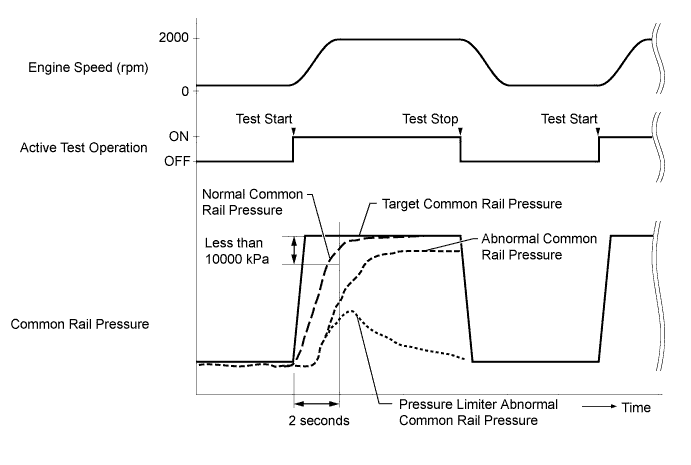
Measure the difference between the target fuel pressure (Target Common Rail Pressure) and the actual fuel pressure (Common Rail Pressure) when the "Test the Fuel Leak" Active Test is performed (Click here).
Tip:In order to obtain an exact measurement, perform the Active Test 5 times and measure the difference once each time the Active Test is performed.
OK The difference between the target common rail pressure and the actual common rail pressure 2 seconds after the Active Test starts is less than 10000 kPa. Tip:
-
"Target Common Rail Pressure" is the target fuel pressure controlled by the ECM.
-
"Common Rail Pressure" is the actual fuel pressure.
Table 4. Result Result Proceed to The difference between the target common rail pressure and the actual common rail pressure 2 seconds after the Active Test starts is less than 10000 kPa. B Except above A -
-
- Click here
CLEAN FUEL FILTER CASE AND REPLACE FUEL FILTER
-
Clean the fuel filter case and replace the fuel filter.
Tip:Be sure to clean the inside of the fuel filter case as the fuel injectors may not operate properly if the fuel filter is installed with foreign matter remaining inside the fuel filter case.
- NEXTClick here
-
- Click here
REPLACE SUCTION CONTROL VALVE
-
Replace the suction control valve (Click here).
- NEXTClick here
-
- Click here
BLEED AIR FROM FUEL SYSTEM
-
Bleed the air from the fuel system (Click here).
- NEXTClick here
-
- Click here
PERFORM FUEL SUPPLY PUMP INITIALIZATION
-
Perform fuel supply pump initialization (Click here).
- NEXTClick here
-
- Click here
CHECK CONFIRM WHETHER MALFUNCTION HAS BEEN SUCCESSFULLY REPAIRED
-
Connect the GTS to the DLC3.
-
Clear the DTCs (Click here).
-
Turn the ignition switch off for 30 seconds or more.
-
Start the engine.
-
Idle the engine for 60 seconds, and then run it at 2500 rpm without load for 60 seconds.
-
Confirm that the DTC is not output again.
Tip:Perform the following procedure using the GTS to determine whether or not the DTC judgment has been carried out.
-
Enter the following menus: Powertrain / Engine and ECT / Utility / All Readiness.
-
Input DTC P1229.
-
Check that STATUS is NORMAL. If STATUS is INCOMPLETE or N/A, increase the idling time.
-
- NEXTClick here
-
- Click here
END
- Click here
GO TO FUEL RAIL PRESSURE SENSOR CIRCUITClick here
- Click here
CHECK FOR INTERMITTENT PROBLEMSClick here