AIR CONDITIONING SYSTEM(for Automatic Air Conditioning System), Diagnostic DTC:B14A3
| DTC Code | DTC Name |
|---|---|
| B14A3 | Front Passenger Side Solar Sensor Short Circuit |
DESCRIPTION
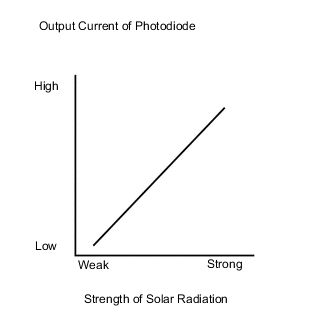
The cooler thermistor (solar sensor), which is installed on the upper side of the instrument panel, detects sunlight and controls the air conditioning in auto mode. The output current from the solar sensor varies according to the amount of sunlight. When the amount of sunlight increases, the output current increases. As the amount of sunlight decreases, the output current decreases. The air conditioning amplifier assembly detects the output current from the solar sensor.
| DTC Code | DTC Detection Condition | Trouble Area |
|---|---|---|
| B14A3 | An open or short in the passenger side solar sensor circuit. |
|
Tech Tips
If the check is performed in a dark place, DTC B14A2 or B14A3 (solar sensor circuit abnormal) may be stored even though the system is normal.
WIRING DIAGRAM
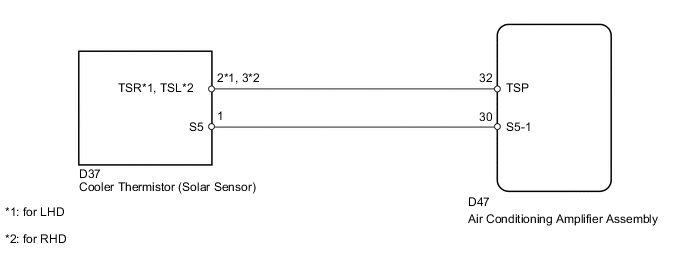
PROCEDURE
-
READ VALUE USING INTELLIGENT TESTER (SOLAR SENSOR)
-
Use the Data List to check if the solar sensor is functioning properly.
Air Conditioner Tester Display Measurement Item/Range Normal Condition Diagnostic Note Solar Sensor (P Side) Solar sensor /
Min.: 0, Max.: 255
Passenger side solar sensor voltage increases as brightness increases Open in the circuit: 0.
Short in the circuit: 255.
OK The display is as specified in the normal condition column.
OK 
PROCEED TO NEXT SUSPECTED AREA SHOWN IN PROBLEM SYMPTOMS TABLE Click here
NG 
-
-
CHECK HARNESS AND CONNECTOR (SOLAR SENSOR - AIR CONDITIONING AMPLIFIER)
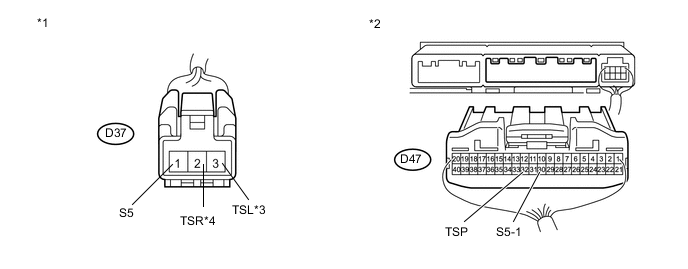
-
Disconnect the D37 sensor connector.
-
Disconnect the D47 amplifier connector.
-
Measure the resistance according to the value(s) in the table below.
Standard Resistance for LHD Tester Connection Condition Specified Condition D47-32 (TSP) - D37-2 (TSR) Always Below 1 Ω D47-30 (S5-1) - D37-1 (S5) Always Below 1 Ω D47-32 (TSP) - Body ground Always 10 kΩ or higher D47-30 (S5-1) - Body ground Always 10 kΩ or higher for RHD Tester Connection Condition Specified Condition D47-32 (TSP) - D37-3 (TSL) Always Below 1 Ω D47-30 (S5-1) - D37-1 (S5) Always Below 1 Ω D47-32 (TSP) - Body ground Always 10 kΩ or higher D47-30 (S5-1) - Body ground Always 10 kΩ or higher Text in Illustration *1 Front view of wire harness connector
(to Solar Sensor)
*2 Rear view of wire harness connector
(to Air Conditioning Amplifier Assembly)
*3 for RHD *4 for LHD
NG
REPAIR OR REPLACE HARNESS OR CONNECTOR
OK
-
-
INSPECT COOLER THERMISTOR (SOLAR SENSOR)
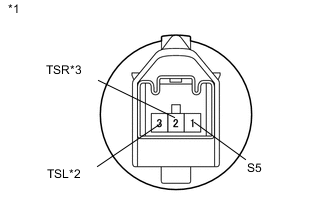
Text in Illustration *1 Component without harness connected
(Solar Sensor)
*2 for RHD *3 for LHD
-
Remove the solar sensor Click here.
-
Measure the resistance of the sensor.
-
Connect the positive (+) lead of the ohmmeter to terminal 1 and the negative (-) lead to terminal 2*3 or 3*2 of the solar sensor.
Standard Resistance for LHD Tester Connection Condition Specified Condition 1 (S5) - 2 (TSR)
-
Vehicle indoors
-
Sensor exposed to electric light
Below 1 Ω 1 (S5) - 2 (TSR)
-
Vehicle indoors
-
Sensor covered with cloth
10 kΩ or higher for RHD Tester Connection Condition Specified Condition 1 (S5) - 3 (TSL)
-
Vehicle indoors
-
Sensor exposed to electric light
Below 1 Ω 1 (S5) - 3 (TSL)
-
Vehicle indoors
-
Sensor covered with cloth
10 kΩ or higher Tech Tips
-
As the inspection light is moved away from the sensor, the voltage decreases.
-
Use an incandescent light for the inspection. Position it about 30 cm (11.8 in.) from the solar sensor.
Note
The connection procedure for using a digital tester is shown above. When using an analog tester, connect the positive (+) lead to terminal 2*3 or 3*2 and the negative (-) lead to terminal 1 of the solar sensor.
-
-
OK
REPLACE AIR CONDITIONING AMPLIFIER ASSEMBLY Click here
NG
REPLACE COOLER THERMISTOR (SOLAR SENSOR) Click here
-