ECD SYSTEM(for DPF), Diagnostic DTC:P0488
| DTC Code | DTC Name |
|---|---|
| P0488 | Exhaust Gas Recirculation Throttle Position Control Range / Performance |
DESCRIPTION
The ECM opens and closes the throttle valve using a DC motor type actuator. Due to the opening and closing of the valve, the exhaust gas recirculation volume can be properly controlled. Also, engine vibration and noise will be reduced by closing the valve when the engine is stopped.
Although the DTC title says "Exhaust Gas Recirculation Throttle Position Control Range / Performance", this DTC indicates that the throttle valve is malfunctioning.
| DTC Detection Drive Pattern | DTC Detection Condition | Trouble Area |
|---|---|---|
| Perform the following repeatedly for 1 minute: gradually raise the engine speed to 3000 rpm from an idling over approximately 10 seconds, and then release the accelerator pedal to return to an idling state. | The throttle motor activation duty is more than specified value for 30 seconds (1 trip detection logic). |
|
| DTC No. | Data List |
|---|---|
| P0488 |
|
| Condition | Throttle Valve Position |
|---|---|
| Moment when accelerator pedal is depressed further or released at 3000 rpm | Throttle valve opening angle varies smoothly |
MONITOR DESCRIPTION
The ECM opens and closes the throttle valve by adjusting the current flowing to the DC motor with a duty ratio. If the throttle valve does not move smoothly or is stuck, the duty ratio used during valve movement control increases or decreases greatly. The ECM will determine that the throttle valve is malfunctioning and illuminate the MIL.
| Throttle Condition | Target Throttle Position | Actual Throttle Position | Throttle Close Learning Val. | Diesel Throttle Learn Status |
|---|---|---|---|---|
| Throttle Valve Fully Closed | 100% | 100% | 14 to 21.25 deg | OK |
| Throttle Valve Fully Open | 0% | 0% |
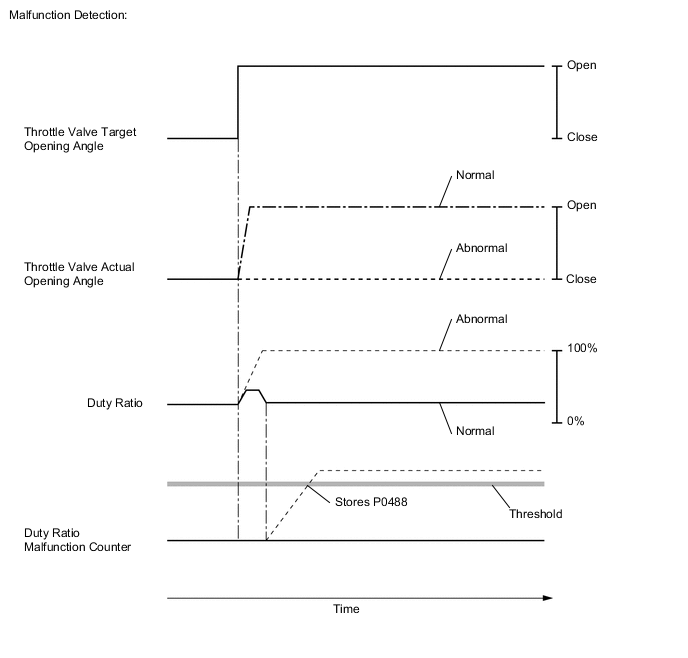
Tech Tips
-
If carbon deposits exist in the diesel throttle body assembly, the following parts possibly also have deposits inside: The EGR valve assembly, intake manifold, exhaust fuel addition injector, DPF catalyst, and other parts related to the exhaust gas.
By removing the EGR valve assembly from the intake manifold, the carbon deposit condition between the EGR valve and intake manifold can be checked visually. When checking for deposits in the EGR valve assembly, hold the EGR valve to a light and confirm that the valve contacts the valve seat securely.
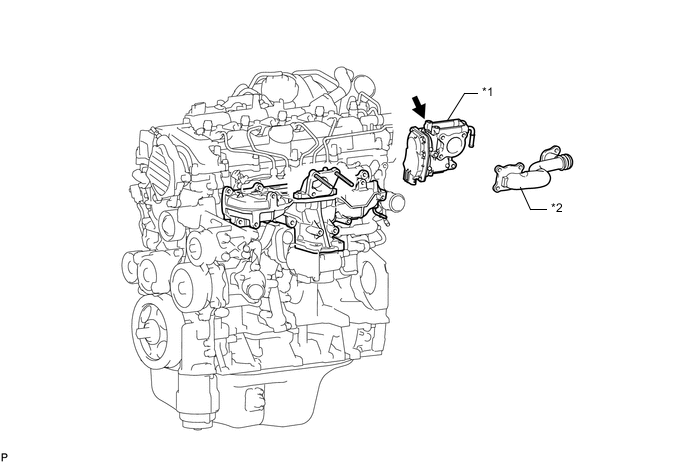
*1 EGR Valve Assembly *2 No. 2 EGR Pipe -
DPF catalyst diagnosis:
The value of "Catalyst Differential Press" in the Data List is high when the catalyst is clogged. If this value exceeds approximately 0.4, DTC P244B is stored.
If the "Catalyst Differential Press" become near about 0.4, the catalyst is probably clogged with PM even if DTC P244B is not present.
Check the Catalyst differential press when the engine is running at 3000 rpm with no load. Enter the following menus: Powertrain / Engine and ECT / Data List / Catalyst differential press.
If the value of MAF in the Data List is less than 25 g/s, a correct value for Catalyst Differential Press is not output due to exhaust gas pulsation.
-
Exhaust fuel addition injector diagnosis:
When the fuel volume injected by the exhaust fuel addition injector decreases, the value of "Exhaust Fuel Addition FB" in the Data List increases. Exhaust Fuel Addition FB in the Data List is a correction value to increase the fuel volume injected from the exhaust fuel addition injector when the catalyst temperature does not rise to the target during catalyst regeneration. Under normal conditions, the value is between 0.9 and 1.45.
Check the value by entering the following menus on an intelligent tester: Powertrain / Engine and ECT / Data List / Exhaust Fuel Addition FB. Under normal conditions, the exhaust gas temperature becomes 150 to 350°C (302 to 662°F) when the vehicle is driven in 3rd gear at a constant vehicle speed of about 50 km/h (31 mph). While driving under these conditions, the exhaust gas temperature rises to 500 to 700°C (932 to 1292°F) when the catalyst regeneration function in the Active Test (Activate the DPF Rejuvenate (PM)) is performed. If the temperature does not rise sufficiently, the exhaust fuel addition injector or the DPF catalyst may be damaged.
WIRING DIAGRAM
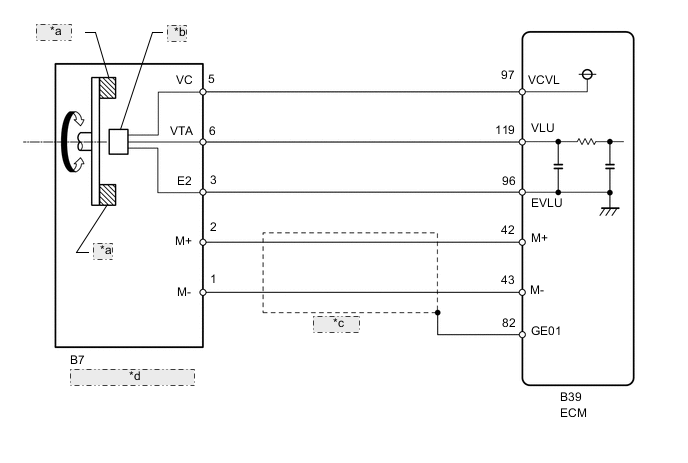
| *a | Magnet |
| *b | Hall IC |
| *c | Shielded |
| *d | Diesel Throttle Body |
CAUTION / NOTICE / HINT
Note
-
When cleaning the EGR valve or diesel throttle body, use a piece of cloth soaked with cleaning solvent. Spraying the solvent directly onto these parts or soaking the parts in solvent may damage the parts.
-
After replacing the ECM, the new ECM needs registration (See page ) and initialization Click here.
PROCEDURE
-
CHECK ANY OTHER DTCS OUTPUT (IN ADDITION TO DTC P0488)
-
Connect the intelligent tester to the DLC3.
-
Turn the ignition switch to ON and turn the tester on.
-
Enter the following menus: Powertrain / Engine and ECT / DTC.
-
Read the DTCs.
Result Result Proceed to DTC P0488 A DTC P0488 and other DTCs B Tech Tips
-
If any DTCs other than DTC P0488 are output, troubleshoot those DTCs first.
-
Be sure to also record the values of "Actual Throttle Position" and "Target Throttle Position" listed in the freeze frame data.
-
B 
GO TO DTC CHART Click here
A 
-
-
READ VALUE USING INTELLIGENT TESTER (DIESEL THROTTLE LEARN STATUS)
-
Connect the intelligent tester to the DLC3.
-
Turn the ignition switch to ON and turn the tester on.
-
Clear the DTCs Click here.
-
Turn the ignition switch off for 30 seconds or more.
Tech Tips
Be sure to turn off the ignition switch before performing this inspection. The fully closed position of the diesel throttle valve is learned when the ignition switch is turned off.
-
Enter the following menus: Powertrain / Engine and ECT / Data List / Diesel Throttle Learn Status.
-
Read the values when the ignition switch is ON.
Standard Diesel Throttle Learn Status is OK Note
Extremely cold conditions might cause the throttle valve movement to be delayed.
NG 
REMOVE DEPOSIT (CLEAN EGR PASSAGE) Click here
OK
-
-
PERFORM ACTIVE TEST USING INTELLIGENT TESTER (DIESEL THROTTLE TARGET ANGLE)
-
Connect the intelligent tester to the DLC3.
-
Turn the ignition switch to ON and turn the tester on.
-
Enter the following menus: Powertrain / Engine and ECT / Active Test / Diesel Throttle Target Angle.
-
When changing the Active Test continuously value to 0, 30, 60, 90, 60, 30 and 0%, check that Actual Throttle Position smoothly changes to the set opening angle.
OK Value smoothly changes to set opening angle.
NG
REMOVE DEPOSIT (CLEAN EGR PASSAGE) Click here
OK
-
-
REMOVE DEPOSIT (CLEAN EGR PASSAGE)
-
Remove the EGR valve assembly, No. 2 intake manifold and intake manifold.
-
Remove the deposits from those parts and clean the parts.
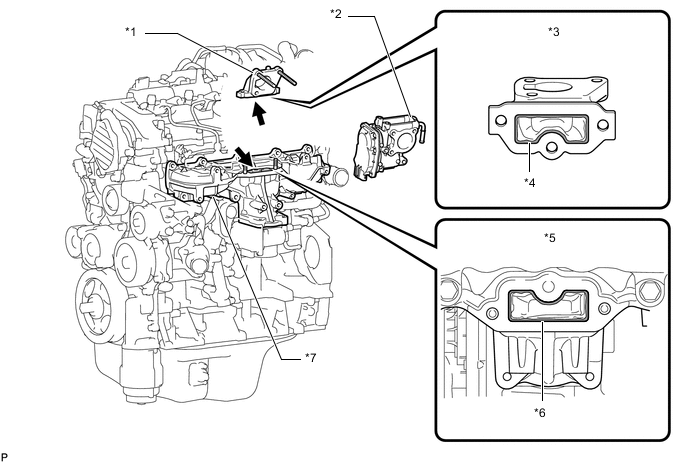
Text in Illustration *1 No. 2 Intake Manifold *2 EGR Valve Assembly *3 No. 2 Intake Manifold *4 Carbon Deposit *5 Intake Manifold *6 Carbon Deposit *7 Intake Manifold - - Note
-
When cleaning the EGR valve and diesel throttle body, use a piece of cloth soaked with cleaning solvent. Spraying the solvent directly onto these parts or soaking the parts in solvent may damage the parts.
-
Extreme care must be taken to prevent the removed deposits from falling into the engine unit during cleaning.
Tech Tips
Remove the intake manifold from the cylinder head when it has to be cleaned.
-
-
Reinstall the EGR valve assembly, No. 2 intake manifold and intake manifold.
NEXT
-
-
INSPECT DIESEL THROTTLE BODY ASSEMBLY (THROTTLE VALVE MOVEMENT)
-
Using your finger, move the throttle valve from the fully open position to the fully closed position and check that it moves smoothly.
OK Throttle valve moves smoothly. Note
Take care not to damage the throttle valve or valve housing.
OK
CHECK WHETHER DTC OUTPUT RECURS (DTC P0488) Click here
NG
REPLACE DIESEL THROTTLE BODY ASSEMBLY Click here
-
-
REMOVE DEPOSIT (CLEAN EGR PASSAGE)
-
Remove the EGR valve assembly, No. 2 intake manifold and intake manifold.
-
Remove the deposits from those parts and clean the parts.
Text in Illustration *1 No. 2 Intake Manifold *2 EGR Valve Assembly *3 No. 2 Intake Manifold *4 Carbon Deposit *5 Intake Manifold *6 Carbon Deposit *7 Intake Manifold - - Note
-
When cleaning the EGR valve and diesel throttle body, use a piece of cloth soaked with cleaning solvent. Spraying the solvent directly onto these parts or soaking the parts in solvent may damage the parts.
-
Extreme care must be taken to prevent the removed deposits from falling into the engine unit during cleaning.
Tech Tips
Remove the intake manifold from the cylinder head when it has to be cleaned.
-
-
Reinstall the EGR valve assembly, No. 2 intake manifold and intake manifold.
NEXT
-
-
INSPECT DIESEL THROTTLE BODY ASSEMBLY (THROTTLE VALVE MOVEMENT)
-
Using your finger, move the throttle valve from the fully open position to the fully closed position and check that it moves smoothly.
OK Throttle valve moves smoothly. Note
Take care not to damage the throttle valve or valve housing.
NG
REPLACE DIESEL THROTTLE BODY ASSEMBLY Click here
OK
-
-
CHECK HARNESS AND CONNECTOR (ECM - DIESEL THROTTLE BODY ASSEMBLY)
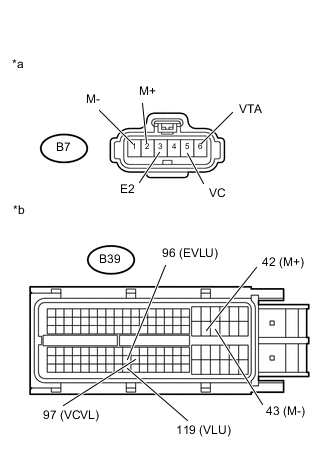
Text in Illustration *a Front view of wire harness connector
(to Throttle Body)
*b Front view of wire harness connector
(to ECM)
-
Disconnect the diesel throttle body assembly connector.
-
Disconnect the ECM connector.
-
Measure the resistance according to the value(s) in the table below.
Standard Resistance Tester Connection Condition Specified Condition B7-5 (VC) - B39-97 (VCVL) Always Below 1 Ω B7-6 (VTA) - B39-119 (VLU) Always Below 1 Ω B7-3 (E2) - B39-96 (EVLU) Always Below 1 Ω B7-2 (M+) - B39-42 (M+) Always Below 1 Ω B7-1 (M-) - B39-43 (M-) Always Below 1 Ω B7-5 (VC) or B39-97 (VCVL) - Body ground Always 10 kΩ or higher B7-6 (VTA) or B39-119 (VLU) - Body ground Always 10 kΩ or higher B7-3 (E2) or B39-96 (EVLU) - Body ground Always 10 kΩ or higher B7-2 (M+) or B39-42 (M+) - Body ground Always 10 kΩ or higher B7-1 (M-) or B39-43 (M-) - Body ground Always 10 kΩ or higher -
Reconnect the diesel throttle body assembly connector.
-
Reconnect the ECM connector.
OK
REPLACE DIESEL THROTTLE BODY ASSEMBLY Click here
NG
-
-
REPAIR OR REPLACE HARNESS OR CONNECTOR
-
Repair or replace the harness or connector.
NEXT
CHECK WHETHER DTC OUTPUT RECURS (DTC P0488) Click here
-
-
REPLACE DIESEL THROTTLE BODY ASSEMBLY
-
Replace the diesel throttle body assembly Click here.
NEXT
-
-
CHECK WHETHER DTC OUTPUT RECURS (DTC P0488)
-
Start the engine and warm it up.
-
Connect the intelligent tester to the DLC3.
-
Turn the tester on.
-
Enter the following menus: Powertrain / Engine and ECT / Data List / Engine Speed, Target Throttle Position and Actual Throttle Position.
-
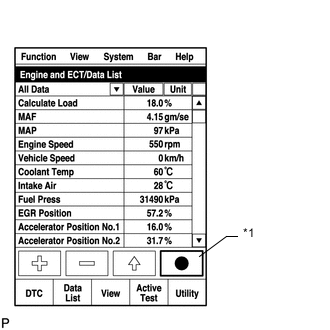
Text in Illustration *1 Snapshot Button Take a snapshot with the intelligent tester.
Tech Tips
Detailed graphs can be displayed by transferring the stored snapshot from the tester to a PC (personal computer) with Intelligent Viewer installed.
-
Enter the following menus: Powertrain / Engine and ECT / Active Test / Diesel Throttle Target Angle.
Tech Tips
The movement of the throttle valve can be determined by performing the following inspection.
-
When changing the Active Test value continuously to 0, 30, 60, 90, 60, 30 and 0%, check that Actual Throttle Position smoothly changes to the set opening angle.
OK Value smoothly changes to set opening angle. -
Perform the following repeatedly for 1 minute: gradually raise the engine speed to 3000 rpm from an idling over approximately 10 seconds, and then release the accelerator pedal to return to an idling state.
-
Enter the following menus: Powertrain / Engine and ECT / DTC.
-
Read DTCs.
OK No DTCs are output.
OK
END
NG
-
-
REPLACE ECM
-
Replace the ECM Click here.
NEXT
-
-
CHECK WHETHER DTC OUTPUT RECURS (DTC P0488)
-
Start the engine and warm it up.
-
Connect the intelligent tester to the DLC3.
-
Turn the tester on.
-
Enter the following menus: Powertrain / Engine and ECT / Data List / Engine Speed, Target Throttle Position and Actual Throttle Position.
-
Text in Illustration *1 Snapshot Button Take a snapshot with the intelligent tester.
Tech Tips
Detailed graphs can be displayed by transferring the stored snapshot from the tester to a PC (personal computer) with Intelligent Viewer installed.
-
Enter the following menus: Powertrain / Engine and ECT / Active Test / Diesel Throttle Target Angle.
Tech Tips
The movement of the throttle valve can be determined by performing the following inspection.
-
When changing the Active Test value continuously to 0, 30, 60, 90, 60, 30 and 0%, check that Actual Throttle Position smoothly changes to the set opening angle.
OK Value smoothly changes to set opening angle. -
Perform the following repeatedly for 1 minute: gradually raise the engine speed to 3000 rpm from an idling over approximately 10 seconds, and then release the accelerator pedal to return to an idling state.
-
Enter the following menus: Powertrain / Engine and ECT / DTC.
-
Confirm that the DTC is not output again.
NEXT
END
-