SFI SYSTEM, Diagnostic DTC:P0105, P0107, P0108
| DTC Code | DTC Name |
|---|---|
| P0105 | Manifold Absolute Pressure / Barometric Pressure Circuit |
| P0107 | Manifold Absolute Pressure / Barometric Pressure Circuit Low Input |
| P0108 | Manifold Absolute Pressure / Barometric Pressure Circuit High Input |
DESCRIPTION
The vacuum sensor detects pressure inside the intake manifold as an absolute pressure with a built-in sensor and outputs a voltage. Based on the voltage from the vacuum sensor, the ECM controls the purge VSV and corrects any errors in the air-fuel ratio due to changes in pressure.
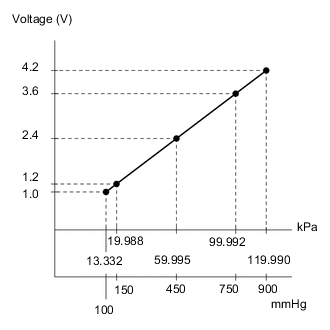
| DTC No. | DTC Detection Condition | Trouble Area |
|---|---|---|
| P0105 | The output voltage from the vacuum sensor remains below 0.5 V for 0.5 seconds. The output voltage from the vacuum sensor remains higher than 4.5 V for 0.5 seconds. (1 trip detection logic) |
|
| P0107 | The vacuum sensor voltage is below 0.5 V for 0.5 seconds. (1 trip detection logic) |
|
| P0108 | The vacuum sensor voltage is higher than 4.5 V for 0.5 seconds. (1 trip detection logic) |
|
Tech Tips
When any of these DTCs are output, check the manifold absolute pressure using the intelligent tester. Enter the following menus: Powertrain / Engine and ECT / Data List / All Data / MAP.
| MAP | Malfunction |
|---|---|
| Approximately 0 kPa |
|
| 130 kPa or higher |
|
WIRING DIAGRAM
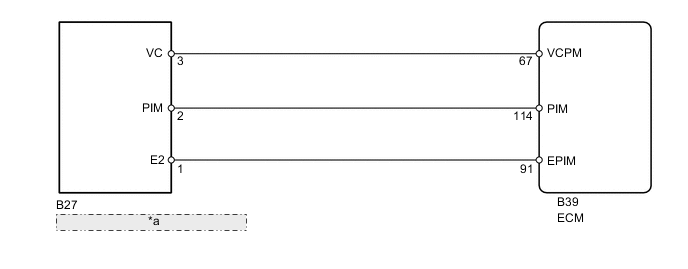
| *a | Manifold Absolute Pressure Sensor |
CAUTION / NOTICE / HINT
Tech Tips
-
If DTCs relating to different systems are stored, and they share terminal E2 as their ground, check this ground circuit first.
-
Read freeze frame data using the intelligent tester. The ECM records vehicle and driving condition information as freeze frame data the moment a DTC is stored. When troubleshooting, freeze frame data can help determine if the vehicle was moving or stationary, if the engine was warmed up or not, if the air fuel ratio was lean or rich, and other data from the time the malfunction occurred.
PROCEDURE
-
READ VALUE USING INTELLIGENT TESTER (MANIFOLD ABSOLUTE PRESSURE)
-
Connect the intelligent tester to the DLC3.
-
Turn the ignition switch to ON.
-
Turn the tester on.
-
Enter the following menus: Powertrain / Engine and ECT / Data List / MAP.
-
Read the MAP value.
Result Result Proceed to 0 kPa A 130 kPa or higher B Approximately same as atmospheric pressure C
B 
CHECK VACUUM SENSOR (POWER SOURCE) Click here
C 
CHECK FOR INTERMITTENT PROBLEMS Click here
A 
-
-
READ VALUE USING INTELLIGENT TESTER (MANIFOLD ABSOLUTE PRESSURE)
-
Connect the intelligent tester to the DLC3.
-
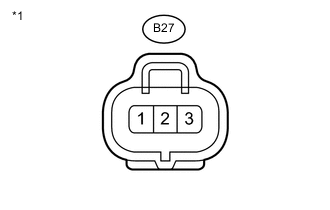
Text in Illustration *1 Front view of wire harness connector
(to Vacuum Sensor)
Disconnect the vacuum sensor connector.
-
Turn the ignition switch to ON.
-
Turn the tester on.
-
Enter the following menus: Powertrain / Engine and ECT / Data List / MAP.
-
Check how the "MAP" displayed on the intelligent tester changes compared to the value measured before disconnecting the connector of the vacuum sensor.
Result Result Proceed to Changes (From approximately 0 kPa (0 mmHg, 0 in.Hg) to a value of 130 kPa (975 mmHg, 38.4 in.Hg) or more) A Does not change (Approximately 0 kPa (0 mmHg, 0 in.Hg)) B -
Reconnect the vacuum sensor connector.
A
REPLACE VACUUM SENSOR Click here
B
CHECK HARNESS AND CONNECTOR (VACUUM SENSOR - ECM) Click here
-
-
CHECK VACUUM SENSOR (POWER SOURCE)
-
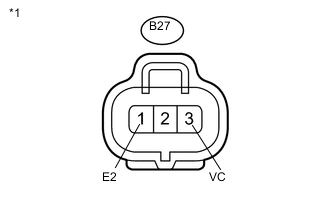
Text in Illustration *1 Front view of wire harness connector
(to Vacuum Sensor)
Disconnect the connector.
-
Measure the voltage according to the value(s) in the table below.
Standard Voltage Tester Connection Switch Condition Specified Condition B27-3 (VC) - B27-1 (E2) Ignition switch ON 4.5 to 5.5 V -
Reconnect the vacuum sensor connector.
NG
CHECK HARNESS AND CONNECTOR (VACUUM SENSOR - ECM) Click here
OK
-
-
CHECK HARNESS AND CONNECTOR (VACUUM SENSOR - ECM)
-
Disconnect the vacuum sensor connector.
-
Disconnect the ECM connector.
-
Measure the resistance according to the value(s) in the table below.
Standard Resistance (Check for open) Tester Connection Condition Specified Condition B27-2 (PIM) - B39-114 (PIM) Always Below 1 Ω Standard Resistance (Check for short) Tester Connection Condition Specified Condition B27-2 (PIM) or B39-114 (PIM) - Body ground Always 10 kΩ or higher -
Reconnect the ECM connector.
-
Reconnect the vacuum sensor connector.
NG
REPAIR OR REPLACE HARNESS OR CONNECTOR (VACUUM SENSOR - ECM)
OK
-
-
REPLACE VACUUM SENSOR
-
Replace the vacuum sensor Click here.
NEXT
-
-
CHECK WHETHER DTC OUTPUT RECURS
-
Connect the intelligent tester to the DLC3.
-
Clear the DTCs Click here.
-
Turn the ignition switch off.
-
Turn the ignition switch to ON and turn the tester on.
-
After the engine is started, race the engine for 1 second.
-
Enter the following menus: Powertrain / Engine and ECT / DTC.
-
Read the DTCs.
Result Display (DTC output) Proceed to No output A P0105, P0107 and/or P0108 B
A
END
B
REPLACE ECM Click here
-
-
CHECK HARNESS AND CONNECTOR (VACUUM SENSOR - ECM)
-
Disconnect the vacuum sensor connector.
-
Disconnect the ECM connector.
-
Measure the resistance according to the value(s) in the table below.
Standard Resistance (Check for open) Tester Connection Condition Specified Condition B27-2 (PIM) - B39-114 (PIM) Always Below 1 Ω B27-3 (VC) - B39-67 (VCPM) Always Below 1 Ω B27-1 (E2) - B39-91 (EPIM) Always Below 1 Ω Standard Resistance (Check for short) Tester Connection Condition Specified Condition B27-2 (PIM) or B39-114 (PIM) - Body ground Always 10 kΩ or higher B27-3 (VC) or B39-67 (VCPM) - Body ground Always 10 kΩ or higher -
Reconnect the ECM connector.
-
Reconnect the vacuum sensor connector.
OK
REPLACE ECM Click here
NG
REPAIR OR REPLACE HARNESS OR CONNECTOR (VACUUM SENSOR - ECM)
-