SFI SYSTEM, Diagnostic DTC:P0013
| DTC Code | DTC Name |
|---|---|
| P0013 | Camshaft Position "B" Actuator Circuit / Open (Bank 1) |
DESCRIPTION
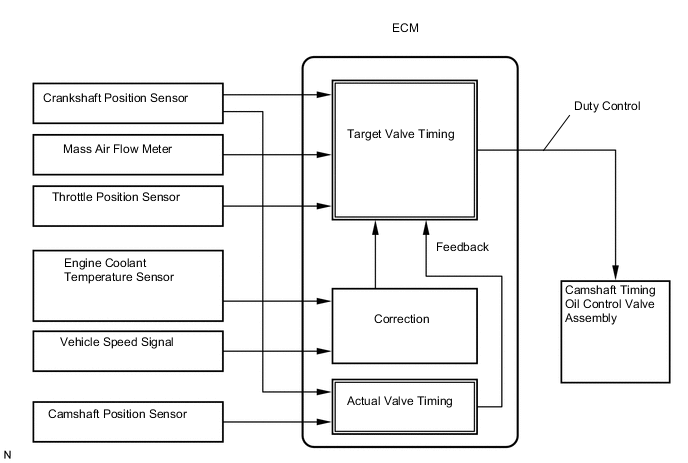
The Variable Valve Timing (VVT) system includes the ECM, exhaust camshaft timing oil control valve assembly and VVT controller. The ECM sends a target duty-cycle control signal to the exhaust camshaft timing oil control valve assembly. This control signal regulates the oil pressure supplied to the VVT controller. Camshaft timing control is performed according to engine operating conditions such as the intake air volume, throttle valve position and engine coolant temperature. The ECM controls the exhaust camshaft timing oil control valve assembly, based on the signals transmitted by several sensors. The VVT controller regulates the exhaust camshaft angle using oil pressure through the exhaust camshaft timing oil control valve assembly. As a result, the relative positions of the camshaft and crankshaft are optimized, the engine torque and fuel economy improve, and the exhaust emissions decrease under overall driving conditions. The ECM detects the actual exhaust valve timing using signals from the camshaft and crankshaft position sensors, and performs feedback control. This is how the target intake valve timing is verified by the ECM.
| DTC No. | DTC Detection Condition | Trouble Area |
|---|---|---|
| P0013 | An open or short in camshaft timing oil control valve assembly for the exhaust camshaft circuit (1 trip detection logic). |
|
WIRING DIAGRAM
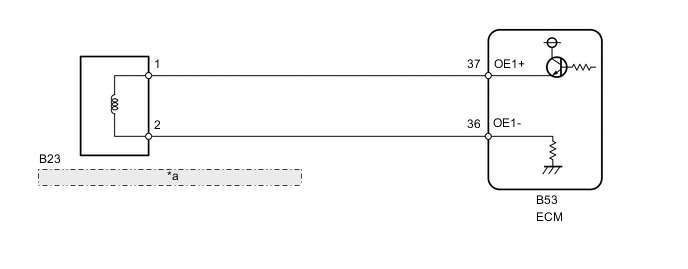
| *a | Camshaft Timing Oil Control Valve Assembly (for exhaust side) |
CAUTION / NOTICE / HINT
Tech Tips
Read freeze frame data using the GTS. Freeze frame data records the engine conditions when malfunctions are detected. When troubleshooting, freeze frame data can help determine if the vehicle was moving or stationary, if the engine was warmed up or not, if the air fuel ratio was lean or rich, and other data from the time the malfunction occurred.
PROCEDURE
-
PERFORM ACTIVE TEST USING GTS (OPERATE CAMSHAFT TIMING OIL CONTROL VALVE)
-
Connect the GTS to the DLC3.
-
Start the engine and turn the GTS on.
-
Enter the following menus: Powertrain / Engine and ECT / Active Test / Control the VVT Exhaust Linear (Bank 1).
-
Check the engine speed when the oil control valve is operated using the GTS when the engine coolant temperature is 50°C (122°F) or less.
Tech Tips
-
When performing the Active Test, the air conditioning should be on.
-
Make sure engine coolant temperature when the engine is started should be 30°C (86°F) or less.
OK GTS Operation Specified Condition -128% (Oil control valve OFF) Normal engine speed 127% (Oil control valve ON) Engine idles roughly or stalls (soon after oil control valve switched from OFF to ON) -
OK 
CHECK FOR INTERMITTENT PROBLEMS Click here
NG 
-
-
INSPECT CAMSHAFT TIMING OIL CONTROL VALVE ASSEMBLY (FOR EXHAUST SIDE)
-
Inspect the camshaft timing oil control valve assembly (for exhaust side) Click here.
NG
REPLACE CAMSHAFT TIMING OIL CONTROL VALVE ASSEMBLY (FOR EXHAUST SIDE) Click here
OK
-
-
CHECK HARNESS AND CONNECTOR (CAMSHAFT TIMING OIL CONTROL VALVE ASSEMBLY - ECM)
-
Disconnect the camshaft timing oil control valve assembly (for exhaust side) connector.
-
Disconnect the ECM connector.
-
Measure the resistance according to the value(s) in the table below.
Standard Resistance (Check for Open) Tester Connection Condition Specified Condition B23-1 - B53-37 (OE1+) Always Below 1 Ω B23-2 - B53-36 (OE1-) Always Below 1 Ω Standard Resistance (Check for Short) Tester Connection Condition Specified Condition B23-1 or B53-37 (OE1+) - Body ground Always 10 kΩ or higher B23-2 or B53-36 (OE1-) - Body ground Always 10 kΩ or higher -
Reconnect the camshaft timing oil control valve assembly (for exhaust side) connector.
-
Reconnect the ECM connector.
OK
REPLACE ECM Click here
NG
REPAIR OR REPLACE HARNESS OR CONNECTOR (CAMSHAFT TIMING OIL CONTROL VALVE ASSEMBLY - ECM)
-