OCCUPANT CLASSIFICATION SYSTEM, Diagnostic DTC:B1771

| DTC Code | DTC Name |
|---|---|
| B1771 | Passenger Side Buckle Switch Circuit Malfunction |
DESCRIPTION
The passenger side buckle switch circuit consists of the occupant detection ECU and front seat inner belt assembly RH.
DTC B1771 is stored when a malfunction is detected in the passenger side buckle switch circuit.
| DTC No. | DTC Detection Condition | Trouble Area |
|---|---|---|
| B1771 |
|
|
Tech Tips
When DTC B1650/32 is detected as a result of troubleshooting for the airbag system, check the DTCs stored in the occupant detection ECU. When DTC B1771 is output, perform troubleshooting for the DTC.
WIRING DIAGRAM
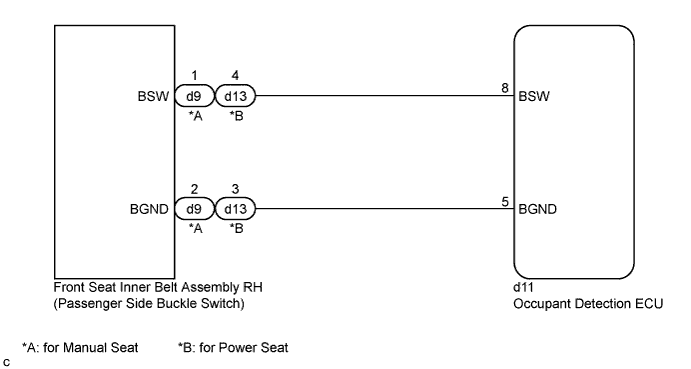
INSPECTION PROCEDURE
Note
After turning the power switch off, waiting time may be required before disconnecting the cable from the negative (-) auxiliary battery terminal. Therefore, make sure to read the disconnecting the cable from the negative (-) auxiliary battery terminal notices before proceeding with work Click here.
Tech Tips
-
If troubleshooting (wire harness inspection) is difficult to perform, remove the front passenger seat installation bolts to see under the seat cushion.
-
In the above case, lift and hold the seat so that it does not fall down. Hold the seat only as necessary because holding the seat for a long period of time may cause seat rail deformation.
PROCEDURE
-
CHECK CONNECTORS
-
Turn the power switch off.
-
Disconnect the cable from the negative (-) auxiliary battery terminal.
-
Check that the connectors are properly connected to the occupant detection ECU and front seat inner belt assembly RH.
OK The connectors are properly connected. Tech Tips
If the connectors are not connected securely, reconnect the connectors and proceed to the next inspection.
-
Disconnect the connectors from the occupant detection ECU and front seat inner belt assembly RH.
-
Check that the terminals of the connectors are not damaged.
OK The terminals are not deformed or damaged.
NG 
REPLACE FRONT SEAT WIRE RH
OK 
-
-
CHECK FRONT SEAT WIRE RH (SHORT TO B+)
-
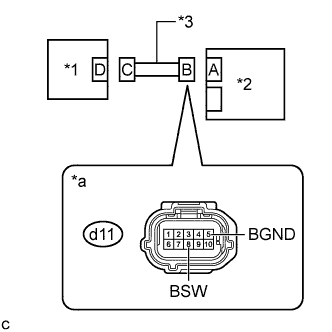
Text in Illustration *1 Front Seat Inner Belt Assembly RH *2 Occupant Detection ECU *3 Front Seat Wire RH *a Front view of wire harness connector
(to Occupant Detection ECU)
Connect the cable to the negative (-) auxiliary battery terminal.
-
Turn the power switch on (IG).
-
Measure the voltage according to the value(s) in the table below.
Standard Voltage Tester Connection Condition Specified Condition d11-8 (BSW) - Body ground Power switch on (IG) Below 1 V d11-5 (BGND) - Body ground Power switch on (IG) Below 1 V -
Turn the power switch off.
-
Disconnect the cable from the negative (-) auxiliary battery terminal.
NG
REPLACE FRONT SEAT WIRE RH
OK
-
-
CHECK FRONT SEAT WIRE RH (OPEN)
-
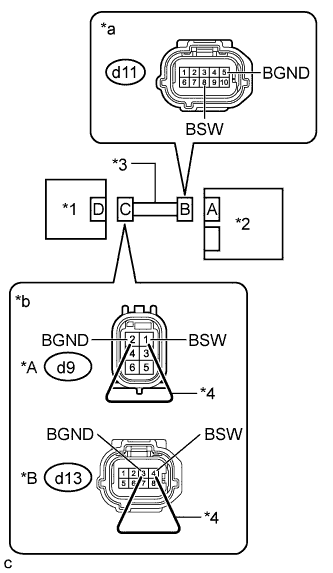
Text in Illustration *A for Manual Seat: *B for Power Seat: *1 Front Seat Inner Belt Assembly RH *2 Occupant Detection ECU *3 Front Seat Wire RH *4 Service Wire *a Front view of wire harness connector
(to Occupant Detection ECU)
*b Front view of wire harness connector
(to Front Seat Inner Belt Assembly RH)
Using a service wire, connect terminals BSW and BGND of connector C as shown in the illustration.
Note
Do not forcibly insert the service wire into the terminals of the connector when connecting the wire.
-
Measure the resistance according to the value(s) in the table below.
Standard Resistance Tester Connection Condition Specified Condition d11-8 (BSW) - d11-5 (BGND) Always Below 1 Ω -
Disconnect the service wire from connector C.
NG
REPLACE FRONT SEAT WIRE RH
OK
-
-
CHECK FRONT SEAT WIRE RH (SHORT)
-
Text in Illustration *1 Front Seat Inner Belt Assembly RH *2 Occupant Detection ECU *3 Front Seat Wire RH *a Front view of wire harness connector
(to Occupant Detection ECU)
Measure the resistance according to the value(s) in the table below.
Standard Resistance Tester Connection Condition Specified Condition d11-8 (BSW) - d11-5 (BGND) Always 1 MΩ or higher
NG
REPLACE FRONT SEAT WIRE RH
OK
-
-
CHECK FRONT SEAT WIRE RH (SHORT TO GROUND)
-
Text in Illustration *1 Front Seat Inner Belt Assembly RH *2 Occupant Detection ECU *3 Front Seat Wire RH *a Front view of wire harness connector
(to Occupant Detection ECU)
Measure the resistance according to the value(s) in the table below.
Standard Resistance Tester Connection Condition Specified Condition d11-8 (BSW) - Body ground Always 1 MΩ or higher d11-5 (BGND) - Body ground Always 1 MΩ or higher
NG
REPLACE FRONT SEAT WIRE RH
OK
-
-
CHECK DTC
-
Connect the connectors to the occupant detection ECU and front seat inner belt assembly RH.
-
Connect the cable to the negative (-) auxiliary battery terminal.
-
Clear the DTCs stored in the occupant detection ECU Click here.
-
Clear the DTCs stored in the airbag sensor assembly Click here.
-
Turn the power switch off.
-
Turn the power switch on (IG).
-
Check for DTCs Click here.
OK DTC B1771 is not output. Tech Tips
Codes other than DTC B1771 may be output at this time, but they are not related to this check.
-
Turn the power switch off.
NG 
CHECK FRONT SEAT INNER BELT ASSEMBLY RH Click here
OK 
USE SIMULATION METHOD TO CHECK Click here
-
-
CHECK FRONT SEAT INNER BELT ASSEMBLY RH
-
Disconnect the cable from the negative (-) auxiliary battery terminal.
-
Replace the front seat inner belt assembly RH with a known good one Click here.
Tech Tips
Perform the following inspection using known good parts from another vehicle if possible.
-
Connect the cable to the negative (-) auxiliary battery terminal.
-
Clear the DTCs stored in the occupant detection ECU Click here.
-
Clear the DTCs stored in the airbag sensor assembly Click here.
-
Turn the power switch off.
-
Turn the power switch on (IG).
-
Check for DTCs Click here.
OK DTC B1771 is not output. Tech Tips
Codes other than DTC B1771 may be output at this time, but they are not related to this check.
-
Turn the power switch off.
-
Disconnect the cable from the negative (-) auxiliary battery terminal.
-
Restore the front seat inner belt assembly RH that was installed for testing to its original location Click here.
NG
REPLACE OCCUPANT DETECTION ECU Click here
OK
REPLACE FRONT SEAT INNER BELT ASSEMBLY RH Click here
-
-
REPLACE OCCUPANT DETECTION ECU
-
Disconnect the cable from the negative (-) auxiliary battery terminal.
-
Replace the occupant detection ECU with a new one Click here.
-
Connect the cable to the negative (-) auxiliary battery terminal.
NEXT
-
-
PERFORM ZERO POINT CALIBRATION AND SENSITIVITY CHECK
-
Using the Techstream, perform Zero Point Calibration and Sensitivity Check Click here.
NEXT
END
-