CAN COMMUNICATION SYSTEM Check CAN Bus Line for Short to +B
DESCRIPTION
There may be a short circuit between one of the CAN bus lines and +B when no resistance exists between terminals 6 (CANH) and 16 (BAT) or 14 (CANL) and 16 (BAT) of the DLC3.
| Symptom | Trouble Area |
|---|---|
| No resistance exists between terminals 6 (CANH) and 16 (BAT) or 14 (CANL) and 16 (BAT) of DLC3. |
|
-
*1: for Navigation receiver type
-
*2: for Radio and display type (w/ Intuitive parking assist system)
-
*3: for Radio and display type (w/o Intuitive parking assist system)
-
*4: w/ Intuitive parking assist system
WIRING DIAGRAM
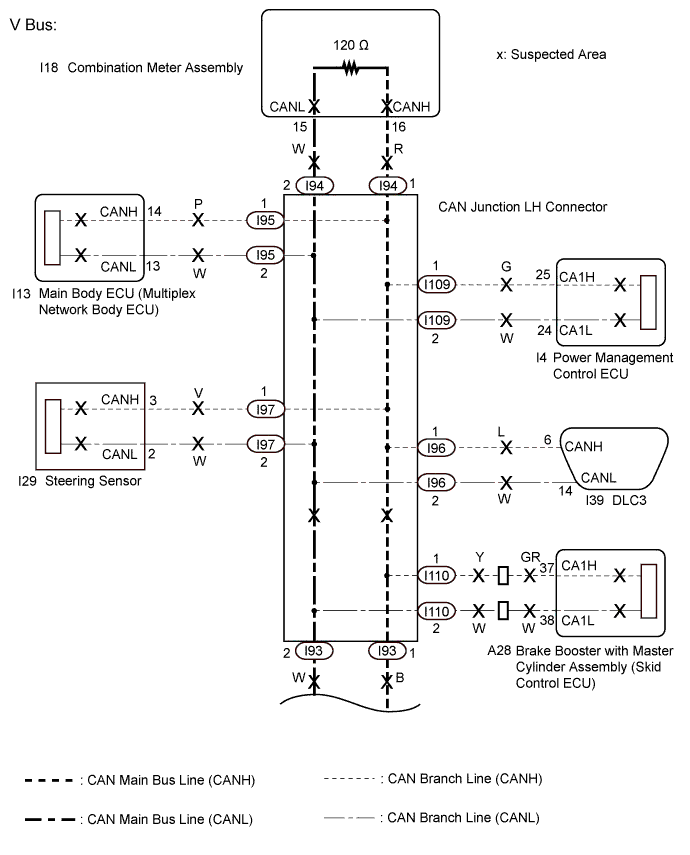
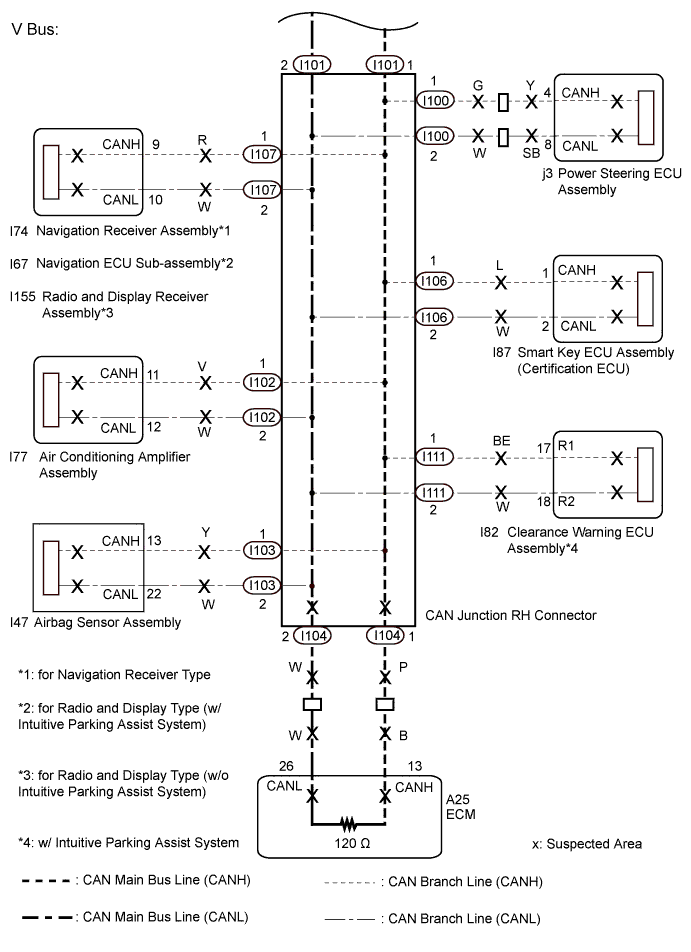
INSPECTION PROCEDURE
Note
-
Before measuring the resistance of the CAN bus, turn the power switch off and leave the vehicle for 1 minute or more without operating the key, switches or opening or closing the doors. After that, disconnect the cable from the negative (-) auxiliary battery terminal and leave the vehicle for 1 minute or more before measuring the resistance.
-
After turning the power switch off, waiting time may be required before disconnecting the cable from the negative (-) auxiliary battery terminal. Therefore, make sure to read the disconnecting the cable from the negative (-) auxiliary battery terminal notices before proceeding with work Click here.
-
Because the order of diagnosis is important to allow correct diagnosis, make sure to begin troubleshooting using How to Proceed with Troubleshooting when CAN communication system related DTCs are output Click here.
-
After performing repairs, perform the DTC check procedure and confirm that the DTCs are not output again.
-
DTC check procedure: Turn the power switch on (IG), turn the cruise control main switch on, turn the blind spot monitor main switch on, wait at least 60 seconds and then drive the vehicle at a speed of 20 km/h (12 mph) or more for 11 seconds or more.
-
After the repair, perform the CAN bus check and check that all the ECUs and sensors connected to the CAN communication system are displayed Click here.
Tech Tips
-
Operating the power switch, any other switches or a door triggers related ECU and sensor communication on the CAN. This communication will cause the resistance value to change.
-
Even after DTCs are cleared, if a DTC is stored again after driving the vehicle for a while, the malfunction may be occurring due to vibration of the vehicle. In such a case, wiggling the ECUs or wire harness while performing the inspection below may help determine the cause of the malfunction.
-
Connectors that connect to the CAN junction connector can be distinguished by color of their CAN bus lines. When the connectors have been disconnected from the CAN junction connector, reconnecting the connectors to non-original positions on the CAN junction connector does not affect system performance. However, it is preferred to reconnect the connectors to their original positions to avoid negative effects on the wiring such as tension on the wiring harnesses, and to make future maintenance easier.
PROCEDURE
-
CHECK FOR SHORT TO +B IN CAN BUS LINE (DLC3 BRANCH LINE)
-
Disconnect the cable from the negative (-) auxiliary battery terminal.
-
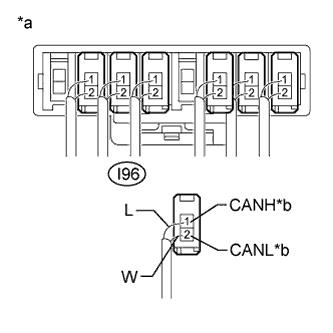
Text in Illustration *a Rear view of wire harness connector
(to CAN Junction LH Connector)
*b to DLC3 Disconnect the DLC3 branch line connector (I96) from the CAN junction LH connector.
Note
-
Before disconnecting the connector, make a note of where it is connected.
-
Reconnect the connector to its original position.
-
-
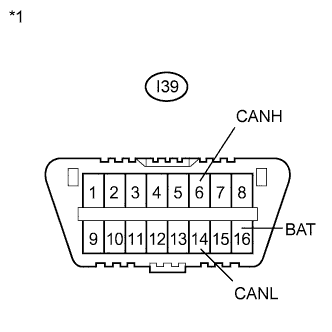
Text in Illustration *1 DLC3 Measure the resistance according to the value(s) in the table below.
Standard Resistance Tester Connection Condition Specified Condition I39-6 (CANH) - I39-16 (BAT) Cable disconnected from negative (-) auxiliary battery terminal 6 kΩ or higher I39-14 (CANL) - I39-16 (BAT) Cable disconnected from negative (-) auxiliary battery terminal 6 kΩ or higher
NG 
REPAIR OR REPLACE CAN BRANCH LINE CONNECTED TO DLC3
OK 
-
-
CHECK FOR SHORT TO +B IN CAN BUS LINE
-
Reconnect the DLC3 branch line connector (I96) to the CAN junction LH connector.
-
Text in Illustration *1 DLC3 Disconnect the connectors from the CAN junction LH connector and CAN junction RH connector one at a time.
Tech Tips
Disconnect the ECU and sensor connectors other than the DLC3 branch lines and CAN main bus lines between the CAN junction LH connector and CAN junction RH connector.
-
Using an ohmmeter, measure the resistance between terminals 6 (CANH) and 16 (BAT), and between terminals 14 (CANL) and 16 (BAT) of the DLC3 each time a connector is disconnected.
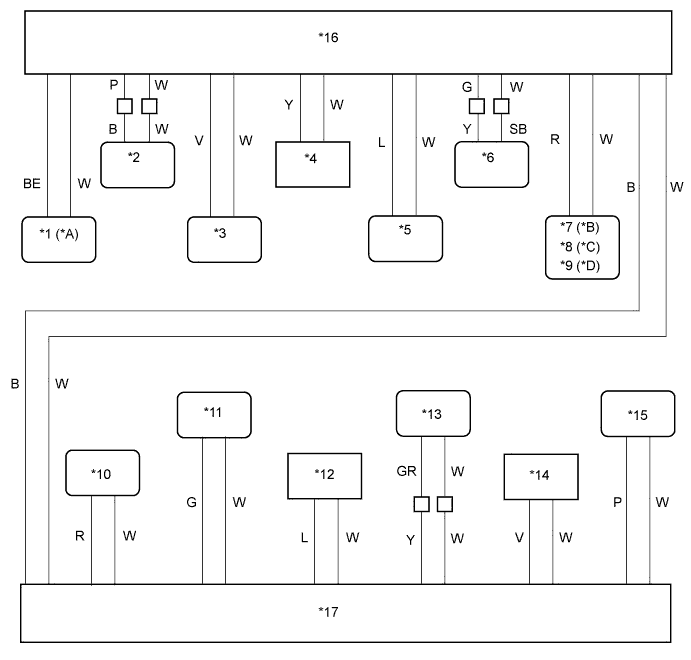
Text in Illustration *A w/ Intuitive Parking Assist System *B for Navigation Receiver Type *C for Radio and Display Type (w/ Intuitive Parking Assist System) *D for Radio and Display Type (w/o Intuitive Parking Assist System) *1 Clearance Warning ECU Assembly *2 ECM *3 Air Conditioning Amplifier Assembly *4 Airbag Sensor Assembly *5 Smart Key ECU Assembly (Certification ECU) *6 Power Steering ECU Assembly *7 Navigation Receiver Assembly *8 Navigation ECU Sub-assembly *9 Radio and Display Receiver Assembly *10 Combination Meter Assembly *11 Power Management Control ECU *12 DLC3 *13 Brake Booster with Master Cylinder Assembly (Skid Control ECU) *14 Steering Sensor *15 Main Body ECU (Multiplex Network Body ECU) *16 CAN Junction RH Connector *17 CAN Junction LH Connector - - 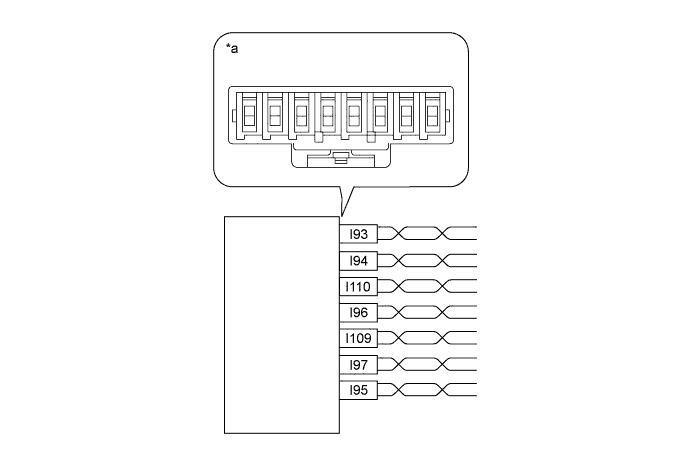
Text in Illustration *a Component without harness connected
(CAN Junction LH Connector)
- - Wiring Color CAN Junction LH Connector Side Code Color (CANH Side) Color (CANL Side) CAN main bus line (bus line connecting CAN junction LH connector and CAN junction RH connector) I93 B W Combination meter assembly I94 R W Brake booster with master cylinder assembly (Skid control ECU) I110 Y W DLC3 I96 L W Power management control ECU I109 G W Steering sensor I97 V W Main body ECU (Multiplex network body ECU) I95 P W 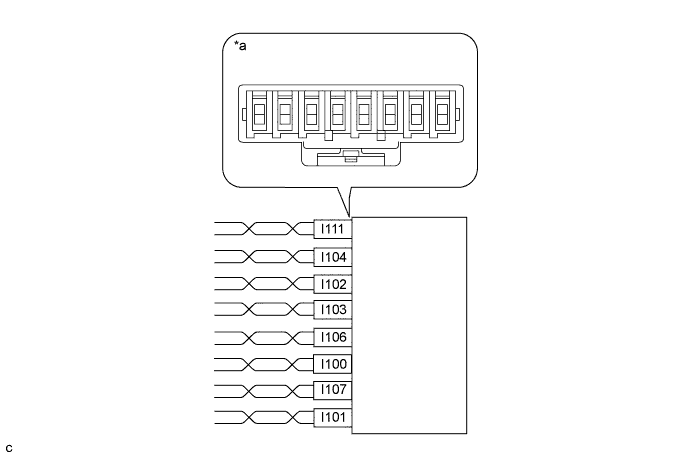
Text in Illustration *a Component without harness connected
(CAN Junction RH Connector)
- - Wiring Color CAN Junction RH Connector Side Code Color (CANH Side) Color (CANL Side) Clearance warning ECU assembly*4 I111 BE W ECM I104 P W Air conditioning amplifier assembly I102 V W Airbag sensor assembly I103 Y W Smart key ECU assembly (Certification ECU) I106 L W Power steering ECU assembly I100 G W
-
Navigation receiver assembly*1
-
Navigation ECU sub-assembly*2
-
Radio and display receiver assembly*3
I107 R W CAN main bus line (bus line connecting CAN junction LH connector and CAN junction RH connector) I101 B W
-
*1: for Navigation receiver type
-
*2: for Radio and display type (w/ Intuitive parking assist system)
-
*3: for Radio and display type (w/o Intuitive parking assist system)
-
*4: w/ Intuitive parking assist system
Note
Do not reconnect the disconnected connectors until this inspection is complete because there may be a short to +B in 2 or more CAN bus lines.
Result Symptom Proceed to The resistance between terminals 6 (CANH) and 16 (BAT), or the resistance between 14 (CANL) and 16 (BAT) is still below 6 kΩ when all the specified connectors are disconnected from the CAN junction connector. (There is a short to +B in the CAN main bus lines between the CAN junction LH connector and CAN junction RH connector.) A The resistance between terminals 6 (CANH) and 16 (BAT), or the resistance between 14 (CANL) and 16 (BAT) becomes normal (6 kΩ or more) when a connector is disconnected from the CAN junction connector. (There is a short to +B in one of the areas that relate to one or more of the disconnected bus lines.) B -
-
When there is a short to +B in one or more of the bus lines that connect to an ECU (or sensor):
-
Reconnect all of the connectors to the CAN junction connector, except for the one that was disconnected last (the bus line that is shorted to +B). Check that the resistance shown on the tester is normal (6 kΩ or more) to confirm that there is a short to +B in the one bus line only.
Tech Tips
-
Connectors that connect to the CAN junction connector can be distinguished by the color of their CAN bus lines.
-
Reconnecting the connectors to non-original positions on the CAN junction connector does not affect system performance. However, it is preferred to reconnect the connectors to their original positions to avoid negative effects on the wiring such as tension on the wiring harnesses, and to make future maintenance easier.
-
-
-
When there is no short to +B in any of the bus lines that connect to the ECUs and sensors:
-
With all the specified connectors for ECUs and sensors disconnected, proceed with the inspection of the CAN bus main lines between the CAN junction LH connector and CAN junction RH connector.
-
B 
CHECK FOR SHORT TO +B IN CAN BUS LINE (ECU, SENSOR) Click here
A
-
-
CHECK FOR SHORT TO +B IN CAN BUS LINE (CAN J/C LH)
-
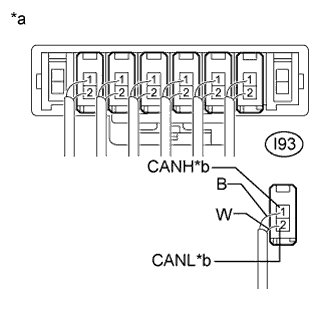
Text in Illustration *a Rear view of wire harness connector
(to CAN Junction LH Connector)
*b to CAN Junction RH Connector Disconnect the CAN main bus line connector (I93) from the CAN junction LH connector.
Note
-
Before disconnecting the connector, make a note of where it is connected.
-
Reconnect the connector to its original position.
-
-
Text in Illustration *1 DLC3 Measure the resistance according to the value(s) in the table below.
Standard Resistance Tester Connection Condition Specified Condition I39-6 (CANH) - I39-16 (BAT) Cable disconnected from negative (-) auxiliary battery terminal 6 kΩ or higher I39-14 (CANL) - I39-16 (BAT) Cable disconnected from negative (-) auxiliary battery terminal 6 kΩ or higher
NG
REPLACE CAN JUNCTION LH CONNECTOR
OK
-
-
CHECK FOR SHORT TO +B IN CAN BUS LINE (CAN J/C LH - CAN J/C RH)
-
Reconnect the CAN main bus line connector (I93) to the CAN junction LH connector.
-
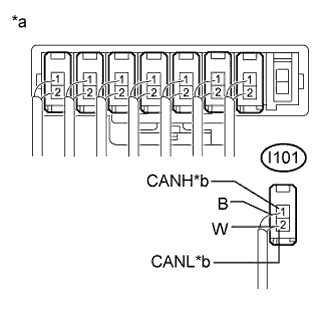
Text in Illustration *a Rear view of wire harness connector
(to CAN Junction RH Connector)
*b to CAN Junction LH Connector Disconnect the CAN main bus line connector (I101) from the CAN junction RH connector.
Note
-
Before disconnecting the connector, make a note of where it is connected.
-
Reconnect the connector to its original position.
-
-
Text in Illustration *1 DLC3 Measure the resistance according to the value(s) in the table below.
Standard Resistance Tester Connection Condition Specified Condition I39-6 (CANH) - I39-16 (BAT) Cable disconnected from negative (-) auxiliary battery terminal 6 kΩ or higher I39-14 (CANL) - I39-16 (BAT) Cable disconnected from negative (-) auxiliary battery terminal 6 kΩ or higher
NG
REPAIR OR REPLACE CAN MAIN BUS LINE (CAN J/C LH - CAN J/C RH)
OK 
REPLACE CAN JUNCTION RH CONNECTOR
-
-
CHECK FOR SHORT TO +B IN CAN BUS LINE (ECU, SENSOR)
-
Reconnect the connector of the bus line that is shorted to +B to the CAN junction connector (the connector that caused the bus line resistance to change to 6 kΩ or more when it was disconnected).
-
Disconnect the connector that includes the DLC3 connected CAN lines (such as CANH and CANL) from the ECU (or sensor) to which the bus line shorted to +B is connected Click here.
-
Text in Illustration *1 DLC3 Measure the resistance according to the value(s) in the table below.
Standard Resistance Tester Connection Condition Specified Condition I39-6 (CANH) - I39-16 (BAT) Cable disconnected from negative (-) auxiliary battery terminal 6 kΩ or higher I39-14 (CANL) - I39-16 (BAT) Cable disconnected from negative (-) auxiliary battery terminal 6 kΩ or higher Tech Tips
If the resistance changes to 6 kΩ or higher when the connector is disconnected from the ECU (or sensor), there may be a short in the ECU (or sensor).
NG
REPAIR OR REPLACE CORRESPONDING ECU OR SENSOR BUS LINE OR CONNECTOR
OK
REPLACE CORRESPONDING ECU OR SENSOR
-