METER / GAUGE SYSTEM Fuel Receiver Gauge Malfunction
DESCRIPTION
-
The meter CPU uses the fuel sender gauge assembly to determine the level of the fuel in the fuel tank. The resistance of the fuel sender gauge will vary between approximately 7.5 Ω with the float at the full position, and 185 Ω*1 or 225 Ω*2 with the float at the empty position. The meter outputs battery voltage through two 820 Ω resistors that are mounted in parallel inside the meter CPU. The meter CPU measures the voltage between the variable resistor in the fuel sender gauge and the two resistors mounted in parallel in the meter. Voltage measured at this point will vary as the float of the fuel sender gauge is moved. The highest voltage observed should be approximately half of the battery voltage.
-
*1: for 2WD
-
*2: for AWD
Tech Tips
The fuel level warning light will come on when the fuel level is below 10.0 liters (10.6 Imp.qts, 8.8 US qts).
WIRING DIAGRAM
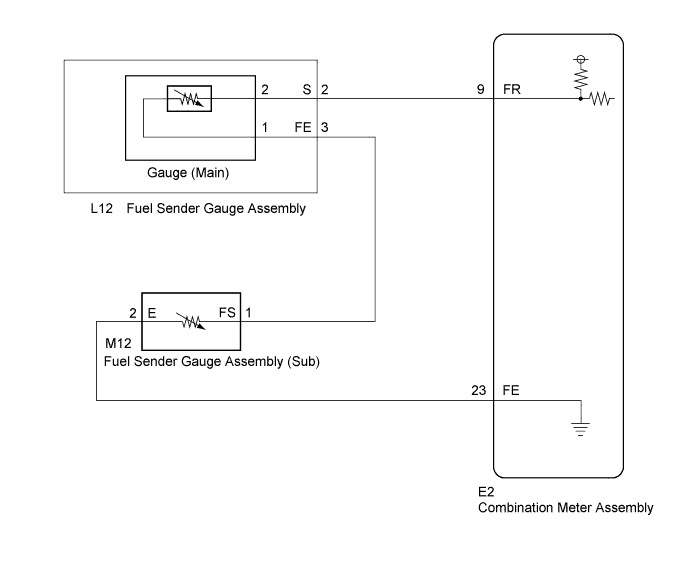
INSPECTION PROCEDURE
PROCEDURE
-
CHECK CAN COMMUNICATION SYSTEM
-
Check if a CAN communication DTC is output Click here.
Result Result Proceed to CAN communication DTC is not output. A CAN communication DTC is output. B
B 
GO TO CAN COMMUNICATION SYSTEM Click here
A 
-
-
PERFORM ACTIVE TEST USING GTS (FUEL METER OPERATION)
-
Connect the GTS to the DLC3.
-
Turn the ignition switch to ON.
-
Turn the GTS on.
-
Enter following menus: Body Electrical / Combination Meter / Active Test.
-
Check the operation by referring to the table below.
Combination Meter Tester Display Test Part Control Range Diagnostic Note Fuel Meter Operation Fuel receiver gauge Empty, 1/2, Full Confirm that the vehicle is stopped with the engine idling OK Fuel receiver gauge indication is normal.
NG
REPLACE COMBINATION METER ASSEMBLY Click here
OK
-
-
READ VALUE USING GTS (FUEL INPUT)
-
Connect the GTS to the DLC3.
-
Turn the ignition switch to ON.
-
Turn the GTS on.
-
Enter following menus: Body Electrical / Combination Meter / Data List.
-
Check the values by referring to the table below.
Combination Meter Tester Display Measurement Item/Range Normal Condition Diagnostic Note Fuel Input Fuel input signal/Min.: 0, Max.: 127.5 Current fuel level displayed Unit: Liter OK Fuel level signal displayed on the GTS is almost the same as fuel receiver gauge indication.
NG
REPLACE COMBINATION METER ASSEMBLY Click here
OK
-
-
CHECK HARNESS AND CONNECTOR (COMBINATION METER ASSEMBLY - FUEL SENDER GAUGE ASSEMBLY)
-
Disconnect the E2 and L12 connectors.
-
Measure the resistance according to the value(s) in the table below.
Standard Resistance Tester Connection Condition Specified Condition E2-9 (FR) - L12-2 (S) Always Below 1 Ω E2-9 (FR) - Body ground Always 10 kΩ or higher E2-23 (FE) - M12-2 (E) Always Below 1 Ω E2-23 (FE) - Body ground Always 10 kΩ or higher L12-3 (FE)- M12-1 (FS) Always Below 1 Ω M12-1 (FS) - Body ground Always 10 kΩ or higher
NG
REPAIR OR REPLACE HARNESS OR CONNECTOR
OK
-
-
INSPECT FUEL SENDER GAUGE ASSEMBLY
-
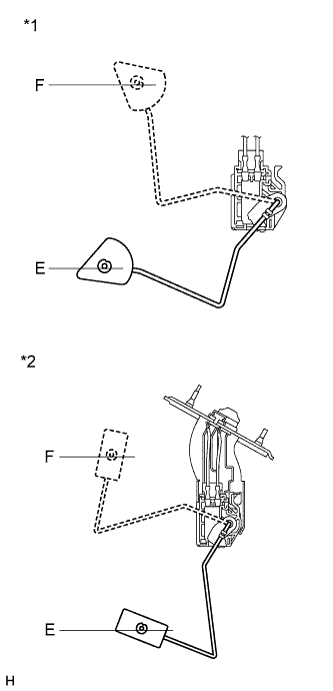
Text in Illustration *1 Front view of wire harness connector
(to Fuel Sender Gauge Assembly (Main))
*2 Front view of wire harness connector
(to Fuel Sender Gauge Assembly (Sub))
Remove the fuel sender gauge assembly Click here.
-
Check that the float moves smoothly between F and E.
-
Check if the fuel sender gauge arm is deformed.
-
Measure the resistance according to the value(s) in the table below.
Standard Resistance (Main) Tester Connection Condition Specified Condition 1 - 2 Float level is F (upper) 6.5 to 8.5 Ω 1 - 2 Float level is between F (upper) and E (lower) 6.5 to 187.2 Ω (Gradually changes) 1 - 2 Float level is E (lower) 183.2 to 187.2 Ω Standard Resistance (Sub) Tester Connection Condition Specified Condition 1 - 2 Float level is F (upper) 6.5 to 8.5 Ω 1 - 2 Float level is between F (upper) and E (lower) 6.5 to 227.3 Ω (Gradually changes) 1 - 2 Float level is E (lower) 222.3 to 227.3 Ω
NG
REPLACE FUEL SENDER GAUGE ASSEMBLY Click here
OK
-
-
CHECK FUEL SENDER GAUGE ASSEMBLY
-
Visually check for deformation on the fuel sender gauge assembly connector.
OK There is no deformation.
NG
REPLACE FUEL SENDER GAUGE ASSEMBLY Click here
OK 
REPLACE COMBINATION METER ASSEMBLY Click here
-