REAR BRAKE FLEXIBLE HOSE INSTALLATION

Note
-
Because the left and right rear flexible hoses are not interchangeable, verify the part number when installing the flexible hoses.
-
If the hoses are to be reused, connect them after checking the identification marks placed when each hose was disconnected.
-
INSTALL REAR FLEXIBLE HOSE
-
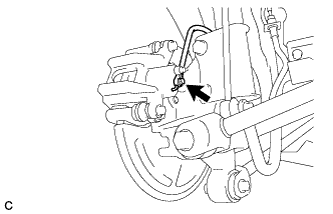
Connect the rear flexible hose to the disc brake cylinder assembly with a new union bolt and a new gasket.
- Torque:
- 29 N*m { 300 kgf*cm, 22 ft.*lbf }
Tech Tips
Install the rear flexible hose lock securely into the lock hole in the rear disc brake cylinder assembly.
-
Install the rear flexible hose to the bracket with a new clip.
Note
Install the clip as far as it will go.
-
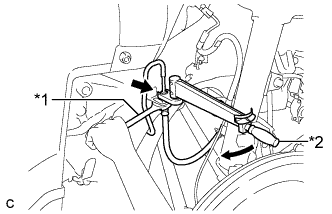
Text in Illustration *1 Hold *2 Turn Using a union nut wrench, connect the brake line to the rear brake flexible hose while holding the flexible hose with a wrench.
- Torque:
- 15 N*m { 155 kgf*cm, 11 ft.*lbf }
Note
-
Do not kink or damage the brake line.
-
Do not allow brake line to twist and interfere with other parts or body during flexible hose tightening.
-
Do not allow any foreign matter such as dirt or dust to enter the brake line.
-
Use the formula to calculate special torque values for situations where union nut wrench is combined with a torque wrench Click here.
-
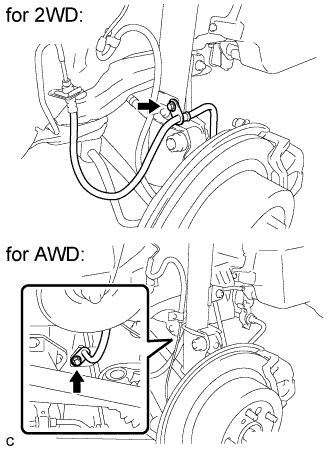
Install the rear flexible hose to the absorber bracket with the bolt.
- Torque:
- 19 N*m { 192 kgf*cm, 14 ft.*lbf }
-
-
FILL RESERVOIR WITH BRAKE FLUID
-
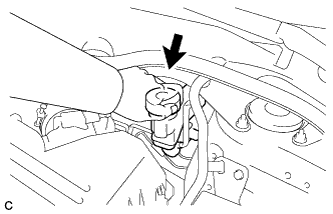
Remove the brake master cylinder reservoir filler cap.
-
Fill the reservoir with brake fluid.
Brake Fluid SAE J1703 or FMVSS No. 116 DOT 3 Note
-
Make sure that there is sufficient brake fluid in the reservoir.
-
Do not remove the filter from the brake master cylinder reservoir and be sure to fill with new brake fluid to avoid any potential contamination of the brake system. Contamination, for example by dirt particles or mineral oil, could lead to functional brake problem.
-
-
-
BLEED BRAKE LINE
Note
Bleed the brake line of the wheel farthest from the master cylinder first.
-
Connect a vinyl tube to the bleeder plug.
-
Depress the brake pedal several times, and while holding down the brake pedal, loosen the bleeder plug*1.
-
When fluid stops coming out, tighten the bleeder plug and release the brake pedal*2.
-
Repeat steps *1 and *2 until all the air in the brake fluid is completely bled out and the new brake fluid comes out.
-
Tighten the bleeder plug completely.
- Torque:
- 13 N*m { 133 kgf*cm, 10 ft.*lbf }
-
Repeat the above steps to replace the brake fluid of the brake lines for each wheel.
-
-
INSPECT FOR BRAKE FLUID LEAK
-
INSPECT FLUID LEVEL IN RESERVOIR
-
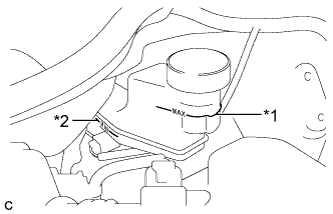
Text in Illustration *1 MAX Line *2 MIN Line Check the fluid level.
Tech Tips
If brake fluid level is lower than the MIN line, check for leaks and inspect the disc brake pads. If necessary, refill the reservoir with brake fluid to the MAX line after repair or replacement.
Brake Fluid SAE J1703 or FMVSS No. 116 DOT 3
-
-
INSTALL REAR WHEEL
- Torque:
- 103 N*m { 1050 kgf*cm, 76 ft.*lbf }