СИСТЕМА SFI, Diagnostic DTC:P0133, P0153
| DTC Code | DTC Name |
|---|---|
| P0133 | Oxygen Sensor Circuit Slow Response (Bank 1 Sensor 1) |
| P0153 | Oxygen Sensor Circuit Slow Response (Bank 2 Sensor 1) |
DESCRIPTION
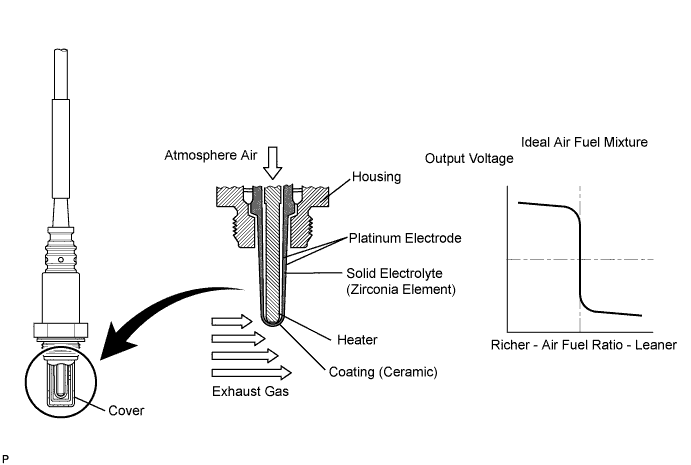
The heated oxygen sensor is used to monitor oxygen concentration in the exhaust gas. For optimum catalytic converter operation, the air-fuel mixture must be maintained near the ideal stoichiometric air-fuel ratio. The heated oxygen sensor output voltage changes suddenly in the vicinity of the stoichiometric air-fuel ratio. The ECM adjusts the fuel injection time so that the air-fuel ratio is nearly stoichiometric. The heated oxygen sensor generates a voltage between 0.1 and 0.9 V in response to oxygen concentration in the exhaust gas.
If the oxygen concentration in the exhaust gas increases, the air-fuel ratio is called LEAN. The heated oxygen sensor voltage drops below 0.45 V, which informs the ECM of the LEAN condition.
If oxygen is not in the exhaust gas, the air-fuel ratio is called RICH. The heated oxygen sensor voltage increases above 0.45 V, which informs the ECM of the RICH condition.
Tech Tips
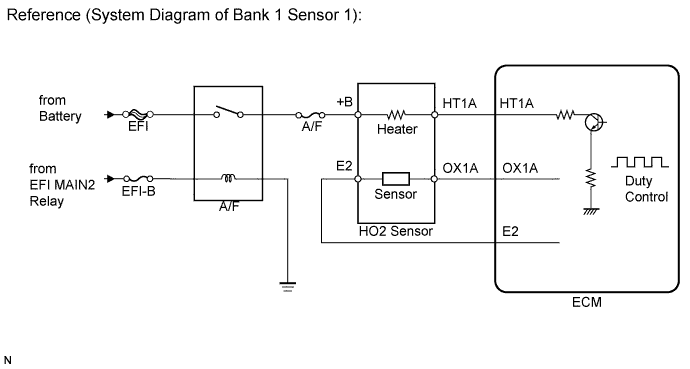
The ECM provides a pulse width modulated control circuit to adjust current through the heater. The heated oxygen sensor heater circuit uses a relay on the +B side of the circuit.
| DTC No. | DTC Detection Condition | Trouble Area |
|---|---|---|
| P0133 P0153 |
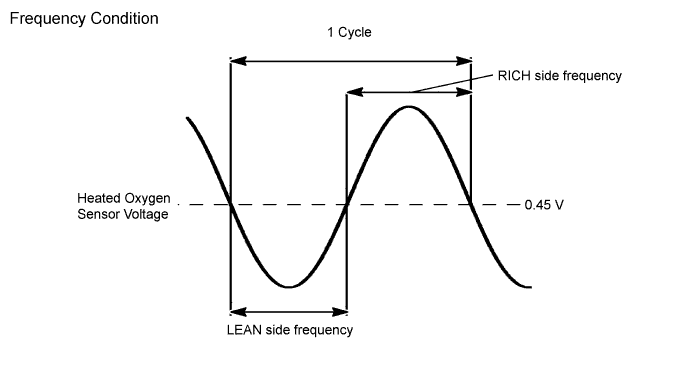
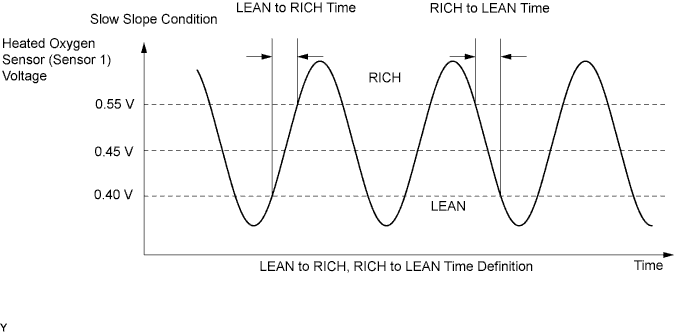
Slow slope condition (2 trip detection logic): Heated oxygen sensor (sensor 1) does not switch between LEAN and RICH for 0.9 seconds LEAN: 0.4 V or less RICH: 0.55 V or more Frequency condition (2 trip detection logic): Time of heated oxygen sensor (sensor 1) frequency per one cycle is 0.8 seconds or more. |
|
MONITOR DESCRIPTION
The ECM uses the heated oxygen sensor information to regulate the air-fuel ratio close to the stoichiometric air-fuel ratio. This maximizes the catalytic converter's ability to purify the exhaust gases. The sensor detects oxygen levels in the exhaust gas and sends a signal to the ECM.
The inner surface of the sensor element is exposed to outside air. The outer surface of the sensor element is exposed to the exhaust gases. The sensor element is made of platinum coated zirconia and includes an integrated heating element. The heated oxygen sensor's output voltage changes suddenly in the vicinity of the stoichiometric air-fuel ratio. The heated oxygen sensor generates waveforms of a voltage between 0.1 V and 0.9 V in response to the oxygen concentration in the exhaust gas. When the heated oxygen sensor voltage is 0.45 V or more, the ECM judges that the air-fuel ratio is RICH. When it is 0.45 V or less, the ECM judges that the air-fuel ratio is LEAN. The ECM monitors the response feature of the heated oxygen sensor. If the response time of the heated oxygen sensor status change from RICH to LEAN (or vice versa) becomes longer, the ECM interprets this as a malfunction in the heated oxygen sensor and sets a DTC.
WIRING DIAGRAM
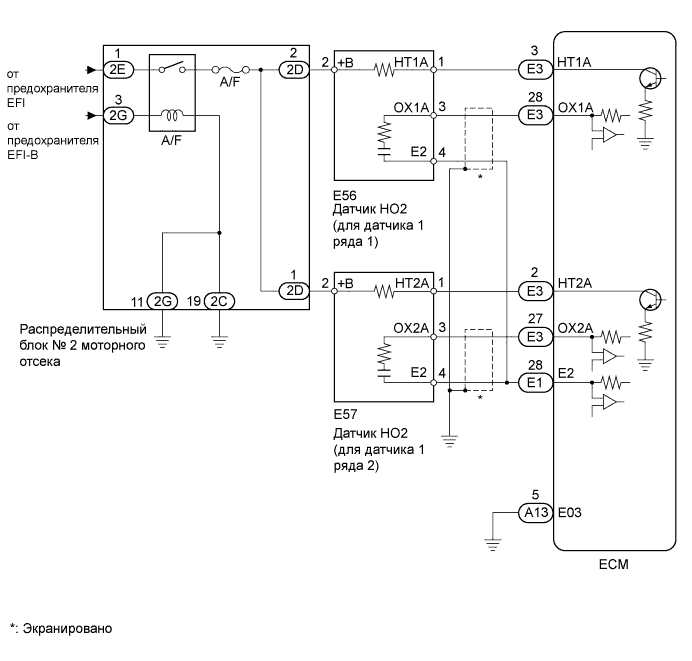
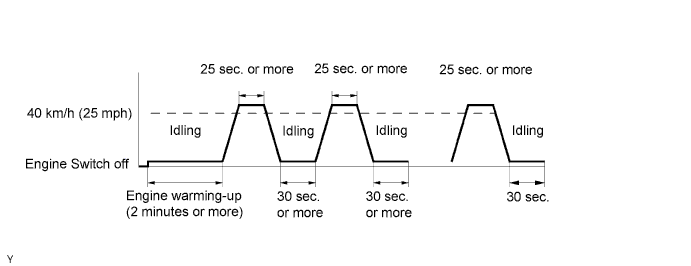
CONFIRMATION DRIVING PATTERN
-
(a) Connect the intelligent tester to the DLC3.
-
(b) Switch the intelligent tester from normal mode to check mode Click here.
-
(c) Allow the engine to idle until the ECT reaches 75°C (167°F).
-
(d) Allow the vehicle to run at 40 km/h (25 mph) or more for 25 seconds or more.
-
(e) Allow the engine to idle for 30 seconds or more.
-
(f) Perform the 2 previous steps at least 3 times.
Tech Tips
If a malfunction exists, the MIL will be illuminated on the multi-information display.
-
(g) Allow the engine to idle for 30 seconds.
Note
If the conditions in this test are not strictly followed, you should perform steps "d" and "e".
If you do not have the intelligent tester, turn the engine switch off after performing steps "c" to "f", and then perform steps "c" to "f" again.
INSPECTION PROCEDURE
Tech Tips
It is possible the malfunctioning area can be found using the Active Test Control operation. The Active Test can determine if the heated oxygen sensor or other potential trouble areas are malfunctioning or not.
The injection volume can be switched to -12.5% (decrease) or +24.8% (increase) by the Active Test.
The Active Test procedure enables a technician to check and graph the voltage outputs of the heated oxygen sensors.
-
Procedure:
-
Connect the intelligent tester to the DLC3.
-
Turn the engine switch on (IG).
-
Warm up the engine by running the engine at 2500 rpm for approximately 90 seconds.
-
Enter the following menus: Powertrain / Engine / Active Test / Control the Injection Volume.
-
Perform the Active Test while the engine is idling.
-
Monitor the output voltages of the HO2 sensors (O2S B1S1 and O2S B1S2 or O2S B2S1 and O2S B2S2) displayed on the tester.
Tech Tips
-
The Control the Injection Volume operation lowers the fuel injection volume by 12.5% or increases the injection volume by 24.8%.
-
Each sensor reacts in accordance with increases and decreases in the fuel injection volume.
| Tester Display | Injection Volume | Status | Voltage |
|---|---|---|---|
| O2S B1S1 or O2S B2S1 | +24.8% | Rich | More than 0.55 V |
| O2S B1S1 or O2S B2S1 | -12.5% | Lean | Less than 0.4 V |
| O2S B1S2 or O2S B2S2 | +24.8% | Rich | More than 0.5 V |
| O2S B1S2 or O2S B2S2 | -12.5% | Lean | Less than 0.4 V |
Note
The heated oxygen sensor (sensor 1) output has a few seconds of delay and the heated oxygen sensor (sensor 2) output has a maximum of 20 seconds of delay.
If the vehicle is short on fuel, the air-fuel ratio becomes LEAN and the DTCs will be recorded.
| Case | Front HO2 Sensor (Sensor 1) Output Voltage | Rear HO2 Sensor (Sensor 2) Output Voltage | Main Suspected Trouble Area |
|---|---|---|---|
| 1 |   |
 |
- |
| 2 |  |
|
|
| 3 | |
|
|
| 4 | |
|
|
Tech Tips
-
Read freeze frame data using the intelligent tester. Freeze frame data records the engine conditions when a malfunction is detected. When troubleshooting, freeze frame data can help determine if the vehicle was running or stopped, if the engine was warmed up or not, if the air-fuel ratio was LEAN or RICH, and other data from the time the malfunction occurred.
-
Bank 1 refers to the bank that includes No. 1 cylinder.
-
Bank 2 refers to the bank that does not include No. 1 cylinder.
-
Cylinder No. 1 is located in the front part of the engine, opposite the transmission.
-
Sensor 1 refers to the sensor closest to the engine body.
PROCEDURE
-
CHECK OTHER DTC OUTPUT
-
Connect the intelligent tester to the DLC3.
-
Enter the following menus: Powertrain / Engine / DTC.
-
Read the DTCs.
Result Display (DTC output) Proceed to P0133 or P0153 A P0133 or P0153 and other DTCs B
B 
GO TO RELEVANT DTC CHART Click here
A 
-
-
READ DATA LIST (HEATED OXYGEN SENSOR (SENSOR 1) VOLTAGE)
-
Connect the intelligent tester to the DLC3.
-
Enter the following menus: Powertrain / Engine / Data List / Primary / O2S B1S1 (or O2S B2S1).
-
Allow the engine to run for 90 seconds at 2500 rpm.
-
Read the heated oxygen sensor voltage while the engine is idling.
OK The heated oxygen sensor voltage alternates between less than 0.4 V and more than 0.55 V, and the period "t" must be less than 0.9 seconds (see the following table). 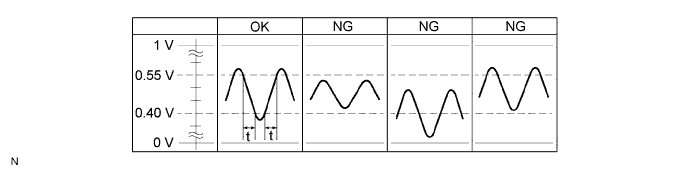
Result Result Proceed to NG A OK B
B 
PERFORM CONFIRMATION DRIVING PATTERN Click here
A
-
-
INSPECT HEATED OXYGEN SENSOR
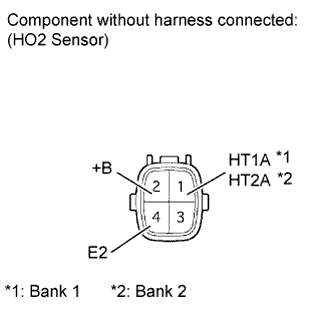
-
Disconnect the E56 and E57 sensor connectors.
-
Measure the resistance according to the value(s) in the table below.
Standard resistance Tester Connection Specified Condition Specified Condition 1 (HT1A) - 2 (+B) Always 11 to 16 Ω 1 (HT2A) - 2 (+B) Always 11 to 16 Ω 1 (HT1A) - 4 (E2) Always 10 kΩ or higher 1 (HT2A) - 4 (E2) Always 10 kΩ or higher
NG
REPLACE HEATED OXYGEN SENSOR Click here
OK
-
-
INSPECT ENGINE ROOM NO. 2 JUNCTION BLOCK (A/F RELAY)
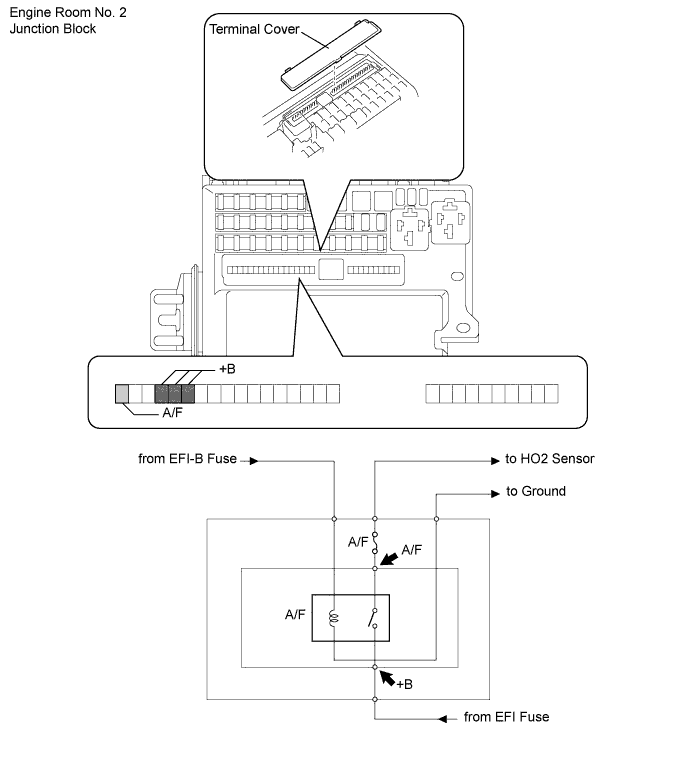
-
Remove the terminal cover.
-
Measure the voltage according to the value(s) in the table below.
Standard voltage Tester Connection Switch Condition Specified Condition +B - Body ground Always 11 to 14 V A/F - Body ground Engine switch on (IG) 11 to 14 V
NG
REPLACE ENGINE ROOM NO. 2 JUNCTION BLOCK
OK
-
-
CHECK HARNESS AND CONNECTOR (HEATED OXYGEN SENSOR (SENSOR 1) - ECM)
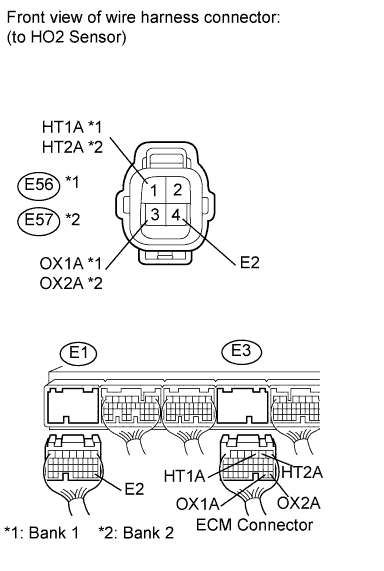
-
Disconnect the E56 and E57 sensor connectors.
-
Disconnect the E1 and E3 ECM connectors.
-
Measure the resistance according to the value(s) in the table below.
Standard resistance Tester Connection Condition Specified Condition E56-1 (HT1A) - E3-3 (HT1A) Always Below 1 Ω E56-3 (OX1A) - E3-28 (OX1A) Always Below 1 Ω E57-1 (HT2A) - E3-2 (HT2A) Always Below 1 Ω E57-3 (OX2A) - E3-27 (OX2A) Always Below 1 Ω E56-4 (E2) - E1-28 (E2) Always Below 1 Ω E57-4 (E2) - E1-28 (E2) Always Below 1 Ω E56-1 (HT1A) or E3-3 (HT1A) - Body ground Always 10 kΩ or higher E56-3 (OX1A) or E3-28 (OX1A) - Body ground Always 10 kΩ or higher E57-1 (HT2A) or E3-2 (HT2A) - Body ground Always 10 kΩ or higher E57-3 (OX2A) or E3-27 (OX2A) - Body ground Always 10 kΩ or higher
NG
REPAIR OR REPLACE HARNESS OR CONNECTOR
OK
-
-
CHECK AIR INDUCTION SYSTEM
-
Check the air induction system for vacuum leaks.
OK There are no vacuum leaks in air induction system.
NG
REPAIR OR REPLACE AIR INDUCTION SYSTEM
OK
-
-
CHECK FUEL PRESSURE
-
Check the fuel pressure Click here.
NG
REPAIR OR REPLACE FUEL SYSTEM
OK
-
-
INSPECT FUEL INJECTOR
-
Check the injector injection [whether fuel volume is high or low, and whether injection pattern is poor] Click here.
NG
REPLACE FUEL INJECTOR Click here
OK 
REPLACE HEATED OXYGEN SENSOR Click here
-
-
PERFORM CONFIRMATION DRIVING PATTERN
Tech Tips
Clear all DTCs before performing the confirmation driving pattern.
NEXT
-
READ OUTPUT DTC (DTC P0133 OR P0153 IS OUTPUT AGAIN)
-
Start the engine and allow the engine to idle for 15 seconds or more.
-
Read the DTC.
Result Display (DTC output) Proceed to P0133 or P0153 A No DTC output B
B
CHECK FOR INTERMITTENT PROBLEMS Click here
A
REPLACE HEATED OXYGEN SENSOR Click here
-