AIR SUSPENSION SYSTEM, Diagnostic DTC:C1715, C1716, C1717, C1796, C1797, C1798

| DTC Code | DTC Name |
|---|---|
| C1715 | Front Acceleration Sensor RH Malfunction |
| C1716 | Front Acceleration Sensor LH Malfunction |
| C1717 | Rear Acceleration Sensor Malfunction |
| C1796 | Front Acceleration Sensor RH Malfunction (Test Mode DTC) |
| C1797 | Front Acceleration Sensor LH Malfunction (Test Mode DTC) |
| C1798 | Rear Acceleration Sensor Malfunction (Test Mode DTC) |
DESCRIPTION
The acceleration sensor (up & down G sensor) detects the upward and downward acceleration of the vehicle, and outputs it as a voltage to the suspension control ECU. Up & down G sensors are installed in 3 locations: 1) the suspension control ECU, 2) the driver side instrument panel, and 3) the rear quarter. Each up & down G sensor independently detects the upward and downward acceleration. During a test mode inspection, the suspension control ECU reads the fluctuations in each sensor's signal. If a sensor's signal does not fluctuate, test mode DTCs C1796, C1797 and C1798 are output.
| DTC No. | Detection Condition | Trouble Area |
|---|---|---|
| C1715 C1796 |
Either condition is met:
|
Suspension control ECU (houses acceleration sensor) |
| C1716 C1797 |
Either condition is met:
|
|
| C1717 C1798 |
Either condition is met:
|
|
WIRING DIAGRAM
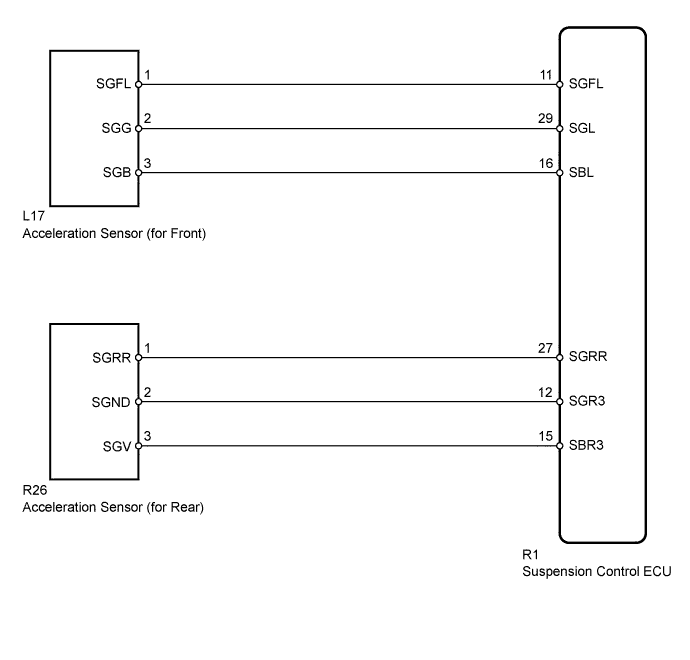
INSPECTION PROCEDURE
Note
-
Before performing troubleshooting, inspect the connectors of related circuits.
-
If DTC C1782 (Power Source Voltage Malfunction) is output at the same time, perform troubleshooting for C1782 first Click here.
-
Before replacing the suspension control ECU, perform all of the following again: 1) symptom simulation Click here; 2) DTC inspection; and 3) intelligent tester inspection (Data List or Active Test). If no malfunctions are found in other areas, replace the suspension control ECU.
-
If the suspension control ECU or height control sensor is replaced, the vehicle height offset calibration must be performed Click here.
-
If DTCs C1715 and C1796 are output, replace the suspension control ECU (houses acceleration sensor).
PROCEDURE
-
CHECK ACCELERATION SENSOR (DATA LIST)
-
Turn the power switch OFF.
-
Connect the intelligent tester to the DLC3.
-
Turn the power switch ON (IG) and the tester ON.
-
Enter the following menus: Chassis / Air suspension / Data List.
-
According to the display on tester, read the Data List.
Air suspension Tester Display Measurement Item/Range Normal Condition Diagnostic Note (Up&Down)G Sensor FR G (up & down) suspension control ECU (houses acceleration sensor) reading /
min.: -1045.29 m/s2
max.: 1045.26 m/s2
0 +/-0.98 m/s2at still condition
Reading changes when vehicle (FR) is bounced (Up&Down)G Sensor FL G (up & down) acceleration sensor (for Front) reading /
min.: -1045.29 m/s2
max.: 1045.26 m/s2
0 +/-0.98 m/s2at still condition
Reading changes when vehicle (FL) is bounced (Up&Down)G Sensor Rear G (up & down) acceleration sensor (for Rear) reading /
min.: -1045.29 m/s2
max.: 1045.26 m/s2
0 +/-0.98 m/s2at still condition
Reading changes when vehicle (rear) is bounced OK Acceleration value changes.
NG 
INSPECT ACCELERATION SENSOR (FRONT LH OR REAR) Click here
OK 
USE SIMULATION METHOD TO CHECK Click here
-
-
INSPECT ACCELERATION SENSOR (FRONT LH OR REAR)
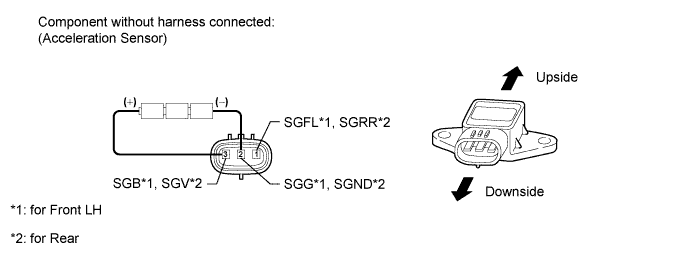
-
Turn the power switch OFF.
-
Remove the acceleration sensor (for Front) for LHD Click here, acceleration sensor (for Front) for RHD Click here or acceleration sensor (for Rear) Click here.
Note
Do not drop the acceleration sensor. If it is dropped, replace it with a new one.
-
Connect 3 1.5 V dry cell batteries in series.
-
Connect the positive (+) end of the batteries to terminal 3 (SGB*1, SGV*2) of the acceleration sensor and the negative (-) end of the batteries to terminal 2 (SGG*1, SGND*2). Then measure the voltage between terminal 1 (SGFL*1, SGRR*2) and terminal 2 (SGG*1, SGND*2)
Tech Tips
*1: for Front LH
*2: for Rear
-
Measure the voltage according to the value(s) in the table below.
Standard voltage for Front LH: (C1716, C1797) Tester Connection Condition Specified Condition 1 (SGFL) - 2 (SGG) Sensor stationary Approx. 2.0 to 2.5 V Sensor is tilted Change between approx. 0.9 to 2.3 V for Rear: (C1717, C1798) Tester Connection Condition Specified Condition 1 (SGRR) - 2 (SGND) Sensor stationary Approx. 2.0 to 2.5 V Sensor is tilted Change between approx. 0.9 to 2.3 V Note
Do not apply a voltage of higher than 6 V.
Tech Tips
When the acceleration sensor is tilted, it may output a different value.
Result Result Proceed to OK A Acceleration sensor (for Front) malfunction (for LHD) B Acceleration sensor (for Front) malfunction (for RHD) C Acceleration sensor (for Rear) malfunction D
B 
REPLACE ACCELERATION SENSOR Click here
C
REPLACE ACCELERATION SENSOR Click here
D
REPLACE ACCELERATION SENSOR Click here
A 
-
-
CHECK HARNESS AND CONNECTOR (ACCELERATION SENSOR - SUSPENSION CONTROL ECU)
-
Check the acceleration sensor (for Front) harness and connector (when DTC C1716 or C1797 is output).
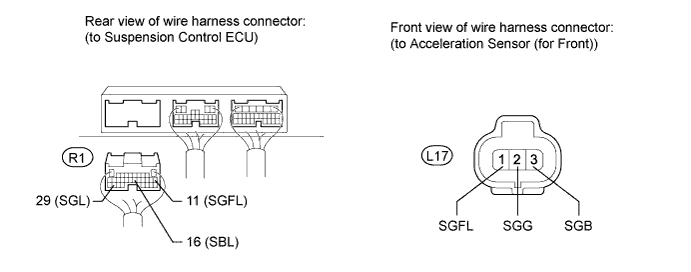
-
Disconnect the R1 ECU connector.
-
Disconnect the L17 sensor connector.
-
Measure the resistance according to the value(s) in the table below.
Standard resistance Tester Connection Condition Specified Condition L17-1 (SGFL) - R1-11 (SGFL) Always Below 1 Ω L17-2 (SGG) - R1-29 (SGL) Always Below 1 Ω L17-3 (SGB) - R1-16 (SBL) Always Below 1 Ω L17-1 (SGFL) or R1-11 (SGFL) - Body ground Always 10 kΩ or higher L17-2 (SGG) or R1-29 (SGL) - Body ground Always 10 kΩ or higher L17-3 (SGB) or R1-16 (SBL) - Body ground Always 10 kΩ or higher
-
-
Check the acceleration sensor (for Rear) harness and connector (when DTC C1717 or C1798 is output).
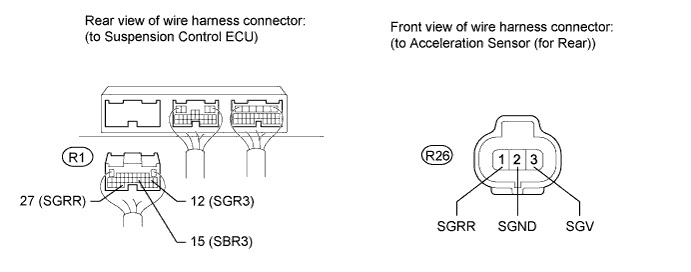
-
Disconnect the R1 ECU connector.
-
Disconnect the R26 sensor connector.
-
Measure the resistance according to the value(s) in the table below.
Standard resistance Tester Connection Condition Specified Condition R26-1 (SGRR) - R1-27 (SGRR) Always Below 1 Ω R26-2 (SGND) - R1-12 (SGR3) Always Below 1 Ω R26-3 (SGV) - R1-15 (SBR3) Always Below 1 Ω R26-1 (SGRR) or R1-27 (SGRR) - Body ground Always 10 kΩ or higher R26-2 (SGND) or R1-12 (SGR3) - Body ground Always 10 kΩ or higher R26-3 (SGV) or R1-15 (SBR3) - Body ground Always 10 kΩ or higher Result Result Proceed to NG A OK (for LHD) B OK (for RHD) C
-
B
REPLACE SUSPENSION CONTROL ECU Click here
C
REPLACE SUSPENSION CONTROL ECU Click here
A
REPAIR OR REPLACE HARNESS OR CONNECTOR
-