ENGINE ASSEMBLY INSTALLATION

CAUTION:
As the engine assembly with transmission is extremely heavy, the engine lifter may suddenly drop if the instructions listed in the repair manual are not followed. Therefore, always follow the instructions listed in the repair manual when performing this procedure.
-
INSTALL ENGINE HANGER
-
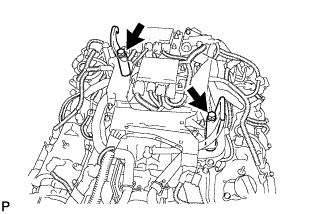
Install the 2 engine hangers with the 2 bolts as shown in the illustration.
- Torque:
- 43 N*m { 438 kgf*cm, 32 ft.*lbf }
Tech Tips
Engine hanger 12281-38150 Bolt 90119-14120 -
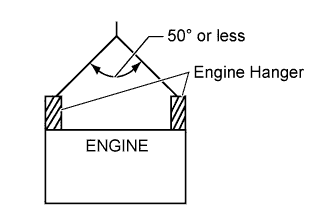
Attach an engine sling device and hang the engine with a chain block.
Note
When hanging the engine, make sure to hang the engine with the sling device's hanging angle at 50° or less. If not, the engine or engine hangers may be damaged.
-
-
REMOVE ENGINE FROM ENGINE STAND
-
Lift the engine, and remove it from the engine stand.
Note
With the exception of installing the engine assembly to an engine stand or removing the engine assembly from an engine stand, do not perform any work on the engine while it is suspended, as doing so is dangerous.
-
Place the engine onto a waking bench.
-
-
INSTALL FLYWHEEL SUB-ASSEMBLY
-
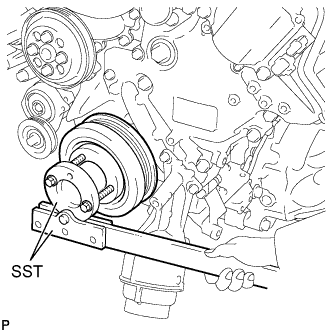
Using SST, hold the crankshaft.
- SST
- 09213-54015 ( 90119-08216 )
- 09330-00021
-
Clean the bolts and their installation holes.
-
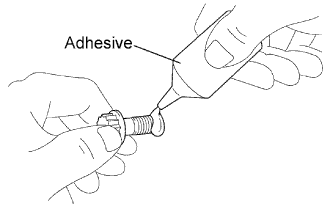
Apply adhesive to 2 or 3 threads of the bolt end.
Adhesive Toyota Genuine Adhesive 1324, Three Bond 1324 or equivalent -
Install the crankshaft angle sensor plate and flywheel sub-assembly on the crankshaft.
-
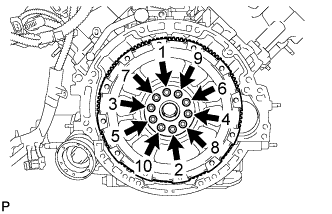
Uniformly install and tighten the 10 bolts in the sequence shown in the illustration.
- Torque:
- 30 N*m { 301 kgf*cm, 22 ft.*lbf }
Note
Do not strike or damage the flywheel sub-assembly installation bolts. Be sure to handle them carefully.
-
Mark the upside of each flywheel sub-assembly installation bolt with paint.
-
Tighten the flywheel sub-assembly installation bolts 90°.
-
Check that the painted marks are now at a 90° angle to the upside.
Note
Do not start the engine for at least 1 hour after the installation.
-
-
INSTALL INPUT TRANSMISSION DAMPER COVER ASSEMBLY
-
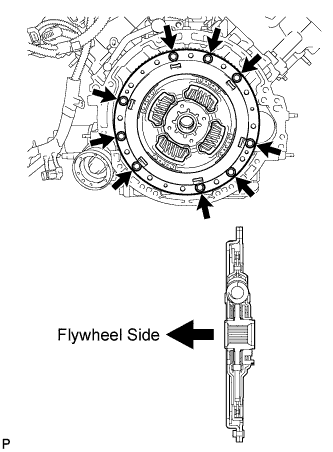
Install the input transmission damper cover assembly with the 9 bolts.
- Torque:
- 49 N*m { 500 kgf*cm, 36 ft.*lbf }
Note
Make sure to insert the clutch disc in the correct direction.
-
-
INSTALL HYBRID VEHICLE TRANSMISSION ASSEMBLY
-
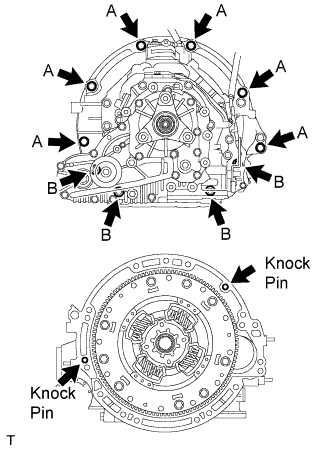
Make sure that the knock pins are installed on the engine.
-
While keeping the engine and the hybrid vehicle transmission assembly horizontal, align the knock pins and the knock pin holes, and then tighten the 10 bolts shown in the illustration.
- Torque:
- for Bolt A
- 71 N*m { 724 kgf*cm, 52 ft.*lbf }
- for Bolt B
- 37 N*m { 377 kgf*cm, 27 ft.*lbf }
Note
-
Do not forcibly pry out the hybrid vehicle transmission assembly.
-
Do not apply grease either to the splines or to the input shaft.
Bolt Diameter Bolt length A 12 mm (0.47 in.) 50 mm (1.97 in.) B 10 mm (0.39 in.) 43 mm (1.69 in.)
-
-
INSTALL STARTER HOLE INSULATOR
-
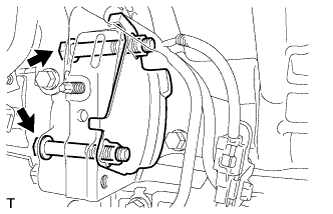
Install the starter hole insulator with the 2 bolts.
- Torque:
- 58 N*m { 591 kgf*cm, 43 ft.*lbf }
Diameter Bolt length 10 mm (0.39 in.) 65 mm (2.56 in.)
-
-
INSTALL OUTLET NO. 1 HYBRID WATER PUMP PIPE (for LHD)
-
Install the outlet No. 1 hybrid water pump pipe with the 2 bolts.
- Torque:
- 22 N*m { 224 kgf*cm, 16 ft.*lbf }
-
-
INSTALL OIL COOLER TUBE SUB-ASSEMBLY
-
Install the oil cooler tube with the 2 clips and the 3 bolts in the order shown in the illustration.
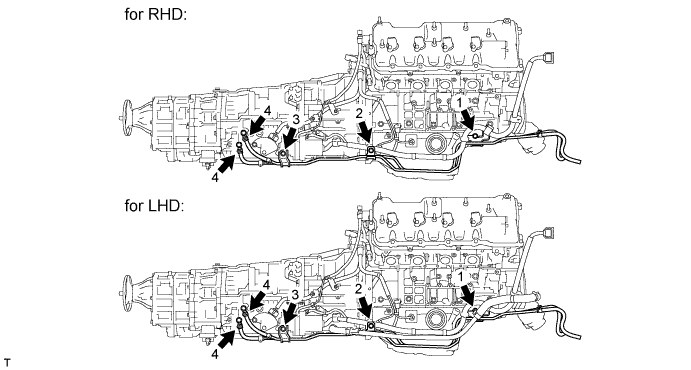
- Torque:
- 12 N*m { 122 kgf*cm, 9 ft.*lbf }
-
-
INSTALL REAR NO. 2 ENGINE MOUNTING INSULATOR
Tech Tips
Only perform this procedure when replacement of the rear No. 2 engine mounting insulator is necessary.
-
Install the rear No. 2 engine mounting insulator with the 2 bolts.
- Torque:
- 30 N*m { 306 kgf*cm, 22 ft.*lbf }
-
-
INSTALL REAR NO. 1 ENGINE MOUNTING INSULATOR
Tech Tips
Only perform this procedure when replacement of the rear No. 1 engine mounting insulator is necessary.
-
Install the 2 rear No. 1 engine mounting insulators with the 4 bolts.
- Torque:
- 30 N*m { 306 kgf*cm, 22 ft.*lbf }
-
-
INSTALL REAR ENGINE MOUNTING MEMBER
Tech Tips
Only perform this procedure when replacement of the rear engine mounting member is necessary.
-
Install the rear engine mounting member and No. 3 mounting insulator with the 5 nuts.
- Torque:
- 38 N*m { 387 kgf*cm, 28 ft.*lbf }
-
-
INSTALL FRONT PROPELLER SHAFT ASSEMBLY
-
INSTALL FRONT NO. 2 ENGINE MOUNTING BRACKET LH
-
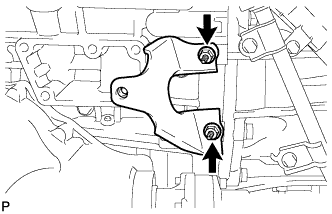
Temporarily install the front No. 2 engine mounting bracket LH with the 2 nuts.
-
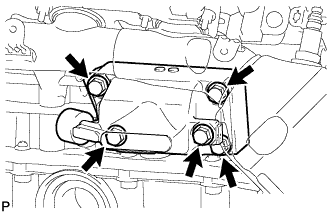
Temporarily install the front No. 1 engine mounting bracket LH with the 5 bolts.
-
Tighten the 2 nuts.
- Torque:
- 21 N*m { 214 kgf*cm, 15 ft.*lbf }
-
Remove the 5 bolts and front No. 1 engine mounting bracket LH.
-
-
INSTALL FRONT NO. 2 ENGINE MOUNTING BRACKET RH
-
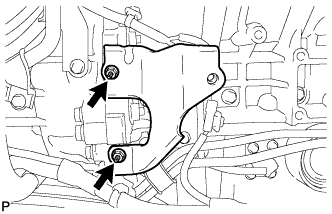
Temporarily install the front No. 2 engine mounting bracket RH with the 2 nuts.
-
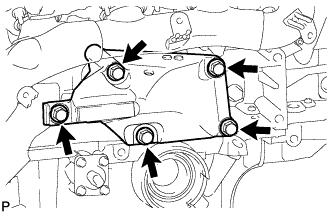
Temporarily install the front No. 1 engine mounting bracket RH with the 5 bolts.
-
Tighten the 2 nuts.
- Torque:
- 21 N*m { 214 kgf*cm, 15 ft.*lbf }
-
Remove the 5 bolts and front No. 1 engine mounting bracket RH.
-
-
INSTALL EXHAUST MANIFOLD SUB-ASSEMBLY LH
-
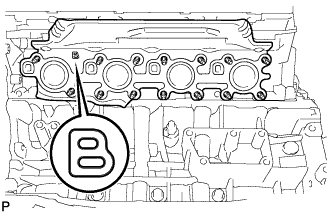
Place a new gasket on the cylinder head with the "B" mark facing the manifold side.
Note
Be careful of the installation direction.
-
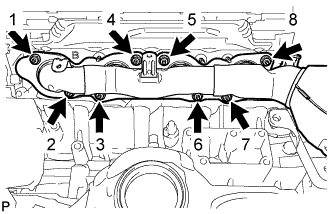
Temporarily install the exhaust manifold, and then uniformly tighten 8 new nuts in several steps, in the sequence shown in the illustration.
- Torque:
- 21 N*m { 214 kgf*cm, 15 ft.*lbf }
-
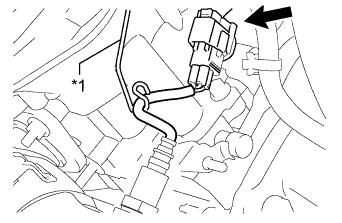
Text in Illustration *1 Bracket Connect the air fuel ratio sensor connector.
Tech Tips
Hook the wire harness to the bracket.
-
-
INSTALL EXHAUST MANIFOLD SUB-ASSEMBLY RH
-
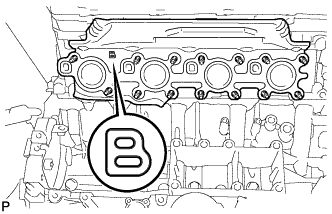
Place a new gasket on the cylinder head with the "B" mark facing the manifold side.
Note
Be careful of the installation direction.
-
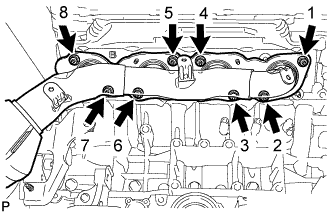
Temporarily install the exhaust manifold, and then uniformly tighten 8 new nuts in several steps, in the sequence shown in the illustration.
- Torque:
- 21 N*m { 214 kgf*cm, 15 ft.*lbf }
-
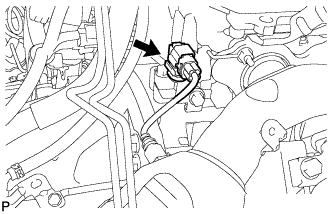
Connect the air fuel ratio sensor connector.
-
-
INSTALL FRONT NO. 1 ENGINE MOUNTING BRACKET LH
-
Install the front No. 1 engine mounting bracket LH with the 5 bolts.
- Torque:
- 35 N*m { 357 kgf*cm, 26 ft.*lbf }
-
-
INSTALL FRONT NO. 1 ENGINE MOUNTING BRACKET RH
-
Install the front No. 1 engine mounting bracket RH with the 5 bolts.
- Torque:
- 35 N*m { 357 kgf*cm, 26 ft.*lbf }
-
-
INSTALL FRONT ENGINE MOUNTING INSULATOR
-
Install the 2 spacers and 2 front engine mounting insulators with the 2 nuts.
- Torque:
- 35 N*m { 357 kgf*cm, 26 ft.*lbf }
-
-
INSTALL NO. 2 EXHAUST MANIFOLD HEAT INSULATOR
-
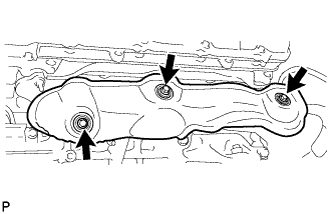
Install the heat insulator with the 3 bolts.
- Torque:
- 10 N*m { 102 kgf*cm, 7 ft.*lbf }
-
-
INSTALL NO. 1 EXHAUST MANIFOLD HEAT INSULATOR
-
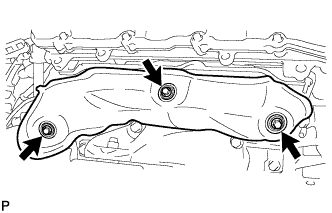
Install the heat insulator with the 3 bolts.
- Torque:
- 10 N*m { 102 kgf*cm, 7 ft.*lbf }
-
-
INSTALL ENGINE OIL LEVEL DIPSTICK GUIDE
-
Apply a light coat of engine oil to a new O-ring.
-
Install the O-ring to the engine oil level dipstick guide.
-
Install the engine oil level dipstick guide with the bolt.
- Torque:
- 10 N*m { 102 kgf*cm, 7 ft.*lbf }
-
Install the engine oil level dipstick.
-
-
INSTALL FRONT FRAME ASSEMBLY
-
Slowly lower the engine and set it to the front frame assembly.
-
Install the 4 nuts.
- Torque:
- 70 N*m { 714 kgf*cm, 52 ft.*lbf }
-
Attach the 2 clips and connect the heater wire connector.
-
-
INSTALL ENGINE AND TRANSMISSION
-
Place the engine on a engine lifter.
Note
-
Place wooden blocks or plate lift attachments so that the engine is level.
-
With the exception of installing the engine assembly to an engine stand or removing the engine assembly from an engine stand, do not perform any work on the engine while it is suspended, as doing so is dangerous.
-
Never install attachments to the oil pan of the engine assembly or transmission as doing so may deform the oil pan.
-
-
Remove the 2 bolts and 2 engine hangers.
-
Operate the engine lifter, then install the engine to the vehicle.
Note
Make sure that the engine is clear of all wiring and hoses.
-
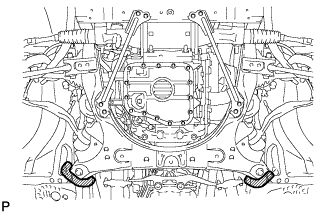
Align the front frame to the marks on the vehicle, and temporarily install the front frame with the 4 bolts.
Note
Make sure the crossmember is aligned to the vehicle marks as accurately as possible. If not performed accurately, the suspension alignment may become extremely misaligned.
-
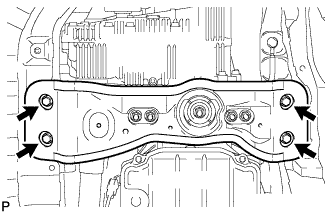
Install the 4 rear engine mounting member's bolts.
- Torque:
- 35 N*m { 354 kgf*cm, 26 ft.*lbf }
-
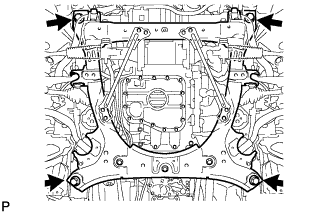
Tighten the 4 front frame bolts.
- Torque:
- 165 N*m { 1683 kgf*cm, 122 ft.*lbf }
-
-
CONNECT FRONT LOWER SHOCK ABSORBER BRACKET SUB-ASSEMBLY LH
-
Connect the front lower shock absorber bracket sub-assembly LH. Then install the bolt.
- Torque:
- 48 N*m { 489 kgf*cm, 35 ft.*lbf }
-
-
CONNECT FRONT LOWER SHOCK ABSORBER BRACKET SUB-ASSEMBLY RH
-
Connect the front lower shock absorber bracket sub-assembly RH. Then install the bolt.
- Torque:
- 48 N*m { 489 kgf*cm, 35 ft.*lbf }
-
-
CONNECT TRANSMISSION CONTROL SHAFT LEVER
-
Connect the transmission control shaft lever and spring washer with the nut.
- Torque:
- 16 N*m { 163 kgf*cm, 12 ft.*lbf }
-
-
INSTALL PROPELLER SHAFT WITH CENTER BEARING ASSEMBLY
-
INSTALL FRONT EXHAUST PIPE ASSEMBLY
-
INSTALL FRONT DRIVE SHAFT ASSEMBLY
-
INSTALL NO. 2 STEERING INTERMEDIATE SHAFT ASSEMBLY
-
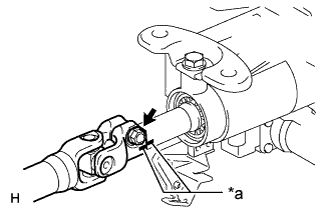
Text in Illustration *a Matchmark Put matchmarks on the No. 2 steering intermediate shaft and the steering column.
-
Remove the bolt.
-
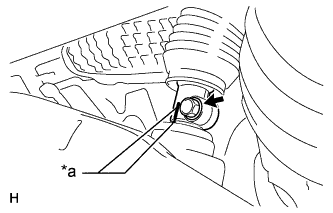
Text in Illustration *a Matchmark Put matchmarks on the No. 2 steering intermediate shaft and the steering link.
-
Remove the bolt.
-
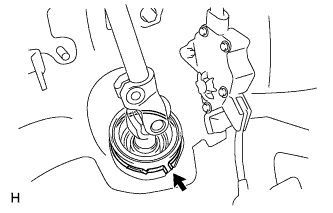
Remove the clamp and No. 2 steering intermediate shaft.
-
-
INSTALL NO. 2 AIR DUCT SUB-ASSEMBLY (for LHD)
-
Attach the 2 claws to install the No. 2 air duct sub-assembly with the bolt.
- Torque:
- 9.8 N*m { 100 kgf*cm, 87 in.*lbf }
-
-
INSTALL NO. 1 AIR DUCT SUB-ASSEMBLY (for RHD)
-
Attach the 2 claws to install the No. 1 air duct sub-assembly with the bolt.
- Torque:
- 9.8 N*m { 100 kgf*cm, 87 in.*lbf }
-
-
INSTALL DRIVER SIDE KNEE AIRBAG ASSEMBLY
-
CONNECT HOSES AND CONNECTORS
-
for LHD:
-
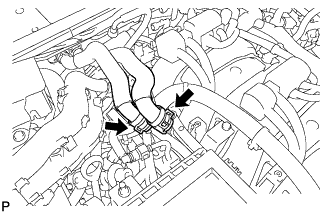
Connect the 2 heater hoses.
-
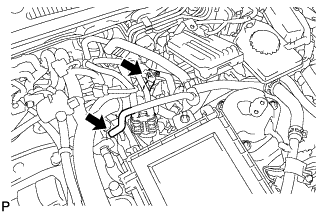
Connect the purge line hose and No. 5 inverter cooling hose.
-
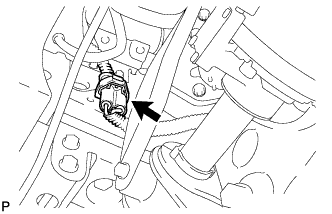
Connect the heater wire connector.
-
-
for RHD:
-
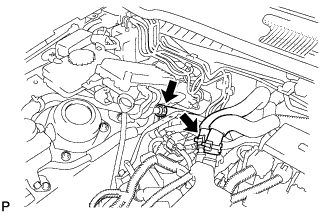
Connect the 2 heater hoses and No. 6 inverter cooling hose.
-
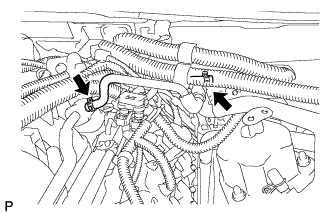
Connect the purge line hose and No. 2 inverter cooling hose.
-
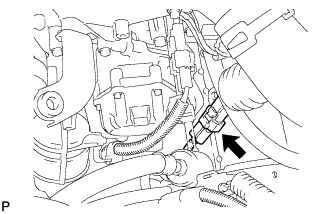
Connect the heater wire connector.
-
-
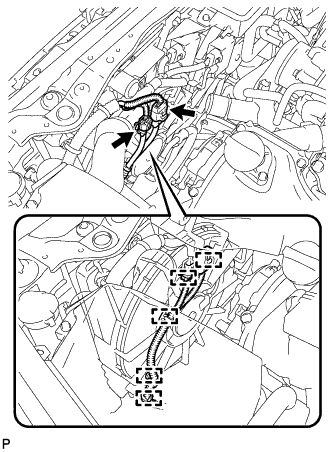
Attach the 5 clamps and connect the 2 connectors.
-
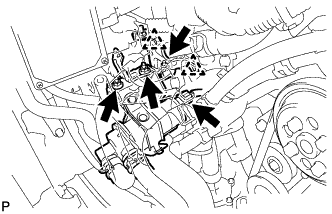
Install the heater water pump and bracket with the 2 nuts.
- Torque:
- 9.8 N*m { 100 kgf*cm, 87 in.*lbf }
-
Connect the heater water pump connector.
-
Install the inverter cooling pipe bracket with the nut. Then attach the 2 clamps.
- Torque:
- 13 N*m { 133 kgf*cm, 10 ft.*lbf }
-
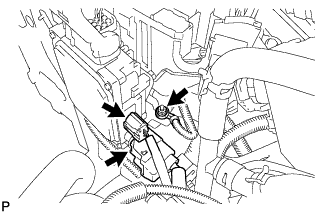
Connect the 2 oil pump motor controller connectors.
Tech Tips
Refer to the following procedures to connect the oil pump driver connector Click here.
-
Install the ground wire with the nut.
- Torque:
- 8.5 N*m { 87 kgf*cm, 75 in.*lbf }
-
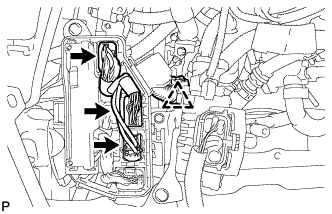
Connect the 3 connectors to the front controller and attach the clamp.
-
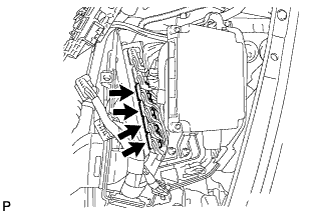
Lift up the wiring harness support and connect the 4 ECM connectors.
-
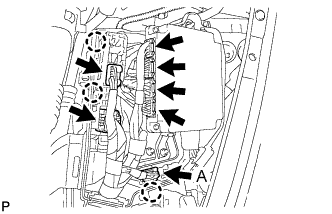
Install the wiring harness support to the ECM box.
-
Attach the clip of connector A to the ECM box.
-
Connect the 4 hybrid vehicle control ECU connectors and 2 wiring harness support connectors.
-
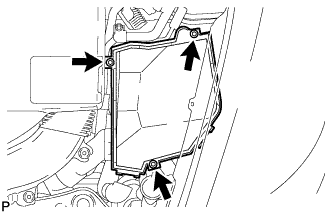
Install the engine room ECU box cover with the 3 bolts.
- Torque:
- 5.5 N*m { 56 kgf*cm, 49 in.*lbf }
-
-
INSTALL WATER PUMP ASSEMBLY WITH MOTOR AND BRACKET
-
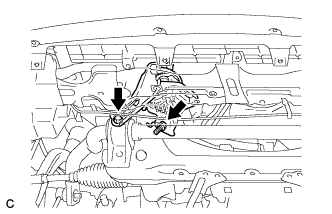
Install the water pump with motor and bracket assembly with the 2 bolts.
- Torque:
- 22 N*m { 224 kgf*cm, 16 ft.*lbf }
-
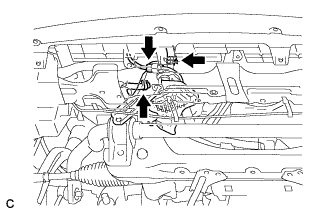
Connect the 2 water pump hoses with the 2 clips.
Note
Do not remove the pieces of cloth or plastic bags from the pipe and disconnected hose until installation.
-
Connect the water pump connector.
Note
Do not hold the water pump with motor assembly by the connector terminals when removing or installing it.
-
-
CONNECT SUCTION HOSE SUB-ASSEMBLY
-
Remove the vinyl tape and/or plastic bags from the openings of the disconnected parts and motor compressor.
-
Sufficiently apply compressor oil to a new O-ring and the fitting surface of the motor compressor.
Compressor oil ND-OIL 11 or equivalent -
Install the O-ring on the suction hose sub-assembly.
-
Connect the suction hose sub-assembly to the motor compressor with the bolt.
- Torque:
- 9.8 N*m { 100 kgf*cm, 87 in.*lbf }
-
-
CONNECT DISCHARGE HOSE SUB-ASSEMBLY
-
Remove the vinyl tape and/or plastic bags from the openings of the disconnected parts and motor compressor.
-
Sufficiently apply compressor oil to a new O-ring and the fitting surface of the motor compressor.
Compressor oil ND-OIL 11 or equivalent -
Install the O-ring on the discharge hose sub-assembly.
-
Connect the discharge hose sub-assembly to the motor compressor with the bolt.
- Torque:
- 9.8 N*m { 100 kgf*cm, 87 in.*lbf }
-
-
CONNECT GENERATOR CABLE (for LHD)
CAUTION:
Wear insulating gloves.
-
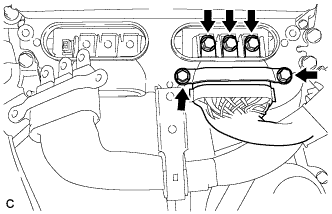
Using an insulated tool, connect the generator cable to the inverter with converter assembly.
-
Secure the generator cable to the inverter with converter assembly with the 5 bolts.
- Torque:
- 8.0 N*m { 82 kgf*cm, 71 in.*lbf }
Note
-
When installing the bolts that secure the cable, do not damage anything inside the inverter with converter assembly.
-
Make sure that no foreign matter is present on the terminal block.
-
Be sure to tighten the bolt to the specified torque. Failure to do so may damage the bolt.
-
-
CONNECT MOTOR CABLE (for LHD)
CAUTION:
Wear insulating gloves.
-
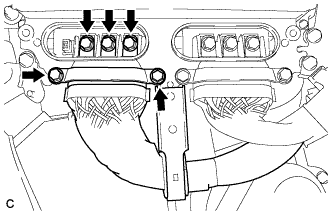
Using an insulated tool, connect the motor cable to the inverter with converter assembly.
-
Secure the motor cable to the inverter with converter assembly with the 5 bolts.
- Torque:
- 8.0 N*m { 82 kgf*cm, 71 in.*lbf }
Note
-
When installing the bolts that secure the cable, do not damage anything inside the inverter with converter assembly.
-
Make sure that no foreign matter is present on the terminal block.
-
Be sure to tighten the bolt to the specified torque. Failure to do so may damage the bolt
-
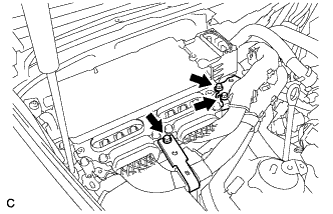
Install the motor cable bracket with the 3 bolts.
- Torque:
- 8.0 N*m { 82 kgf*cm, 71 in.*lbf }
-
-
INSTALL INVERTER TERMINAL COVER (for LHD)
CAUTION:
Wear insulating gloves.
-
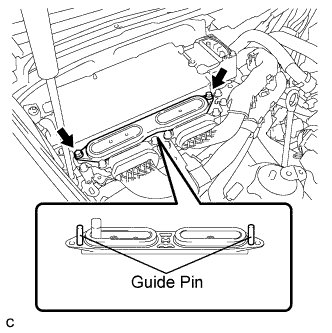
Set the inverter terminal cover to the inverter with converter assembly.
Note
-
Check that the sealing rubber is securely installed to the inverter terminal cover before installing the cover.
-
Making sure that there are no foreign objects on the waterproofed parts before installing the inverter terminal cover.
-
Install the inverter terminal cover while inserting the guide pins on both sides of the cover into guide pin holes of the inverter case.
-
When removing the inverter terminal cover, do not bend the connector terminals around the interlock part.
-
-
Push in both ends of the inverter terminal cover horizontally by hand.
Note
-
Insert the inverter terminal cover horizontally to prevent it from tilting. Failure to do so may damage the inverter terminal cover guide pins.
-
Make sure that both the inverter terminal cover bolt holes are aligned and in contact with the holes in the inverter case.
-
-
Using an insulated tool, secure the inverter terminal cover to the inverter with converter assembly with the 2 bolts.
- Torque:
- 8.0 N*m { 82 kgf*cm, 71 in.*lbf }
-
-
CONNECT GENERATOR CABLE (for RHD)
CAUTION:
Wear insulating gloves.
-
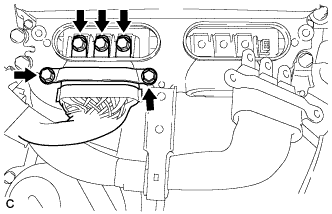
Connect the generator cable to the inverter with converter assembly.
-
Using an insulated tool, secure the generator cable to the inverter with converter assembly with the 5 bolts.
- Torque:
- 8.0 N*m { 82 kgf*cm, 71 in.*lbf }
Note
-
When installing the bolts that secure the cable, do not damage anything inside the inverter with converter assembly.
-
Make sure that no foreign matter is present on the terminal block.
-
Be sure to tighten the bolt to the specified torque. Failure to do so may damage the bolt.
-
-
CONNECT MOTOR CABLE (for RHD)
CAUTION:
Wear insulating gloves.
-
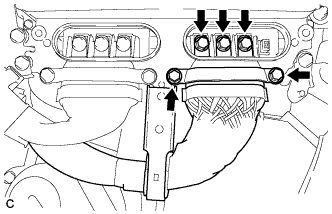
Connect the motor cable to the inverter with converter assembly.
-
Using an insulated tool, secure the motor cable to the inverter with converter assembly with the 5 bolts.
- Torque:
- 8.0 N*m { 82 kgf*cm, 71 in.*lbf }
Note
-
When installing the bolts that secure the cable, do not damage anything inside the inverter with converter assembly.
-
Make sure that no foreign matter is present on the terminal block.
-
Be sure to tighten the bolt to the specified torque. Failure to do so may damage the bolt.
-
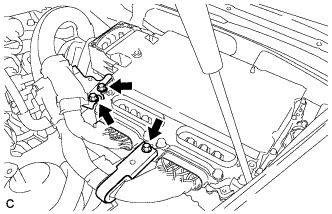
Install the motor cable bracket with the 3 bolts.
- Torque:
- 8.0 N*m { 82 kgf*cm, 71 in.*lbf }
-
-
INSTALL INVERTER TERMINAL COVER (for RHD)
CAUTION:
Wear insulating gloves.
-
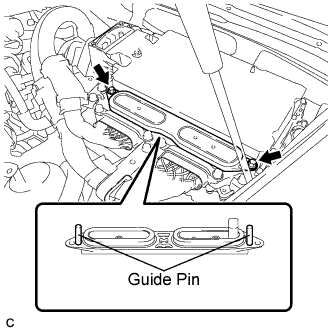
Set the inverter terminal cover to the inverter with converter assembly.
Note
-
Check that the sealing rubber is securely installed to the inverter terminal cover before installing the cover.
-
Making sure that there are no foreign objects on the waterproofed parts before installing the inverter terminal cover.
-
Install the inverter terminal cover while inserting the guide pins on both sides of the cover into guide pin holes of the inverter case.
-
When removing the inverter terminal cover, do not bend the connector terminals around the interlock part.
-
-
Push in both ends of the inverter terminal cover horizontally by hand.
Note
-
Insert the inverter terminal cover horizontally to prevent it from tilting. Failure to do so may damage the inverter terminal cover guide pins.
-
Make sure that both the inverter terminal cover bolt holes are aligned and in contact with the holes in the inverter case.
-
-
Using an insulated tool, secure the inverter terminal cover to the inverter with converter assembly with the 2 bolts.
- Torque:
- 8.0 N*m { 82 kgf*cm, 71 in.*lbf }
-
-
CONNECT NO. 3 FUEL HOSE
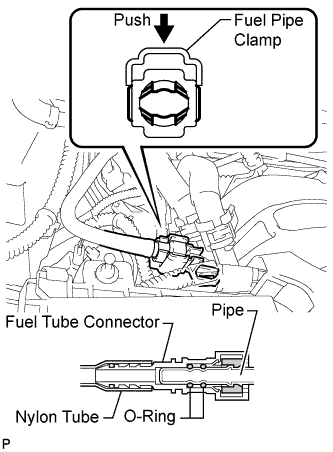
-
Push in the tube connector to the pipe until the tube connector makes a "click" sound.
-
Install the fuel pipe clamp.
Note
-
Check that there is no damage or foreign objects on the connected part of the fuel pipe.
-
After connecting, check that the fuel tube connector and the pipe are securely connected by pulling on them.
-
-
-
CONNECT NO. 1 FUEL HOSE
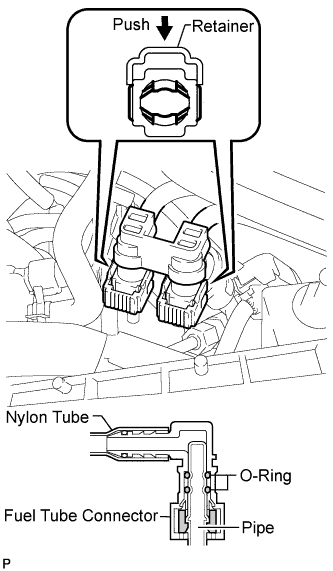
-
Push in the tube connector to the pipe until the tube connector makes a "click" sound.
-
Push down on the retainer to lock it in place.
Note
-
Check that there is no damage or foreign objects on the connected part of the fuel pipe.
-
After connecting, check that the fuel tube connector and the pipe are securely connected by pulling on them.
-
-
-
INSTALL ENGINE OIL PRESSURE SWITCH ASSEMBLY
-
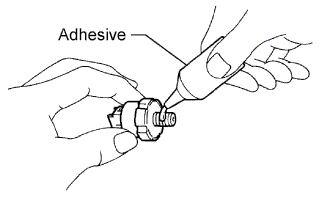
Apply adhesive to 2 or 3 threads of the switch.
Adhesive Toyota Genuine Adhesive 1344, Three Bond 1344 or equivalent -
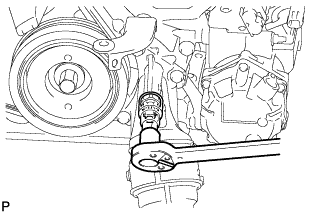
Using a 24 mm deep socket wrench, install the switch.
- Torque:
- 15 N*m { 153 kgf*cm, 11 ft.*lbf }
Note
Do not start the engine within 1 hour after installation.
-
Connect the switch connector.
-
-
INSTALL RESONATOR BRACKET SUB-ASSEMBLY
-
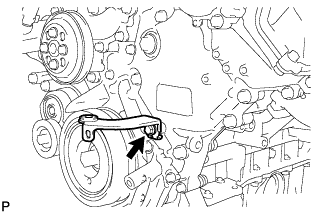
Install the resonator bracket sub-assembly with the bolt.
- Torque:
- 20 N*m { 204 kgf*cm, 15 ft.*lbf }
-
-
INSTALL NO. 2 RADIATOR HOSE
-
INSTALL NO. 1 RADIATOR HOSE
-
INSTALL OUTLET ENGINE ROOM ECM DUCT
-
Install the outlet engine room ECM duct.
-
-
INSTALL RADIATOR RESERVOIR ASSEMBLY
-
Install the radiator reservoir assembly with the 2 bolts.
- Torque:
- 5.0 N*m { 51 kgf*cm, 44 in.*lbf }
-
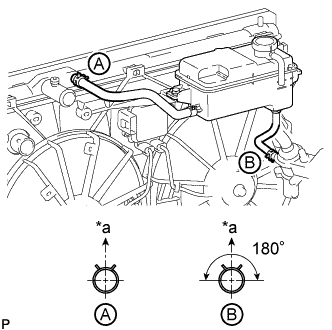
Text in Illustration *a Upper Connect the 2 reservoir hoses.
Tech Tips
The direction of each hose clamp is indicated in the illustration.
-
-
INSTALL AIR CLEANER ASSEMBLY RH
-
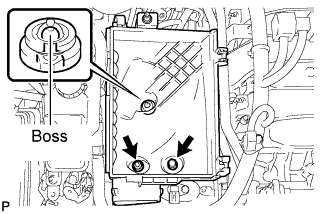
Align the air cleaner cases 2 holes to the 2 stud bolts and attach the air cleaner case RH to the boss. Then install the 2 nuts.
- Torque:
- 5.0 N*m { 51 kgf*cm, 44 in.*lbf }
-
Install the air cleaner filter element to the air cleaner case RH.
-
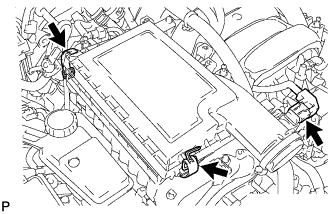
Install the air cleaner cap RH and secure the 2 clamps.
-
Connect the mass air flow meter connector.
-
-
INSTALL AIR CLEANER ASSEMBLY LH
-
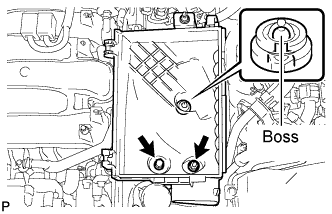
Align the air cleaner cases 2 holes to the 2 stud bolts and attach the air cleaner case LH to the boss. Then install the 2 nuts.
- Torque:
- 5.0 N*m { 51 kgf*cm, 44 in.*lbf }
-
Install the air cleaner filter element to the air cleaner case LH.
-
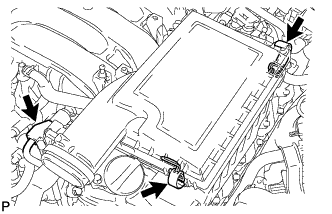
Install the air cleaner cap LH and secure the 2 clamps.
-
Connect the mass air flow meter connector.
-
-
INSTALL INTAKE AIR CONNECTOR PIPE
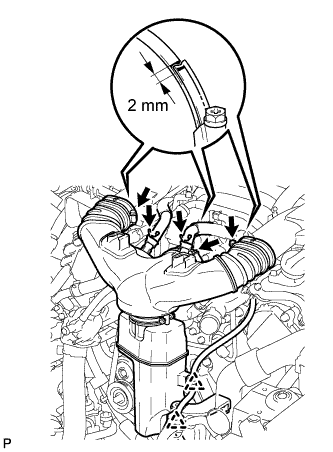
-
Align the protrusion of the intake air resonator with the cutout of the bracket and insert the protrusion.
-
Install the intake air connector pipe with the 3 hose clamps.
- Torque:
- for intake air connector pipe and throttle body
- 4.8 N*m { 49 kgf*cm, 42 in.*lbf }
- for intake air connector pipe and intake air resonator
- 3.8 N*m { 39 kgf*cm, 34 in.*lbf }
Note
Insert the protrusion of the intake air connector pipe into the hole of the hose clamp.
Tech Tips
-
The intake air connector pipe and throttle body clamp can be tightened within the range of 4.0 N*m (41 kgf*cm, 35 in.*lbf) to 5.5 N*m (56 kgf*cm, 49 in.*lbf), and the intake air connector pipe and intake air resonator clamp can be tightened within the range of 2.0 N*m (20 kgf*cm, 18 in.*lbf) to 5.5 N*m (56 kgf*cm, 49 in.*lbf).
-
When tightening the hose clamp, make sure the hose clamp's end is within the painted white line (width: 2 mm (0.0787 in.)).
-
Attach the 2 wire harness clamps.
-
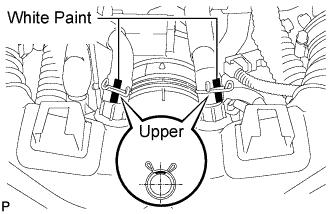
Connect the No. 1 ventilation hose and No. 2 ventilation hose to the intake air connector pipe.
Tech Tips
-
Position the claws of the clamps as shown in the illustration.
-
Install the clamps so that they are within the hose's paint marks.
-
-
-
INSTALL REAR FRAME SIDE RAIL
-
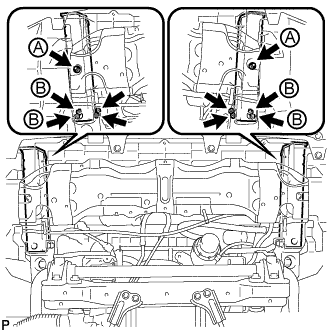
Install the 2 rear frame side rails with the 6 bolts and 4 nuts.
- Torque:
- for bolt A
- 30 N*m { 306 kgf*cm, 22 ft.*lbf }
- for nut B
- 44 N*m { 453 kgf*cm, 33 ft.*lbf }
-
-
CONNECT FRONT ACTIVE STABILIZER CONTROL ACTUATOR CONNECTOR (w/ Active Stabilizer System)
-
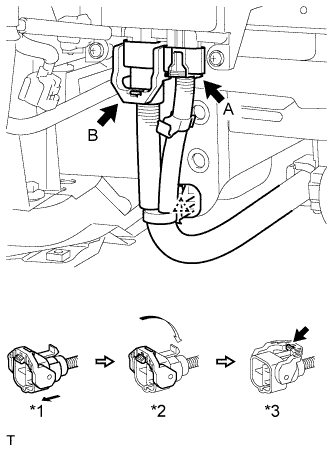
Connect the actuator connector labeled A.
-
Connect the actuator connector labeled B.
-
Connect the actuator connector. (*1)
-
Rotate the lever in the direction of the arrow until a "click" sound is heard. (*2)
-
Lock the lever's lock. (*3)
-
-
Connect the wire harness clamp.
-
-
INSTALL INLET ENGINE ROOM ECM DUCT (w/ Active Stabilizer System)
-
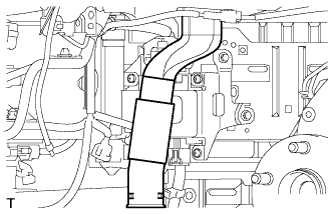
Install the duct.
-
-
INSTALL NO. 3 COOL AIR INTAKE DUCT SUB-ASSEMBLY (w/ Active Stabilizer System)
-
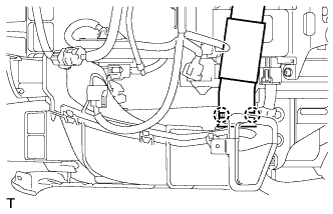
Attach the 2 claws.
-
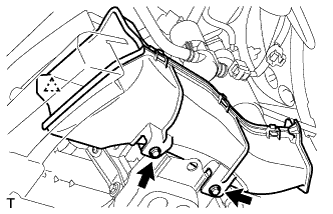
Attach the clamp.
-
Install the duct with the 2 bolts.
- Torque:
- 5.4 N*m { 55 kgf*cm, 48 in.*lbf }
-
-
CONNECT FRONT FENDER LINER LH (w/ Active Stabilizer System)
-
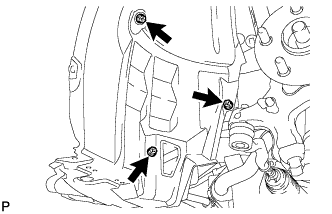
Install the liner with the 3 screws.
-
-
INSTALL FRONT BUMPER COVER
-
CONNECT OUTLET OIL COOLER HOSE
-
Connect the No. 2 oil cooler outlet hose to the radiator assembly.
-
-
CONNECT INLET OIL COOLER HOSE
-
Connect the No. 2 oil cooler inlet hose to the radiator assembly.
-
-
ADD FRONT DIFFERENTIAL OIL
-
for Front Differential:
-
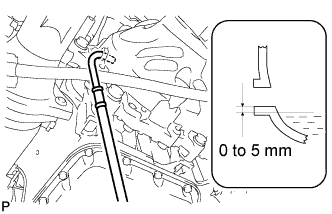
Add differential oil so that the oil level is between 0 to 5 mm (0 to 0.197 in.) from the bottom lip of the differential filler plug hole.
Note
-
Too much or too little oil will lead to differential problems.
-
After changing the oil, drive the vehicle and then check the oil level again.
Oil type Toyota Genuine Differential Gear Oil LT 75W-85 GL-5 or equivalent. Capacity 0.7 to 0.8 liters (0.74 to 0.84 US qts., 0.62 to 0.70 Imp. qts.) -
-
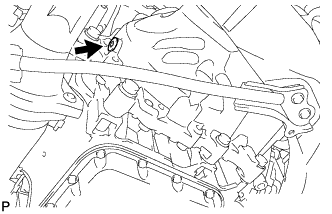
Using a 10 mm hexagon wrench, install a new gasket and the filler plug.
- Torque:
- 39 N*m { 398 kgf*cm, 29 ft.*lbf }
-
-
for Rear Differential:
-
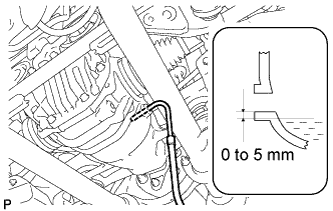
Add differential oil so that the oil level is between 0 to 5 mm (0 to 0.196 in.) from the bottom lip of the differential filler plug hole.
Note
-
Too much or too little oil will lead to differential problems.
-
After changing the oil, drive the vehicle and then check the oil level again.
Oil type Toyota Genuine Differential Gear Oil LX 75W-85 GL-5 or equivalent Capacity 1.3 to 1.4 liters (1.38 to 1.47 US qts., 1.15 to 1.23 Imp. qts.) -
-
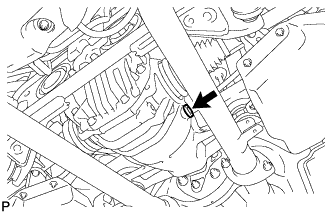
Using a 10 mm hexagon wrench, install a new gasket and the filler plug.
- Torque:
- 49 N*m { 500 kgf*cm, 36 ft.*lbf }
-
-
-
ADD ENGINE COOLANT
CAUTION:
Do not remove the radiator reservoir cap while the engine and radiator are still hot. Pressurized, hot coolant and steam may be released and cause serious burns.
Tech Tips
Before adding coolant, turn the A/C switch off.
Total capacity 11.1 liters (11.7 US qts, 9.8 Imp. qts)
-
Tighten the radiator drain cock plug.
-
Tighten the 2 cylinder block drain cock plugs.
- Torque:
- 13 N*m { 133 kgf*cm, 10 ft.*lbf }
-
Add TOYOTA Super Long Life Coolant (SLLC) into the radiator reservoir.
Capacity 5.0 liters (5.3 US qts, 4.4 Imp. qts) Tech Tips
TOYOTA vehicles are filled with TOYOTA SLLC at the factory. In order to avoid damage to the engine cooling system and other technical problems, only use TOYOTA SLLC or similar high quality ethylene glycol based non-silicate, non-amine, non-nitrite, non-borate coolant with long-life hybrid organic acid technology (coolant with long-life hybrid organic acid technology consists of a combination of low phosphates and organic acids).
-
Further add coolant into the reservoir until it reaches the FULL line.
-
Press the No. 1 and No. 2 radiator hoses several times by hand, and then check the coolant level.
If the coolant level is low, add coolant.
-
Using a 6 mm hexagon wrench, install the vent plug.
- Torque:
- 1.5 N*m { 15 kgf*cm, 13 in.*lbf }
-
Bleed air from the cooling system.
Tech Tips
Before starting the engine to warm up the engine, turn the A/C switch off.
-
Put the engine in inspection mode Click here.
-
While idling the engine for approximately 10 minutes, make sure the coolant remains at the FULL line by adding coolant as necessary.
-
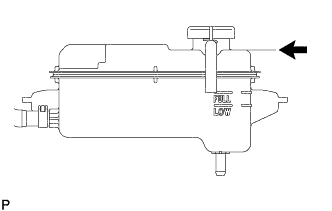
After idling the engine for 10 minutes, add coolant until it reaches the B line.
Capacity 2.5 to 3.5 liters (2.6 to 3.7 US qts, 2.2 to 3.1 Imp. qts) Text in Illustration 
B Line Tech Tips
The B line is the lower edge of the inner wall of the filler neck.
-
Close the radiator reservoir cap, and run the engine at 1500 to 2000 rpm for 5 minutes.
CAUTION:
-
Wear protective gloves.
-
Be careful as the radiator hose is hot.
-
Keep your hands away from the radiator fan.
Tech Tips
The thermostat open timing can be confirmed by pressing the No. 1 radiator hose by hand, and checking when the SLLC starts to flow inside the hose.
-
-
-
Stop the engine and wait until the coolant cools down to ambient temperature.
-
Check the coolant level.
If the coolant level is below the FULL line, add coolant until it reaches the FULL line.
-
-
ADD ENGINE OIL
-
Add fresh oil and install the oil filler cap.
Standard engine oil Oil grade Oil Viscosity (SAE) API grade SL "energy-conserving", SM "energy-conserving", SN "resource-conserving" or ILSAC multigrade engine oil 0W-20
5W-20
5W-30
10W-30
API grade SL, SM or SN multigrade engine oil 15W-40
20W-50
Standard capacity Item Specified Condition Drain and refill without oil filter change 8.4 liters (8.9 US qts, 7.4 Imp. qts) Drain and refill with oil filter change 9.0 liters (9.5 US qts, 7.9 Imp. qts) Dry fill 9.8 liters (10.4 US qts, 8.6 Imp. qts) -
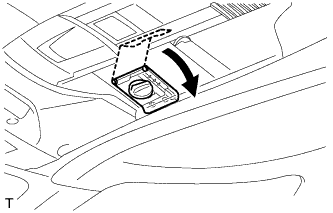
Close the oil filler cap service hole cover.
-
-
INSTALL SERVICE PLUG GRIP
-
CONNECT CABLE TO AUXILIARY BATTERY NEGATIVE TERMINAL
Note
When disconnecting the cable, some systems need to be initialized after the cable is reconnected Click here.
-
ADD COOLANT (for Inverter)
Note
-
Do not reuse the drained coolant because it may contain foreign objects.
-
If the vehicle is driven with air in the inverter cooling system, the following DTCs may be set.
DTC Code Detection Item P0A01-725 Motor Electronics Coolant Temperature Sensor Circuit Range / Performance P0A01-726 Motor Electronics Coolant Temperature Sensor Circuit Range / Performance P0A78-284 Drive Motor "A" Inverter Performance P0A7A-322 Generator Inverter Performance P0A93-346 Inverter Cooling System Performance P0A94-553 DC / DC Converter Performance P0AEE-276 Motor Inverter Temperature Sensor "A" Circuit Range / Performance P0AEE-277 Motor Inverter Temperature Sensor "A" Circuit Range / Performance P3221-314 Generator Inverter Temperature Sensor Circuit Range / Performance P3221-315 Generator Inverter Temperature Sensor Circuit Range / Performance P3226-562 DC/DC Boost Converter Temperature Sensor P3226-563 DC/DC Boost Converter Temperature Sensor
Tech Tips
-
for LHD:
Coolant (for inverter) capacity: 2.6 liters (2.7 US qts, 2.3 Imp. qts.)
-
for RHD:
Coolant (for inverter) capacity: 2.5 liters (2.5 US qts, 2.2 Imp. qts.)
-
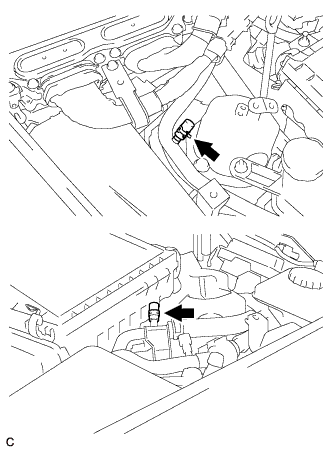
for LHD:
Remove the 2 clips and 2 plugs from the tubes.
Note
Do not reuse the clips or plugs.
-
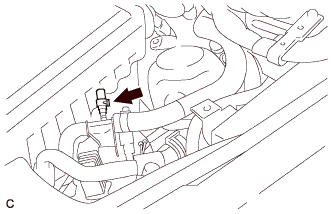
for RHD:
Remove the clip and plug from the tube.
Note
Do not reuse the clip or plug.
-
Add coolant to the reserve tank.
-
for LHD:
Install 2 new plugs and 2 new clips to the tubes.
-
for RHD:
Install a new plug and new clip to the tube.
-
Connect the intelligent tester to the DLC3.
-
Select the following menu items: Powertrain / Hybrid Control / Active Test / Activate the Water Pump.
Tech Tips
The water pump can also be operated using inspection mode Click here.
-
While adding coolant so that the coolant level is kept around the FULL line of the inverter reserve tank, operate the water pump for 3 minutes or more and then stop it for 1 minute or more.
-
While adding coolant so that the coolant level is kept around the FULL line of the inverter reserve tank, operate the water pump for 1 minute or more and stop it for 1 minute or more. Repeat this procedure until bleeding is completed.
Standard When the operation sound of the water pump becomes small or when no air bubbles can be seen in the inverter reserve tank, bleeding of the coolant system is complete. Tech Tips
-
If the water pump operates without a sufficient amount of coolant for approximately 5 seconds, the protective circuit will activate to stop the water pump for approximately 15 seconds. If a sufficient amount of coolant is added, the water pump will start operating automatically.
-
If an excessive amount of coolant is added to the inverter reserve tank, coolant may overflow when operation of the water pump is stopped.
-
-
After bleeding is completed, add coolant to the FULL level, and install the inverter reserve tank cap.
Note
Make sure to add more coolant than was drained initially.
-
-
INSPECT FOR COOLANT LEAK (for Inverter)
-
Remove the reserve tank cap.
CAUTION:
To avoid the danger of being burned, do not remove the reserve tank cap while the coolant for the inverter is still hot.
-
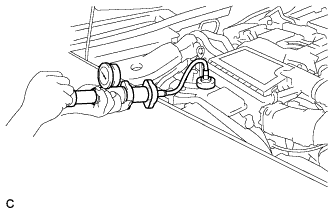
Install the radiator cap tester.
-
Pump the radiator cap tester to 37 kPa (0.38 kgf/ cm2, 5.4 psi), and then check that the pressure does not drop.
Tech Tips
If the pressure drops, check the hoses, radiator, water pump, inverter with converter, and hybrid vehicle transaxle assembly for leakage.
-
Reinstall the reserve tank cap.
-
-
CHARGE REFRIGERANT
-
Perform vacuum purging using a vacuum pump or appropriate equipment.
-
Charge the air conditioning system with refrigerant.
Refrigerant type HFC-134a (R134a) 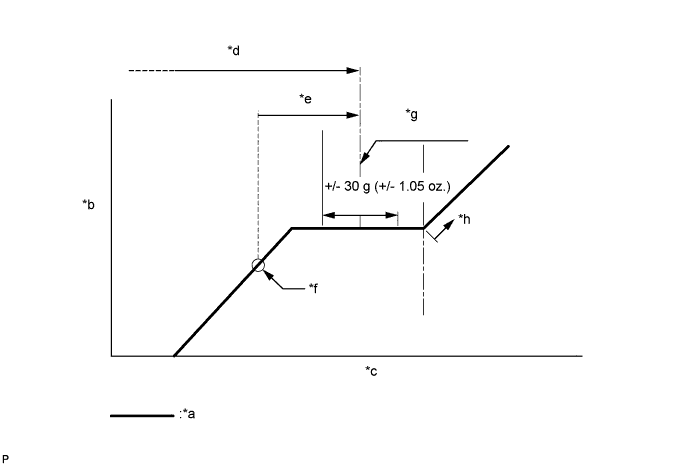
Text in Illustration *a Sub-cool System *b High Pressure *c Refrigerant Amount *d Standard charge amount *e Charge additional 100 g (3.5 oz.) *f Point where bubbles disappear *g Mean value in proper range *h Overcharged Standard charge amount 810 to 870 g (28.6 to 30.7 oz.) - SST
- 09985-20010 ( 09985-02010, 09985-02050, 09985-02060, 09985-02070, 09985-02080, 09985-02090, 09985-02110, 09985-02130, 09985-02140, 09985-02150 )
Note
-
Do not turn the A/C switch on before charging the air conditioning system with refrigerant. Doing so may cause the compressor to work without refrigerant, resulting in overheating of the compressor.
-
The refrigerant amount should be checked by quantity (weight).
Tech Tips
Make sure that sufficient refrigerant is available to recharge the system when using a refrigerant recovery unit. Refrigerant recovery units are not always able to recover 100% of the refrigerant from an air conditioning system.
-
-
CHECK TRANSMISSION FLUID LEVEL
CAUTION:
Do not touch any high temperature parts, such as the exhaust pipe.
-
for Vehicles used in Middle East and China:
-
Turn the power switch on (READY).
-
Move the shift lever to P, depress the accelerator pedal and start the engine.
Tech Tips
Depending on the amount of battery charge, the engine may already be running.
Note
Check State of Charge in the Data List. If the Battery State of Charge value is less than 50%, return to the Check SOC procedure and perform charging again.
-
Release the accelerator pedal, depress the brake pedal, and move the shift lever to N while the engine is running.
-
Check Engine Spd in the Data List. Check that the engine speed is 950 to 1050 rpm.
-
In order to be able to check the Data List, take the intelligent tester out of the vehicle while it is still connected and lift the vehicle up while keeping the vehicle level.
-
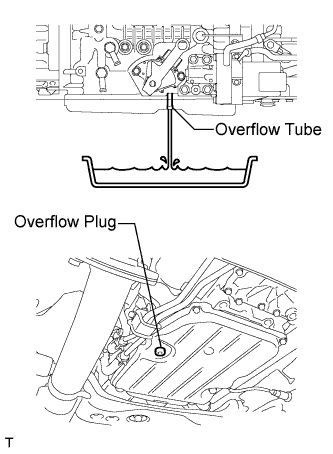
Remove the overflow plug and gasket.
-
When the fluid overflowing from the overflow tube slows to a trickle, check T/M Oil Temperature in the Data List. When the value reaches 50°C (122°F), install a new gasket and the overflow plug.
- Torque:
- 20 N*m { 204 kgf*cm, 15 ft.*lbf }
Note
If the Battery State of Charge value is 30% or less at this time, stop work, return to the Check SOC procedure and start the procedure again from the step in which the battery is charged.
-
-
except Vehicles used in Middle East and China:
-
When the indicator light (D) turns on, lift the vehicle up immediately.
The ATF temperature range is indicated by the indicator light (D) Below Normal Operating Temperature Normal Operating Temperature Above Normal Operating Temperature OFF ON Blinking Note
Perform the fluid level inspection while the indicator light is on.
-
Remove the overflow plug. At the normal operating temperature, check the fluid amount.
If the ATF flows from the overflow tube in a thin stream, the fluid amount is normal.
-
Install a new gasket and the overflow plug.
- Torque:
- 20 N*m { 204 kgf*cm, 15 ft.*lbf }
-
-
-
INSPECT FOR SHIFT LEVER POSITION
-
When moving the shift lever from the P position to the R position with the power switch on (IG) and the brake pedal depressed, make sure that it moves smoothly and correctly into position.
-
Turn the power switch on (READY) and make sure that the vehicle moves forward when the shift lever is moved from the N position to the D position and moves rearward when the shift lever is moved to the R position. If the operation cannot be performed as specified, inspect the shift lever position sensor and check the shift lever assembly installation condition.
-
-
INSPECT FOR OIL LEAK
-
Start the engine. Make sure that there are no oil leaks from the area that was worked on.
-
-
INSPECT FOR COOLANT LEAK
CAUTION:
Do not remove the radiator reservoir cap while the engine and radiator are still hot. Pressurized, hot engine coolant and steam may be released and cause serious burns.
Note
Before each inspection, turn the A/C switch OFF.
-
Fill the radiator with coolant and attach a radiator cap tester.
-
Warm up the engine.
-
Using the radiator cap tester, increase the pressure inside the radiator to 118 kPa (1.2 kgf/cm2, 17 psi), and check that the pressure does not drop.
If the pressure drops, check the hoses, radiator and engine water pump for leaks. If no external leaks are found, check the heater core, cylinder block and head.
-
-
INSPECT FOR FUEL LEAK
-
Connect the intelligent tester to the DLC3.
-
Turn the power switch on (IG).
Note
Do not start the engine.
-
Turn the intelligent tester on.
-
Select the following menus: Powertrain / Engine and ECT / Active Test / Control the Fuel Pump / Speed.
-
Check the fuel pump operation.
-
Check for pressure in the fuel inlet tube from the fuel line. Check that the sound of fuel flowing in the fuel tank can be heard.
If no sound can be heard, check the integration relay, fuel pump, ECM and wiring connector.
-
-
Check for fuel leaks.
-
Check that there are no fuel leaks anywhere on the system after performing maintenance.
If there is a fuel leak, repair or replace parts as necessary.
-
-
-
INSPECT FOR REFRIGERANT LEAK
-
After recharging the air conditioning system with refrigerant, check for refrigerant leaks using a halogen leak detector.
-
Carry out the test under the following conditions:
-
Power switch off.
-
Secure good ventilation (the halogen leak detector may react to volatile gases which are not refrigerant, such as gasoline vapor and exhaust gas).
-
Repeat the inspection 2 or 3 times.
-
Measure the pressure to make sure that there is some refrigerant remaining in the air conditioning system (pressure when the compressor is off: approx. 392 to 588 kPa (3.9 to 5.9 kgf/cm2, 57 to 85 psi)).
-
-
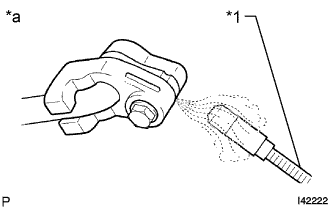
Text in Illustration *1 Halogen Leak Detector *a Check for Leak Using a halogen leak detector, check for refrigerant leaks from the air conditioning system.
-
If a refrigerant leak is not detected from the drain hose, remove the blower motor control from the cooling unit. Insert the halogen leak detector sensor into the unit and check for a leak.
-
Disconnect the pressure sensor connector and leave it for approximately 20 minutes. Bring the halogen leak detector close to the pressure sensor and check for a leak.
Tech Tips
When checking for leaks, the presence of oily dirt at a joint can indicate a leak.
-
-
INSPECT FOR EXHAUST GAS LEAK
-
If gas is leaking, tighten the areas necessary to stop the leak. Replace the damaged parts as necessary.
-
-
INSPECT IGNITION TIMING
-
Put the engine in inspection mode Click here.
-
Warm up the engine.
Tech Tips
A warmed up engine should have an engine coolant temperature of over 80°C (176°F) and an engine oil temperature of 60°C (140°F), and the engine rpm should be stabilized.
-
When using the intelligent tester:
-
Start the engine and idle it.
-
Enter the following menus: Powertrain / Engine and ECT / Data List / Primary / IGN Advance.
Tech Tips
Refer to the intelligent tester operator's manual for further details.
Standard ignition timing 5 to 15° BTDC @ idle (Transmission neutral position and A/C switch OFF)
-
-
When not using the intelligent tester:
-
Remove the V-bank cover.
-
Remove the 5 clips and air cleaner inlet cover.
-
Remove the engine room side cover LH Click here.
-
Remove the 2 bolts and No. 1 air cleaner inlet.
-
Disconnect the air cleaner cap sub-assembly LH.
-
Remove the air cleaner filter element, 2 nuts and air cleaner case LH.
-
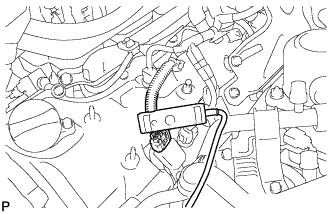
Connect the tester probe of a timing light to the wire of the ignition coil connector for the No. 1 cylinder.
Note
Use a timing light that detects primary signals.
-
Put the engine in inspection mode Click here.
-
Start the engine and idle it.
-
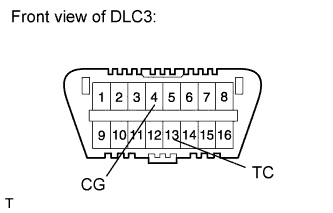
Using SST, connect terminals 13 (TC) and 4 (CG) of the DLC3.
- SST
- 09843-18040
Note
-
Confirm the terminal numbers before connecting the probes. Connecting the probe to the wrong terminal can damage the engine.
-
When checking the ignition timing, the transmission should be in neutral.
-
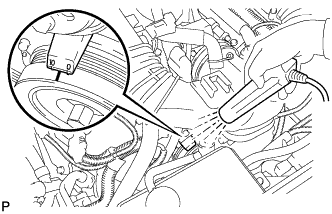
Using a timing light, check the ignition timing.
Standard ignition timing 8 to 12° BTDC @ idle (Transmission neutral position and A/C switch OFF) -
Remove SST from the DLC3.
-
Check the ignition timing.
Standard ignition timing 5 to 15° BTDC @ idle (Transmission neutral position and A/C switch OFF) -
Check that the ignition timing advances immediately when the engine speed is increased.
-
Disconnect the timing light from the engine.
-
Install the air cleaner case LH with the 2 nuts.
- Torque:
- 5.0 N*m { 51 kgf*cm, 44 in.*lbf }
-
Install the air cleaner filter element.
-
Connect the air cleaner cap sub-assembly LH.
-
Install the No. 1 air cleaner inlet with the 2 bolts.
- Torque:
- 5.0 N*m { 51 kgf*cm, 44 in.*lbf }
-
Install the engine room side cover LH Click here.
-
Install the air cleaner inlet cover with the 5 clips.
-
Install the V-bank cover.
-
-
-
INSPECT ENGINE IDLE SPEED
-
Put the engine in inspection mode Click here.
-
Warm up the engine.
Tech Tips
A warmed up engine should have an engine coolant temperature of over 80°C (176°F) and an engine oil temperature of 60°C (140°F), and the engine rpm should be stabilized.
-
When using the intelligent tester:
Note
Switch off all accessories and the A/C before connecting the intelligent tester.
-
Race the engine at 2500 rpm for approximately 90 seconds.
-
Enter the following menus: Powertrain / Engine and ECT / Data List / Primary / Engine Speed.
Tester Display Measurement Item/ Range Normal Condition Diagnostic Note Engine Speed Engine speed:
Min.: 0 rpm, Max.: 16383.75 rpm
800 to 900 rpm: Idling Shift lever on P 950 to 1050 rpm: Idling Shift lever on N Tech Tips
Refer to the intelligent tester operator's manual for further details.
If the idle speed is not as specified, check the air intake system.
-
Disconnect the intelligent tester from the DLC3.
-
-
When not using the intelligent tester:
Note
Switch off all accessories and the A/C before connecting the intelligent tester.
-
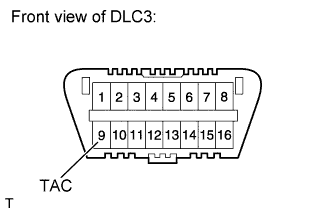
Using SST, connect a tachometer probe to terminal 9 (TAC) of the DLC3.
- SST
- 09843-18030
Note
Confirm the terminal number before connecting the probe. Connecting the probe to the wrong terminal can damage the engine.
-
Race the engine at 2500 rpm for approximately 90 seconds.
-
Check the idle speed.
Standard Idle Speed Condition Specified Condition Shift lever on P 800 to 900 rpm Shift lever on N 950 to 1050 rpm If the speed is not as specified, check the air intake system.
-
Disconnect the tachometer from the DLC3.
-
-
-
INSPECT CO/HC
Tech Tips
This check determines whether or not the idle CO/HC complies with regulations.
-
Put the engine in inspection mode Click here.
-
Warm up the engine.
Tech Tips
A warmed up engine should have an engine coolant temperature of over 80°C (176°F) and an engine oil temperature of 60°C (140°F), and the engine rpm should be stabilized.
-
Keep the engine speed at 2500 rpm for approximately 180 seconds.
-
Insert the CO/HC meter testing probe at least 40 cm (1.31 ft.) into the tailpipe during idling.
-
Immediately check CO/HC concentration at idle and 2500 rpm.
Tech Tips
-
When performing the 2 mode (2500 rpm and idle) test, follow the measurement order prescribed by the applicable local regulations.
-
If the CO/HC concentration does not comply with regulations, troubleshoot in the order given below.
-
Check the air fuel ratio sensor Click here and heated oxygen sensor Click here operation.
-
See the table below for possible causes, then inspect and correct the applicable causes if necessary.
CO HC Symptom Causes Normal High Rough idle
-
1. Faulty ignitions
-
Incorrect timing
-
Plugs (contaminated, shorted, or gaps are defective)
-
2. Leaky intake and exhaust valves
-
3. Leaky cylinder
Low High Rough idle
(Fluctuating HC reading)
-
1. Vacuum leaks
-
PCV hose
-
Intake manifold
-
Throttle body
-
2. Lean mixture causing misfire
High High Rough idle
(Black smoke from exhaust)
-
1. Restricted air filter
-
2. Faulty SFI system
-
Faulty pressure
-
Defective engine coolant temperature sensor
-
Faulty ECM
-
Faulty injector
-
Faulty throttle position sensor
-
Faulty mass air flow meter
-
-
-
-
PLACE FRONT WHEELS FACING STRAIGHT AHEAD
-
CHECK AND ADJUST FRONT WHEEL ALIGNMENT
-
MEASURE VEHICLE HEIGHT
-
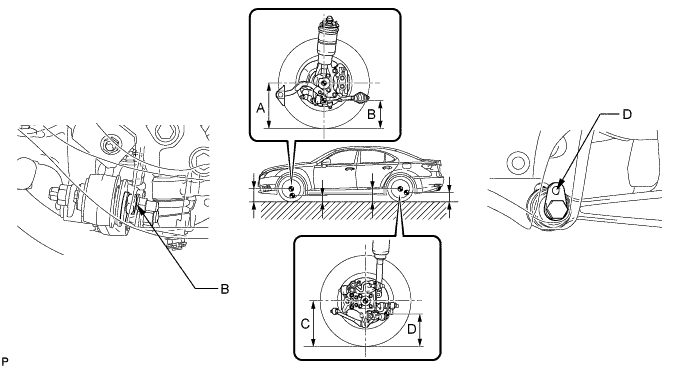
Bounce the vehicle at the corners up and down to stabilize the suspension and inspect the vehicle height.
Standard vehicle height (unloaded) Item Front (A - B) Rear (C - D) except Sports Package 146 mm (5.75 in.) 83 mm (3.27 in.) Sports Package 156 mm (6.14 in.) 93 mm (3.66 in.) Measuring points A Ground clearance of front wheel center B Ground clearance of head center of bolt used to install the front No. 1 suspension lower arm to the front suspension member C Ground clearance of rear wheel center D Ground clearance of pit center of the attachment rear suspension arm Note
-
Before inspecting the wheel alignment, adjust the vehicle height to the specified value.
-
The standard value shown here is a value that is used for adjusting the wheel alignment and does not indicate the height of an actual vehicle.
If the vehicle height is not as specified, adjust the height by pressing down on the vehicle several times to stabilize the suspension.
-
-
-
ADJUST OBJECT RECOGNITION CAMERA
Note
-
Make sure there are no black and white patterned objects in front of the vehicle.
-
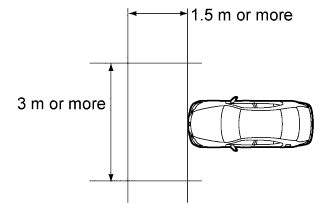
Perform the measurement in a place with no wind, and make sure there is a distance of 1.5 m (4.92 ft.) or more in front of the vehicle and that the surface is level with no obstacles.
-
Make sure that there is no wind when performing the measurement.
-
Check that there are no reflective materials in the surroundings or on the ground within a 3 m (9.84 ft.) or more x 3 m (9.84 ft.) or more area in front of the vehicle.
-
Perform the inspection in a bright area.
-
Beam axis learning preparation
-
Move the vehicle to a level surface.
-
Make sure the engine oil in the vehicle is at the specified amount.
-
Make sure the engine coolant in the vehicle is at the specified amount.
-
Make sure the fuel tank is full.
-
Make sure the spare tire is in the vehicle. (w/ Spare Tire)
-
Make sure the standard tools are in the vehicle.
-
Make sure nobody is in the vehicle.
-
Make sure no extra loads are in the vehicle.
-
Adjust the tire pressures to the specified pressure.
-
Clean the front glass.
-
If the lens of the object recognition camera sensor is dirty, apply a small amount of lens cleaner to a clean, soft cloth and clean the lens.
-
-
Perform height control sensor adjustment
-
Perform the height control sensor adjustment Click here.
Note
Perform this procedure as accurately as possible.
-
-
Perform the front wheel alignment adjustment
-
Perform the front wheel alignment adjustment Click here.
Note
Perform this procedure as accurately as possible.
-
-
Perform the rear wheel alignment adjustment
-
Perform the rear wheel alignment adjustment Click here.
Note
-
Perform this procedure as accurately as possible.
-
Press the height control switch and change the vehicle height to HIGH and return it to NORM. Then repeat.
-
-
-
Target sheet creation
-
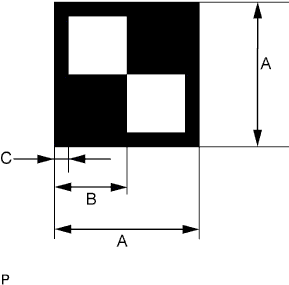
Print or copy the illustration below. Check that the dimensions are +/-5 mm (0.197 in.) of the ones in the table below.
Dimension Area Specification A 160 mm (6.30 in.) B 80 mm (3.15 in.) C 16 mm (0.630 in.) Note
-
Make sure that the black areas of the target sheets are not glossy.
-
Make sure that the borders of the black and white areas on the target sheets are straight, and are not warped or blurry.
If the print or copy's dimensions are not as specified, adjust settings and reprint or recopy so that the print or copy's dimensions are as specified.

-
-
-
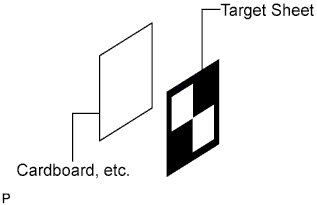
Target sheet attachment
-
Place the prepared target sheet on a piece of cardboard of the same size with the black area on the top right, as shown in the illustration. Then use double-sided tape to fix the target sheet in place.
Note
Do not attach reflective tape, such as scotch tape, etc. to the target face as this may affect target recognition.
-
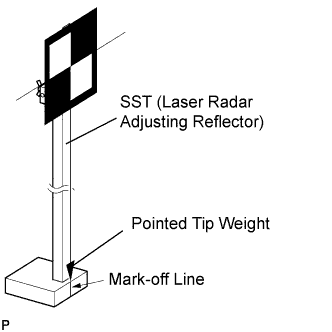
Hang a weight with a pointed tip from the center of the target sheet. Then, with double-sided tape, attach the target sheet to the reflector so that the weight aligns with the mark-off line of SST (laser radar adjusting reflector).
- SST
- 09870-60000 ( 09870-60010, 09870-60020 )
Note
-
Perform this procedure as accurately as possible.
-
Attach the target sheet so that it is horizontal with the ground.
-
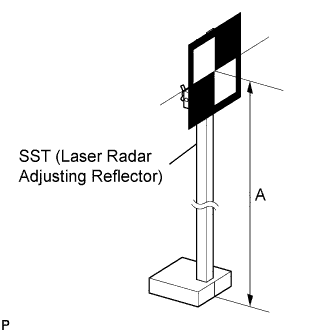
Move the reflector up and down to position the center of the target at the height shown in the illustration, and fix it in place.
Dimension A 1270 mm (4.17ft.) - SST
- 09870-60000 ( 09870-60010, 09870-60020 )
Note
Perform this procedure as accurately as possible.
-
-
Target placement point measurement
Note
-
Perform this procedure as accurately as possible.
-
Do not place reflective materials in the area behind the target.
-
Make sure there are no patterns on the wall behind the target.
-
Make sure the distance between the target and wall is within 3 m (9.84 ft.).
-
Do not place black and white patterned objects near the target.
-
Make sure the target's shadow is not on the wall, as the camera may have a recognition error.
-
From the center of the front bumper (center of the emblem), hang a weight with a pointed tip, and mark point B on the ground.
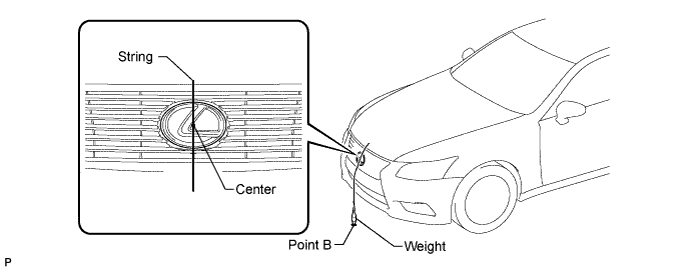
-
From the center of the rear bumper (center of the emblem), hang a weight with a pointed tip, and mark point A on the ground.
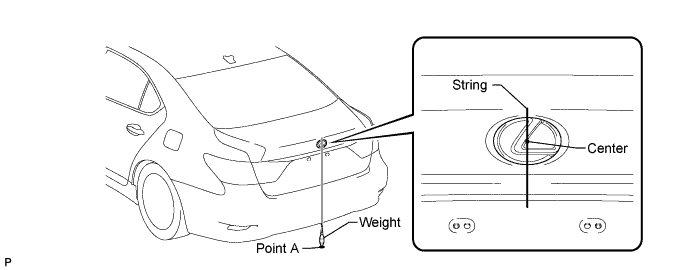
-
Using a piece of string that uses point A as a starting point and that passes through point B, make a straight line on the ground ahead of the vehicle 2 m (6.56 ft.) or more from point B.
Tech Tips
-
Make sure to secure the string (using tape, etc.) when it is taut.
-
Lightly flick the string with your fingers several times to confirm that the string is aligned above point B.
-
-
Mark point C at a position 340 mm (1.12 ft.) from point B.
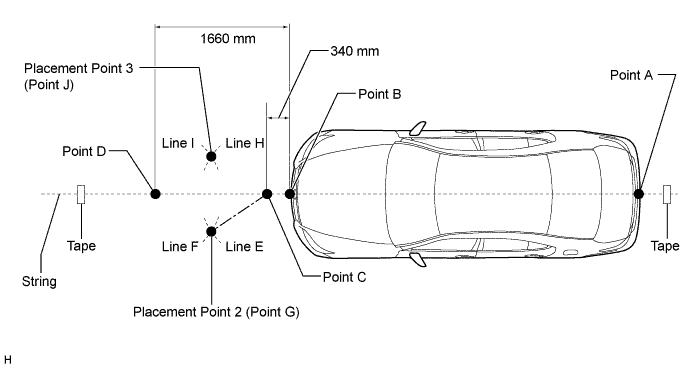
-
Mark point D at a position 1660 mm (5.44 ft.) from point B.
-
Using the string, mark line E at a position 1000 mm (3.28 ft.) from point C.
-
Using the string, mark line H at a position 1000 mm (3.28 ft.) from point C.
-
Using the string, mark line F at a position 1000 mm (3.28 ft.) from point D.
-
Using the string, mark line I at a position 1000 mm (3.28 ft.) from point D.
-
Mark point G at the point where line E and line F intersect (placement point 2).
-
Mark point J at the point where line H and line I intersect (placement point 3).
-
Secure a string that connects point G and point J to the ground (target placement line).
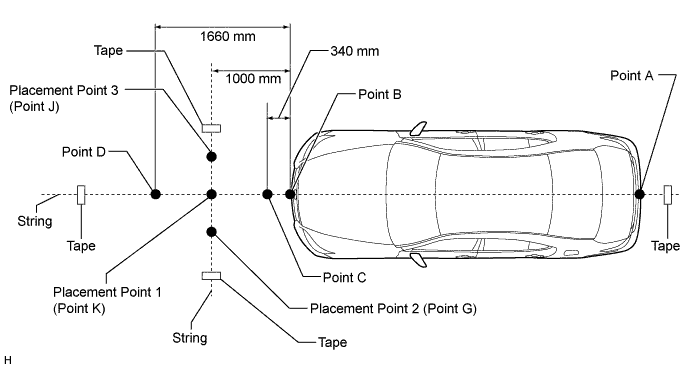
-
Mark point K at the intersection between the string connecting points C and D and the string connecting points G and J (placement point 1).
-
Confirm the distance measurements for points K, G, and J (placement points 1, 2, and 3) again.
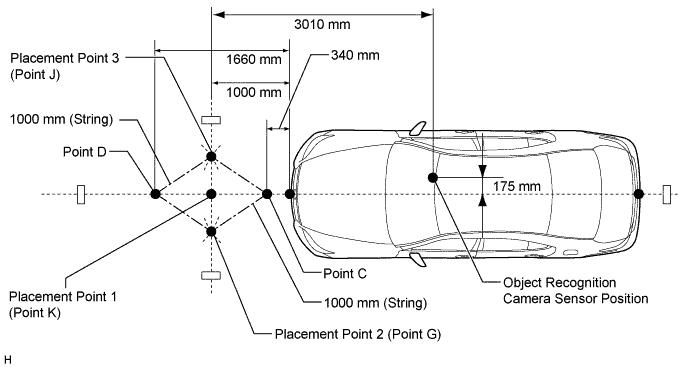
-
-
Object recognition camera sensor height measurement
Note
-
Do not place black and white patterned objects near the target.
-
Face the vehicle toward a wall with no patterns, or make sure the background behind the target has no patterns.
-
Perform this procedure as accurately as possible.
-
Do not place reflective materials in the area behind the target.
-
Make sure there are no patterns on the wall behind the target.
-
Make sure the distance between the target and wall is within 3 m (9.84 ft.).
-
Make sure the target's shadow is not on the wall, as the camera may have a recognition error.
-
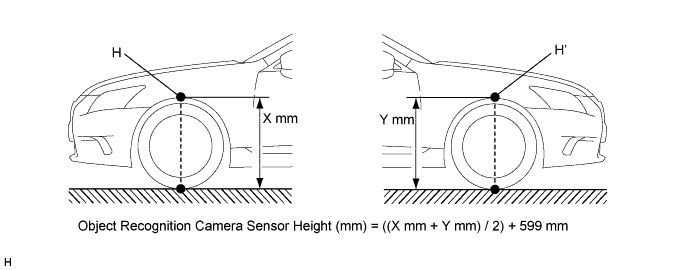
Measure the distance (X mm or in.) from the ground to point H for the front left wheel arch.
-
Measure the distance (Y mm or in.) from the ground to point H for the front right wheel arch.
-
The average of the 2 distances (X mm or in. Y mm or in.) plus 599 mm (23.6 in.) is the height of the object recognition camera sensor.
-
-
Memorize camera/target position
Note
-
Close all doors.
-
Perform the procedure with no one in the vehicle.
-
During the procedure, do not lean on the vehicle.
-
Illuminate the clearance lights.
-
Do not illuminate the headlights.
-
Connect the intelligent tester to the DLC3.
-
Turn the power switch ON (IG).*1
-
Turn the intelligent tester main switch ON.
-
Select "Auto" from the display screen and proceed to the next screen.
-
Select each option for the vehicle being adjusted from the display screen.
-
Select "Chassis" or "Body" from the display screen.
-
Select "Lane Keeping Assist" or "Pre-Crash 2" and then "Utility" from the display screen
-
Select "Camera/target position memory" from the display screen.
-
Follow the tester display, and select "Next".
-
Input the measured height of the object recognition camera sensor and the horizontal position of the camera "175 mm (6.89 in.)" into the input screen. Then press the "Next" button on the display screen.
-
Input "3010 mm (119 in.)" for the distance from the camera to the target and "1270 mm (50.0 in.)" for the height of the target into the input screen. Then press the "Next" button on the display screen.
Tech Tips
When the "Next" button is pressed, a 70 second countdown begins.
-
Press the "Exit" button to finish the camera/target position memory mode.
Note
If "Error Camera/target position memory" is displayed on the screen, press the "Try Again" button, and repeat the procedures from *1 again.
-
-
Beam axis learning
-
Select "Camera axis adjust" from the display screen.*1
-
Follow the tester display, and select "Next".
-
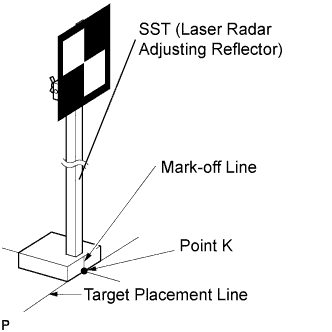
Align the target sheet with the target placement line, and align the mark-off line with placement point 1 (point K).
-
Check that the screen displays beam axis learning for target 1, then press the "Next" button on the display screen.
Tech Tips
When the "Next" button is pressed, the buzzer sounds for 1 second.
-
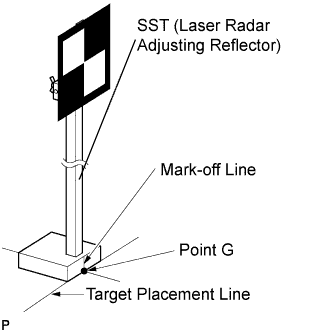
Align the target sheet with the target placement line, and align the mark-off line with placement point 2 (point G).
-
Check that the screen displays beam axis learning for target 2, then press the "Next" button on the display screen.
Tech Tips
When the "Next" button is pressed, a 180 second countdown begins.
Note
Within 3 minutes after the screen displays the beam axis learning for target 2, move the target and press the "Next" button on the display screen.
-
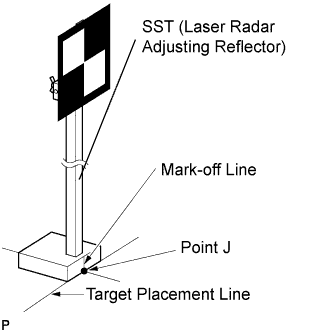
Align the target sheet with the target placement line, and align the mark-off line with placement point 3 (point J).
-
Check that the screen displays beam axis learning for target 3, then press the "Next" button on the display screen.
Tech Tips
When the "Next" button is pressed, a 180 second countdown begins.
Note
Within 3 minutes after the screen displays the beam axis learning for target 3, move the target and press the "Next" button on the display screen.
-
Press the "Exit" button to finish the beam axis learning mode.
Note
If "Error camera axis adjust" is displayed on the screen, press the "Exit" button. Then after checking the conditions below, turn the power switch ON (IG) and OFF, and repeat from procedure *1 again.
-
Height of the target.
-
Distance from object recognition camera sensor to target.
-
Orientation of target (black area positioned on top right).
-
If surrounding area is bright enough.
-
If black and white patterned objects are placed near the target.
-
-
-
-
INSTALL FRONT LOWER SUSPENSION MEMBER PROTECTOR
-

Install the front lower suspension member protector with the 9 bolts.
- Torque:
- for bolt A
- 20 N*m { 204 kgf*cm, 15 ft.*lbf }
- except bolt A
- 58 N*m { 593 kgf*cm, 43 ft.*lbf }
-
-
INSTALL NO. 1 ENGINE UNDER COVER
-
Install the No. 1 engine under cover with the 13 screws and 7 clips.
-
-
INSTALL FRONT WHEEL OPENING EXTENSION PAD LH
-
Install the front wheel opening extension pad LH with the 5 screws.
-
-
INSTALL FRONT WHEEL OPENING EXTENSION PAD RH
Tech Tips
Use the same procedure described for the LH side.
-
INSTALL NO. 2 ENGINE UNDER COVER
-
Install the No. 2 engine under cover with the 4 screws and 2 clips.
-
-
INSTALL FRONT CENTER FLOOR COVER (w/ Cover)
-
Install the front center floor cover with the 3 screws, 2 bolts and clip.
- Torque:
- 5.4 N*m { 55 kgf*cm, 48 in.*lbf }
-
-
INSTALL INVERTER COVER ASSEMBLY LH (for RHD)
-
Install the inverter cover assembly LH and attach the 2 clips.
-
-
INSTALL INVERTER COVER ASSEMBLY RH (for LHD)
-
Install the inverter cover assembly RH and attach the 2 clips.
-
-
INSTALL MOTOR CABLE COVER LH (for RHD)
-
Install the motor cable cover LH with the 2 clips.
-
-
INSTALL MOTOR CABLE COVER RH (for LHD)
-
Install the motor cable cover RH with the 2 clips.
-
-
INSTALL COWL TOP VENTILATOR LOUVER RH (for LHD)
-
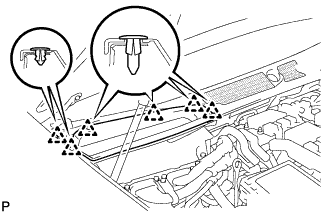
Install the cowl top ventilator louver RH with the 6 clips.
Note
Be sure to install the cowl top ventilator louver RH properly. If it is not installed properly, water may enter the engine room and cause malfunctions.
-
-
INSTALL COWL TOP VENTILATOR LOUVER LH (for RHD)
Tech Tips
Use the same procedures described for LHD vehicles.
-
INSTALL ENGINE ROOM SIDE COVER LH
-
Install the engine room side cover LH with the 5 clips.
-
-
INSTALL ENGINE ROOM SIDE COVER RH
-
Install the engine room side cover RH with the 5 clips.
-
-
CHECK ENGINE COOLANT LEVEL
-
Check that the engine coolant level is between the LOW and FULL lines when the engine is cold.
If the engine coolant is below the LOW line, check for leaks and add "TOYOTA Super Long Life Coolant" or similar high quality ethylene glycol based non-silicate, non-amine, non-nitrite and non-borate coolant with long-life hybrid organic acid technology to the FULL line.
Note
Do not substitute plain water for engine coolant.
Tech Tips
TOYOTA vehicles are filled with TOYOTA SLLC at the factory. In order to avoid damage to the engine cooling system and other technical problems, only use TOYOTA SLLC or similar high quality ethylene glycol based non-silicate, non-amine, non-nitrite, non-borate coolant with long-life hybrid organic acid technology (coolant with long-life hybrid organic acid technology consists of a combination of low phosphates and organic acids).
-
-
INSTALL NO. 1 AIR CLEANER INLET
-
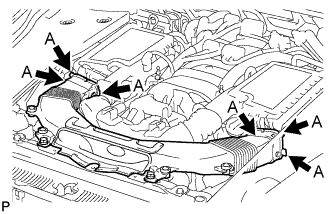
Align the holes with the connection areas labeled A, and attach the No. 1 air cleaner inlet.
-
Install the No. 1 air cleaner inlet with the 2 bolts.
- Torque:
- 5.0 N*m { 51 kgf*cm, 44 in.*lbf }
-
-
INSTALL AIR CLEANER INLET COVER SUB-ASSEMBLY
-
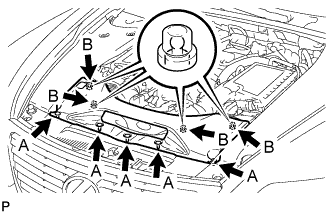
Attach the 4 clips labeled B.
Note
-
Make sure the clips are attached securely.
-
Attaching the clips forcefully or hitting the top of the clips may damage them.
-
-
Install the air cleaner inlet cover sub-assembly with the 5 clips labeled A.
-
-
INSTALL V-BANK COVER SUB-ASSEMBLY
-
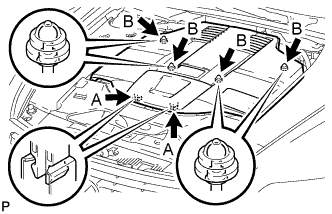
After sliding the V-bank cover sub-assembly from the vehicle front to the rear to attach the 2 clips labeled A, attach the 4 clips labeled B and install the V-bank cover sub-assembly.
CAUTION:
-
Make sure the clips are attached securely.
-
Attaching the clips forcefully or hitting the top of the clips may damage them.
-
-
-
INSTALL BATTERY SERVICE HOLE COVER LH
-
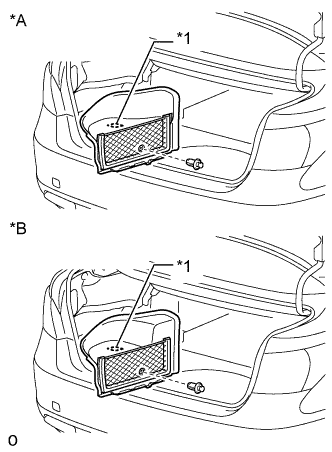
Text in Illustration *A for Standard *B for Ottoman Attach the battery service hole cover LH with the clip and fastening tape.
-
-
INSTALL DECK TRIM SIDE BOARD LH (w/o Spare Tire)
-
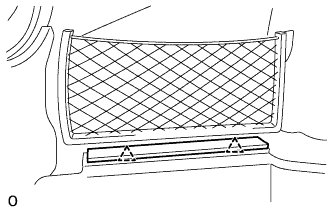
Attach the 2 clips to install the deck trim side board LH.
-
-
INSTALL DECK BOARD ASSEMBLY (w/o Spare Tire)
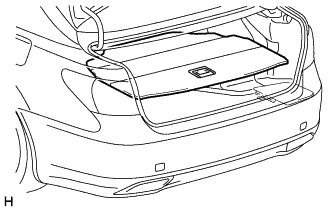
-
INSTALL LUGGAGE COMPARTMENT MAT SUB-ASSEMBLY (w/ Spare Tire)