ENGINE ON-VEHICLE INSPECTION

-
INSPECT ENGINE COOLANT
-
The engine coolant should be between the LOW and FULL lines when the engine is cold.
If the engine coolant is below the LOW line, check for leakage and add TOYOTA Super Long Life Coolant (SLLC) or similar high quality ethylene glycol based non-silicate, non-amine, non-nitrite, non-borate coolant with long-life hybrid organic acid technology to the FULL line.
-
-
INSPECT ENGINE OIL
-
Warm up the engine, stop the engine and wait 5 minutes.
-
Check that the oil level is between the dipstick low level mark and full level mark.
If the level is low, check for leakage and add oil up to the full level mark.
Note
Do not fill engine oil above the full level mark.
-
-
INSPECT BATTERY
Note
If the battery is weak or if the engine is difficult to start, perform the following procedures.
-
Check the battery for damage and deformation. If severe damage, deformation or leakage is found, replace the battery.
-
Check the electrolyte quantity of each cell.
-
For maintenance-free batteries:
-
If the electrolyte quantity is below the lower line, replace the battery.
-
If the electrolyte quantity is above the lower line, check the battery voltage when cranking the engine. If the voltage is below 9.6 V, recharge or replace the battery.
Tech Tips
Before checking the battery voltage, turn off all the electrical systems (headlights, blower motor, rear defogger, etc.).
-
-
For non-maintenance-free batteries:
-
If the electrolyte quantity is below the lower line, add distilled water to each cell. Then, recharge the battery and check the electrolyte's specific gravity.
Standard specific gravity 1.25 to 1.29 at 20°C (68°F) -
If the electrolyte quantity is above the lower line, check the battery voltage when cranking the engine. If the voltage is below 9.6 V, recharge or replace the battery.
Tech Tips
Before checking the battery voltage, turn off all the electrical systems (headlights, blower motor, rear defogger, etc.).
-
-
-
Turn the ignition switch off and turn on the headlights for 20 to 30 seconds. This removes the surface charge from the battery.
-
Measure the battery voltage between the negative (-) and positive (+) terminals of the battery.
Standard voltage 12.5 to 12.9 V at 20°C (68°F) If the voltage is less than the specification, recharge the battery.
-
-
INSPECT AIR CLEANER FILTER ELEMENT SUB-ASSEMBLY
-
Remove the air cleaner cap.
-
Remove the air filter element.
-
Visually check that the air filter is not excessively damaged or oily.
If necessary, replace the air cleaner filter element.
-
-
INSPECT SPARK PLUG
Note
-
Do not use a wire brush for cleaning.
-
Do not attempt to adjust the electrode gap of a used spark plug.
-
Check the electrode.
-
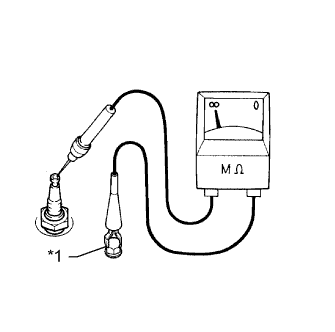
Text in Illustration *1 Ground Using a megohmmeter, measure the insulation resistance.
Standard Insulation Resistance Tester Connection Condition Specified Condition Spark plug (Terminal) - Body ground Always 10 MΩ or higher Tech Tips
If a megohmmeter is not available, perform the following simple inspection.
-
-
Alternative inspection method:
-
Quickly accelerate the engine to 4000 rpm 5 times.
-
Remove the spark plug.
-
Visually check the spark plug.
If the electrode is dry, the spark plug is functioning properly. If the electrode is damp, proceed to the next step.
-
-
Check the spark plug for any damage to its thread and insulator.
If there is damage, replace the spark plug. If not, reinstall the spark plug.
Recommended Spark Plug Manufacturer Spark Plug Type DENSO SK20HR11 -
Check the spark plug electrode gap.
Maximum electrode gap for used spark plug 1.3 mm (0.0512 in.) If the gap is more than the maximum, replace the spark plug.
Electrode gap for new spark plug 1.0 to 1.1 mm (0.0394 to 0.0433 in.) Note
When adjusting the gap of a new spark plug, bend only the base of the ground electrode. Do not touch the tip. Never attempt to adjust the gap of a used plug.
-
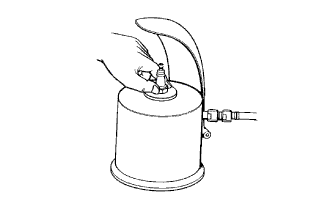
Clean the spark plugs.
If the electrode has traces of wet carbon, clean the electrode with a spark plug cleaner and then dry it.
Air pressure 588 kPa (6.0 kgf/cm2, 85 psi) Duration 20 seconds or less Tech Tips
Only use a spark plug cleaner when the electrode is free of oil. If the electrode has traces of oil, use gasoline to clean off the oil before using the spark plug cleaner.
-
-
INSPECT FAN AND GENERATOR V BELT
-
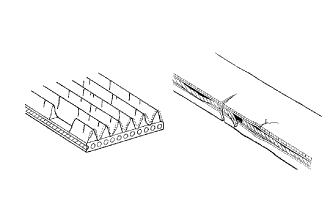
Check the belt for wear, cracks or other signs of damage.
If any of the following defects is found, replace the fan and generator V belt.
-
The belt is cracked.
-
The belt is worn out to the extent that the cords are exposed.
-
The belt has chunks missing from the ribs.
-
-
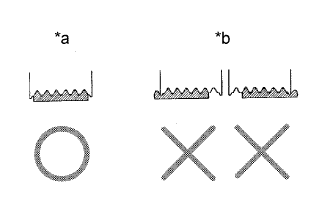
Text in Illustration *a CORRECT *b INCORRECT Check that the belt fits properly in the ribbed grooves.
Tech Tips
Check with your hand to confirm that the belt has not slipped out of the grooves on the bottom of the pulley. If it has slipped out, replace the V belt. Install a new V belt correctly.
-
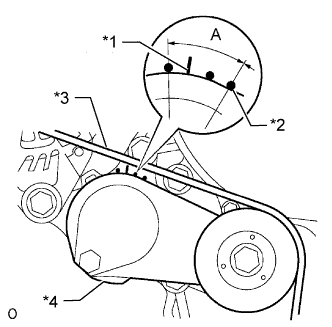
Text in Illustration *1 Bracket Side Indicator *2 Arm Side Indicator *3 Fan and Generator V Belt *4 Tensioner Check that the tensioner indicator mark is within range A shown in the illustration.
If the mark is not within range A, replace the fan and generator V belt.
-
-
INSPECT VALVE LASH ADJUSTER NOISE
-
Rev the engine several times. Check that the engine does not emit unusual noises.
If unusual noises occur, warm up the engine and idle it for more than 30 minutes. Then perform the inspection above again.
If any defects or problems are found during the inspection above, perform a lash adjuster inspection Click here.
-
-
INSPECT IGNITION TIMING
-
Warm up and stop the engine.
-
When using an intelligent tester:
-
Connect the intelligent tester to the DLC3.
-
Start the engine and idle it.
-
Turn the intelligent tester on.
-
Enter the following menus: Powertrain / Engine and ECT / Data List / IGN Advance.
Standard ignition timing 5 to 15° BTDC @ idle Tech Tips
Refer to the intelligent tester operator's manual for further details.
Note
-
When checking the ignition timing, the transaxle should be in neutral or park.
-
Switch off all the accessories and the A/C before connecting the intelligent tester.
-
-
Check that the ignition timing advances immediately when the engine speed is increased.
-
Enter the following menus: Powertrain / Engine and ECT / Active Test / Connect the TC and TE1.
-
Monitor IGN Advance.
-
Perform the Active Test.
Standard ignition timing 3 to 7° BTDC @ idle Tech Tips
Refer to the intelligent tester operator's manual for further details.
Note
When checking the ignition timing, the transmission should be in neutral or park.
-
-
When not using the intelligent tester:
-
Loosen the hose clamp from the throttle body side.
-
Remove the 3 bolts and disconnect the intake air connector.
Tech Tips
Move the intake air connector so that the tester probe of a timing light can be connected to the wire of the ignition coil for the No. 1 cylinder.
-
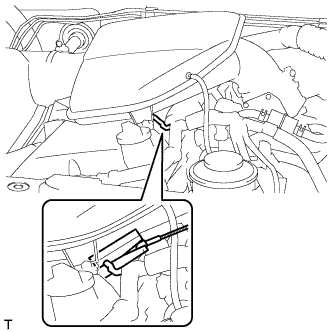
Connect the tester probe of a timing light to the wire of the ignition coil connector for the No. 1 cylinder.
Note
Use a timing light that detects primary signals.
-
Connect the intake air connector.
Tech Tips
Return the parts to their original positions so that the engine can be started.
-
Start the engine and idle it.
-
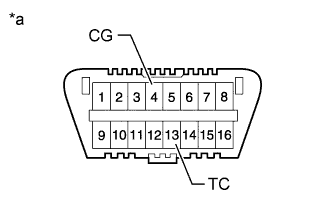
Text in Illustration *a Front view of DLC3 Using SST, connect terminals 13 (TC) and 4 (CG) of the DLC3.
- SST
- 09843-18040
Note
-
Confirm the terminal numbers before connecting them. Connecting the wrong terminals can damage the engine.
-
When checking the ignition timing, the shift lever should be in neutral or P.
-
Using the timing light, check the ignition timing.
Standard ignition timing 3 to 7° BTDC @ idle Note
-
Turn all the electrical systems and the A/C off.
-
When checking the ignition timing, the shift lever should be in neutral or P.
-
-
Remove SST from the DLC3.
-
Check the ignition timing.
Standard ignition timing 5 to 15° BTDC @ idle -
Check that the ignition timing advances immediately when the engine speed is increased.
-
Turn the ignition switch off.
-
Disconnect the timing light from the engine.
-
Connect the intake air connector with the 3 bolts.
- Torque:
- 8.0 N*m { 82 kgf*cm, 71 in.*lbf }
-
Tighten the hose clamp.
- Torque:
- 5.0 N*m { 51 kgf*cm, 44 in.*lbf }
-
-
-
INSPECT ENGINE IDLE SPEED
-
Warm up and stop the engine.
-
When using the intelligent tester:
-
Connect the intelligent tester to the DLC3.
-
Start the engine and idle it.
-
Turn the intelligent tester on.
-
Enter the following menus: Powertrain / Engine and ECT / Data List / Engine Speed.
Standard idle speed 600 to 700 rpm Tech Tips
Refer to the intelligent tester operator's manual for further details.
Note
-
Turn all the electrical systems and the A/C off.
-
When checking the idling speed, the shift lever should be in neutral or P.
-
-
Turn the ignition switch off.
-
Disconnect the intelligent tester from the DLC3.
-
-
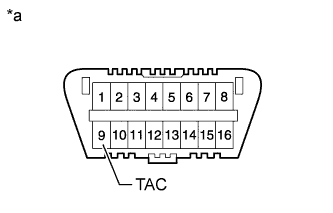
Text in Illustration *a Front view of DLC3 When not using the intelligent tester:
-
Using SST, connect a tachometer probe to terminal 9 (TAC) of the DLC3.
- SST
- 09843-18040
Note
-
Confirm the terminal numbers before connecting them. Connecting the wrong terminals can damage the engine.
-
Turn all the electrical systems and the A/C off.
-
When checking the idling speed, the shift lever should be in neutral or P.
-
Check the idle speed.
Standard idle speed 600 to 700 rpm -
Disconnect the tachometer probe from the DLC3.
-
-
If the engine speed is not as specified, update the idle speed control (ISC) learned value using either procedure 1 or procedure 2 below, and then check the engine speed again.
-
Procedure 1:
After completely warming up the engine, drive the vehicle at 30 km/h (19 mph) for 30 seconds or more and idle the engine for 30 seconds or more. Repeat this pattern 5 times or more.
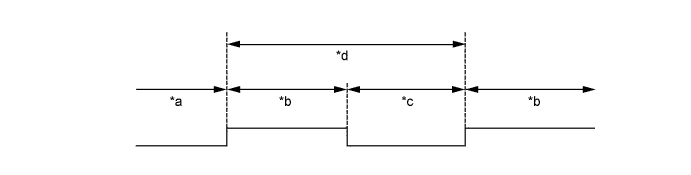
Text in Illustration *a Engine completely warmed up *b Vehicle being driven at 30 km/h (19 mph) *c Idling *d 1 time -
Procedure 2:
After completely warming up the engine, stop the engine and then idle it. Repeat this pattern 5 times or more.
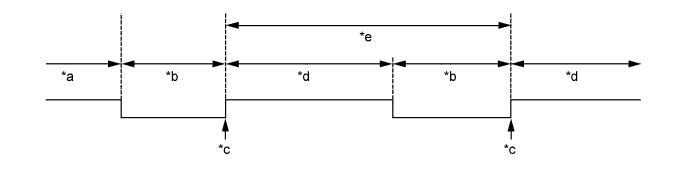
Text in Illustration *a Engine completely warmed up *b Engine stopped *c Engine started *d Idling *e 1 time - - Tech Tips
-
Be sure to idle the engine for 150 seconds or more for each time the pattern is repeated.
-
If the engine speed is not as specified after performing the procedure above, inspect the idle speed control system as it is malfunctioning.
-
-
-
-
INSPECT IDLE SPEED CONTROL SYSTEM
-
Warm up and stop the engine.
Note
A warmed up engine should have an engine coolant temperature of over 80°C (176°F), an engine oil temperature of 60°C (140°F) and a stable engine speed.
-
Check the idle speed control system.
-
Text in Illustration *a Front view of DLC3 Using SST, connect terminals 13 (TC) and 4 (CG) of the DLC3.
- SST
- 09843-18040
Note
-
Confirm the terminal numbers before connecting them. Connection with a wrong terminal can damage the engine.
-
Turn off all the electrical systems before connecting the terminals.
-
Start the engine and run it at idle.
Note
When checking the idle speed control function, the transmission should be in neutral.
-
-
After connecting terminals TC and CG, check that the engine speed changes to approximately 1000 to 1500 rpm for 5 seconds, and then returns to idle speed.
If the result is not as specified, check the throttle body Click here, DTCs Click here and wire harness.
-
-
INSPECT COMPRESSION
-
Warm up and stop the engine.
-
Check for DTCs Click here.
-
Remove the 4 bolts and 4 ignition coils.
-
Remove the 4 spark plugs.
-
Disconnect the 4 fuel injector connectors.
-
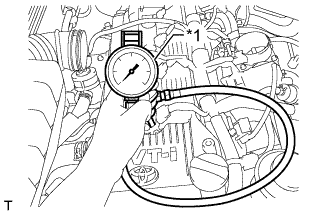
Text in Illustration *1 Compression Gauge Inspect the cylinder compression pressure.
-
Insert a compression gauge into the spark plug hole.
-
Fully open the throttle.
-
While cranking the engine, measure the compression pressure.
Standard compression pressure 1230 kPa (12.5 kgf/cm2, 178 psi) or higher Minimum pressure 880 kPa (9.0 kgf/cm2, 128 psi) Difference between each cylinder 98 kPa (1.0 kgf/cm2, 14.2 psi) or less Tech Tips
If the cylinder compression is low, pour a small amount of engine oil into the cylinder through the spark plug hole and inspect it again.
-
If adding oil increases the compression pressure, the piston rings and/or cylinder bore may be worn or damaged.
-
If the pressure stays low, the valve may be stuck or seated improperly, or there may be leakage from the gasket.
Note
-
Use a fully-charged battery so the engine speed can be increased to 250 rpm or more.
-
Inspect the other cylinders in the same way.
-
Measure the compression in as short a time as possible.
-
-
-
Connect the 4 fuel injector connectors.
-
Install the 4 spark plugs.
- Torque:
- 18 N*m { 184 kgf*cm, 13 ft.*lbf }
-
Install the 4 ignition coils with the 4 bolts.
- Torque:
- 9.0 N*m { 92 kgf*cm, 80 in.*lbf }
-
Clear the DTCs Click here.
-
-
INSPECT CO/HC
-
Start the engine.
-
Run the engine at 2500 rpm for approximately 180 seconds.
-
Insert a CO/HC meter testing probe at least 40 cm (1.31 ft.) into the tailpipe while idling the engine.
-
Check the CO/HC concentration during idling and when the engine is running at 2500 rpm.
Tech Tips
When doing the 2 mode (with the engine idling/ running at 2500 rpm) test, the measuring procedures are determined by applicable local regulations.
If the CO/HC concentration does not comply with regulations, troubleshoot in the order given below.
-
Check the air fuel ratio sensor Click here and heated oxygen sensor Click here.
-
Refer to the table below for possible causes, and then inspect the applicable parts and repair them if necessary.
CO HC Problems Possible Causes Normal High Rough idling
-
Faulty ignition:
-
Incorrect timing
-
Plugs are contaminated or shorted, or gaps are incorrect
-
Incorrect valve clearance
-
Leakage from intake or exhaust valves
-
Leakage from cylinders
Low High Rough idling
(Fluctuating HC reading)
-
Vacuum leaks:
-
PCV hoses
-
Intake manifold
-
Throttle body
-
Brake booster line
-
Lean mixture causing misfire
High High Rough idling
(Black smoke from exhaust)
-
Restricted air cleaner filter element
-
Plugged PCV valve
-
Faulty SFI system:
-
Faulty pressure regulator
-
Faulty engine coolant temperature sensor
-
Faulty mass air flow meter
-
Faulty ECM
-
Faulty injectors
-
Faulty throttle body
-
-
-