DESCRIPTION
This DTC is stored when a malfunction occurs in the speakers.
| DTC Code | DTC Detection Condition | Trouble Area |
|---|---|---|
| B15C3 | A short is detected in the speaker output circuit. |
|
INSPECTION PROCEDURE
PROCEDURE
- Click here
CHECK FOR DTC
-
Clear the DTCs (Click here).
-
Check for DTCs (Click here).
OK No DTCs are output.
- OKClick here
- NGClick here
-
- Click here
CHECK HARNESS AND CONNECTOR (SPEAKER CIRCUIT)
-
*1: for RH Side
-
*2: for LH Side
-
Disconnect the J4*1 and/or K3*2 front No. 1 speaker assembly connector.
-
Disconnect the H10*1 and/or H13*2 front No. 2 speaker assembly connector.
-
Disconnect the H21*1 and/or H22*2 front No. 3 speaker assembly connector.
-
Disconnect the H14 front No. 4 speaker assembly connector.
-
Disconnect the L1*1 and/or M1*2 rear speaker set connector.
-
Disconnect the L3*1 and/or M3*2 rear No. 2 speaker assembly connector.
-
Disconnect the Q15*1 and/or R13*2 rear header speaker assembly connector.
-
Disconnect the R24 No. 1 speaker with box assembly connector.
-
Disconnect the H65 and H66 stereo component amplifier assembly connectors.
-
Measure the resistance according to the value(s) in the table below.
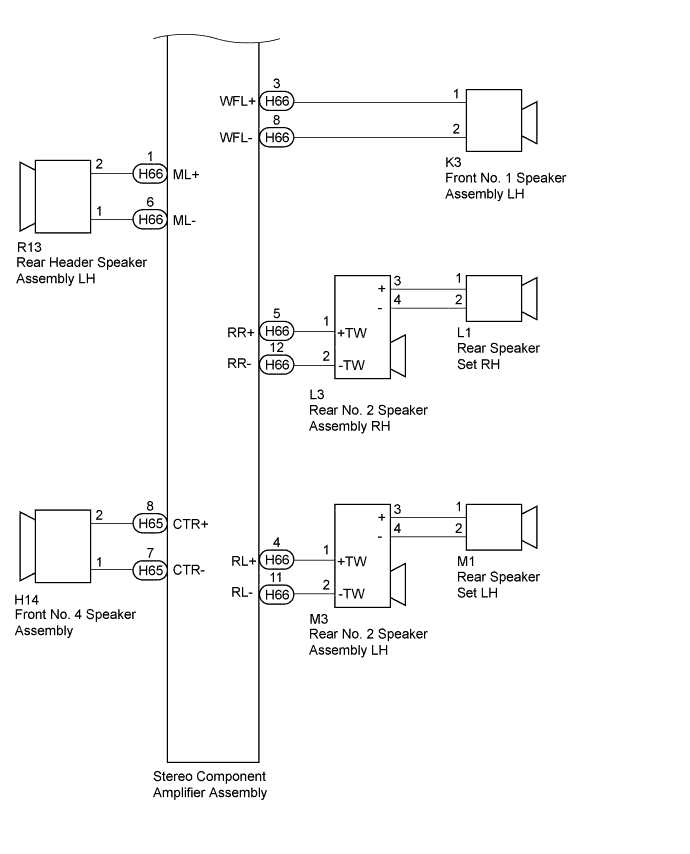
Standard Resistance Tester Connection Condition Specified Condition H65-4 (FR+) - H21-1 (TWR+)*1 Always Below 1 Ω H65-10 (FR-) - H21-2 (TWR-)*1 Always Below 1 Ω H21-3 (+) - H10-2*1 Always Below 1 Ω H21-4 (-) - H10-1*1 Always Below 1 Ω H66-10 (WFR+) - J4-1*1 Always Below 1 Ω H66-9 (WFR-) - J4-2*1 Always Below 1 Ω H65-3 (FL+) - H22-1 (TWL+)*2 Always Below 1 Ω H65-9 (FL-) - H22-2 (TWL-)*2 Always Below 1 Ω H22-3 (+) - H13-2*2 Always Below 1 Ω H22-4 (-) - H13-1*2 Always Below 1 Ω H65-1 (WF1+) - R24-1 (WF1+) Always Below 1 Ω H65-5 (WF1-) - R24-3 (WF1-) Always Below 1 Ω H65-2 (WF2+) - R24-2 (WF2+) Always Below 1 Ω H65-6 (WF2-) - R24-4 (WF2-) Always Below 1 Ω H66-2 (MR+) - Q15-2*1 Always Below 1 Ω H66-7 (MR-) - Q15-1*1 Always Below 1 Ω H66-3 (WFL+) - K3-1*2 Always Below 1 Ω H66-8 (WFL-) - K3-2*2 Always Below 1 Ω H66-5 (RR+) - L3-1 (+TW)*1 Always Below 1 Ω H66-12 (RR-) - L3-2 (-TW)*1 Always Below 1 Ω L3-3 (+) - L1-1*1 Always Below 1 Ω L3-4 (-) - L1-2*1 Always Below 1 Ω H66-4 (RL+) - M3-1 (+TW)*2 Always Below 1 Ω H66-11 (RL-) - M3-2 (-TW)*2 Always Below 1 Ω M3-3 (+) - M1-1*2 Always Below 1 Ω M3-4 (-) - M1-2*2 Always Below 1 Ω H66-1 (ML+) - R13-2*2 Always Below 1 Ω H66-6 (ML-) - R13-1*2 Always Below 1 Ω H65-8 (CTR+) - H14-2 Always Below 1 Ω H66-7 (CTR-) - H14-1 Always Below 1 Ω H65-4 (FR+) - Body ground*1 Always 10 kΩ or higher H65-10 (FR-) - Body ground*1 Always 10 kΩ or higher H21-3 (+) - Body ground*1 Always 10 kΩ or higher H21-4 (-) - Body ground*1 Always 10 kΩ or higher H66-10 (WFR+) - Body ground*1 Always 10 kΩ or higher H66-9 (WFR-) - Body ground*1 Always 10 kΩ or higher H65-3 (FL+) - Body ground*2 Always 10 kΩ or higher H65-9 (FL-) - Body ground*2 Always 10 kΩ or higher H22-3 (+) - Body ground*2 Always 10 kΩ or higher H22-4 (-) - Body ground*2 Always 10 kΩ or higher H65-1 (WF1+) - Body ground Always 10 kΩ or higher H65-5 (WF1-) - Body ground Always 10 kΩ or higher H65-2 (WF2+) - Body ground Always 10 kΩ or higher H65-6 (WF2-) - Body ground Always 10 kΩ or higher H66-2 (MR+) - Body ground*1 Always 10 kΩ or higher H66-7 (MR-) - Body ground*1 Always 10 kΩ or higher H66-3 (WFL+) - Body ground*2 Always 10 kΩ or higher H66-8 (WFL-) - Body ground*2 Always 10 kΩ or higher H66-5 (RR+) - Body ground*1 Always 10 kΩ or higher H66-12 (RR-) - Body ground*1 Always 10 kΩ or higher L3-3 (+) - Body ground*1 Always 10 kΩ or higher L3-4 (-) - Body ground*1 Always 10 kΩ or higher H66-4 (RL+) - Body ground*2 Always 10 kΩ or higher H66-11 (RL-) - Body ground*2 Always 10 kΩ or higher M3-3 (+) - Body ground*2 Always 10 kΩ or higher M3-4 (-) - Body ground*2 Always 10 kΩ or higher H66-1 (ML+) - Body ground*2 Always 10 kΩ or higher H66-6 (ML-) - Body ground*2 Always 10 kΩ or higher H65-8 (CTR+) - Body ground Always 10 kΩ or higher H66-7 (CTR-) - Body ground Always 10 kΩ or higher
- OKClick here
- NGClick here
-
- Click here
INSPECT FRONT NO. 1 SPEAKER ASSEMBLY
-
Remove the front No. 1 speaker assembly (Click here).
-
Inspect the front No. 1 speaker assembly (Click here).
- OKClick here
- NGClick here
-
- Click here
INSPECT FRONT NO. 2 SPEAKER ASSEMBLY
-
Remove the front No. 2 speaker assembly (Click here).
-
Inspect the front No. 2 speaker assembly (Click here).
- OKClick here
- NGClick here
-
- Click here
CHECK FRONT NO. 3 SPEAKER ASSEMBLY
-
Replace the front No. 3 speaker assembly with a known good one (Click here).
-
Check that the malfunction disappears.
Note:
-
Connect all the connectors that were disconnected to the front No. 3 speaker assemblies.
-
Perform the above inspection on both LH and RH sides.
OK Malfunction disappears. -
- OKClick here
- NGClick here
-
- Click here
CHECK FRONT NO. 4 SPEAKER ASSEMBLY
-
Replace the front No. 4 speaker assembly with a known good one (Click here).
-
Check that the malfunction disappears.
OK Malfunction disappears.
- OKClick here
- NGClick here
-
- Click here
INSPECT REAR SPEAKER SET
-
Remove the rear speaker set with a known good one (Click here).
-
Inspect the rear speaker set with a known good one (Click here).
- OKClick here
- NGClick here
-
- Click here
CHECK REAR NO. 2 SPEAKER ASSEMBLY
-
Replace the rear No. 2 speaker assembly with a known good one (Click here).
-
Check that the malfunction disappears.
Note:
-
Connect all the connectors that were disconnected to the rear No. 2 speaker assemblies.
-
Perform the above inspection on both LH and RH sides.
OK Malfunction disappears. -
- OKClick here
- NGClick here
-
- Click here
CHECK REAR HEADER SPEAKER ASSEMBLY
-
Replace the rear header speaker assembly with a known good one (Click here).
-
Check that the malfunction disappears.
Note:
-
Connect all the connectors that were disconnected to the rear header speaker assemblies.
-
Perform the above inspection on both LH and RH sides.
OK Malfunction disappears. -
- OKClick here
- NGClick here
-
- Click here
INSPECT NO. 1 SPEAKER WITH BOX ASSEMBLY
-
Remove the No. 1 speaker with box assembly (Click here).
-
Inspect the No. 1 speaker with box assembly (Click here).
- OKClick here
- NGClick here
-
- Click here
CHECK STEREO COMPONENT AMPLIFIER ASSEMBLY
-
Replace the stereo component amplifier assembly with a known good one (Click here).
-
Check that the malfunction disappears.
OK Malfunction disappears.
- OKClick here
- NGClick here
-
- Click here
USE SIMULATION METHOD TO CHECKClick here
- Click here
REPAIR OR REPLACE HARNESS OR CONNECTOR
- Click here
REPLACE FRONT NO. 1 SPEAKER ASSEMBLYClick here
- Click here
REPLACE FRONT NO. 2 SPEAKER ASSEMBLYClick here
- Click here
END (FRONT NO. 3 SPEAKER ASSEMBLY IS DEFECTIVE)
- Click here
END (FRONT NO. 4 SPEAKER ASSEMBLY IS DEFECTIVE)
- Click here
REPLACE REAR SPEAKER SETClick here
- Click here
END (REAR NO. 2 SPEAKER ASSEMBLY IS DEFECTIVE)
- Click here
END (REAR HEADER SPEAKER ASSEMBLY IS DEFECTIVE)
- Click here
REPLACE NO. 1 SPEAKER WITH BOX ASSEMBLYClick here
- Click here
REPLACE NAVIGATION RECEIVER ASSEMBLYClick here
- Click here
END (STEREO COMPONENT AMPLIFIER ASSEMBLY IS DEFECTIVE)