ECD SYSTEM (w/ DPF), Diagnostic DTC:P0504

| DTC Code | DTC Name |
|---|---|
| P0504 | Brake Switch "A" / "B" Correlation |
DESCRIPTION
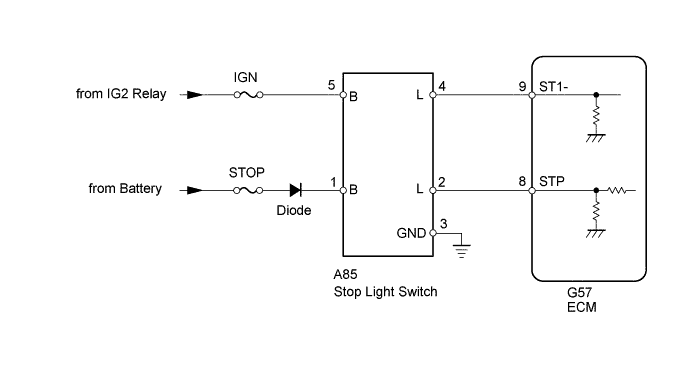
The stop light switch is a duplex system that transmits two signals: STP and ST1-. These two signals are used by the ECM to monitor whether or not the brake system is working properly. If the signals, which indicate that the brake pedal is being depressed and released, are detected simultaneously, the ECM interprets this as a malfunction in the stop light switch and stores the DTC.
Tech Tips
The normal signal conditions are as shown in the table below.
| Signal (ECM Terminal) | Brake Pedal Released | In Transition | Brake Pedal Depressed |
|---|---|---|---|
| STP | OFF | ON | ON |
| ST1- | ON | ON | OFF |
-
[OFF] denotes ground potential.
-
[ON] denotes battery potential (+B).
-
On the intelligent tester, both the Data List items Stop Light Switch and ST1 are ON when the brake pedal is depressed because the ST1 indication characteristic is opposite to the Stop Light Switch indication.
| DTC Detection Drive Pattern | DTC Detection Condition | Trouble Area |
|---|---|---|
| Depress and release brake pedal with engine switch on (IG) | Conditions (a), (b) and (c) continue for 0.5 seconds or more (1 trip detection logic): (a) Engine switch is on (IG). (b) Brake pedal is released. (c) The STP signal is off when the ST1- signal is off, or the STP signal is on when the ST1- signal is on. |
|
| DTC No. | Data List |
|---|---|
| P0504 | Stop Light Switch |
WIRING DIAGRAM
INSPECTION PROCEDURE
Tech Tips
-
Read freeze frame data using the intelligent tester. Freeze frame data records the engine condition when malfunctions are detected. When troubleshooting, freeze frame data can help determine if the vehicle was moving or stationary, if the engine was warmed up or not, and other data from the time the malfunction occurred.
-
Stop light switch conditions can be checked using the intelligent tester.
-
Connect the intelligent tester to the DLC3.
-
Turn the engine switch on (IG).
-
Turn the tester on.
-
Enter the following menus: Powertrain / Engine and ECT / Data List / Stop Light Switch.
-
Check Stop Light Switch when the brake pedal is depressed and released.
| Brake Pedal Operation | Specified Condition |
|---|---|
| Depressed | ON |
| Released | OFF |
Note
-
Inspect the fuses of circuits related to this system before performing the following inspection procedure.
-
After replacing the ECM, the new ECM needs registration Click here and initialization Click here.
-
After replacing the fuel supply pump assembly, the ECM needs initialization Click here.
-
After replacing an injector assembly, the ECM needs registration Click here.
PROCEDURE
-
CHECK ECM (STP AND ST1- VOLTAGE)
-
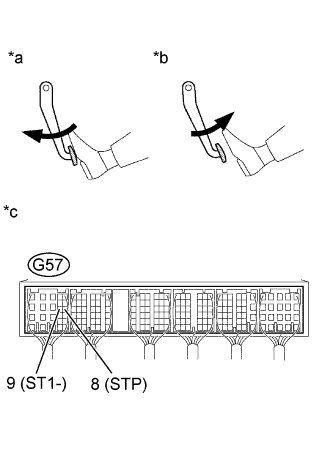
Text in Illustration *a Brake Pedal Depressed *b Brake Pedal Released *c Component with harness connected
(ECM)
Turn the engine switch on (IG).
-
Measure the voltage according to the value(s) in the table below.
Standard Voltage Tester Connection Brake Pedal Condition Specified Condition G57-9 (ST1-) - Body ground Released 11 to 14 V Depressed 0 to 3 V G57-8 (STP) - Body ground Released 0 to 3 V Depressed 11 to 14 V
OK 
CHECK WHETHER DTC OUTPUT RECURS Click here
NG
CHECK STOP LIGHT SWITCH ASSEMBLY (TERMINAL B VOLTAGE) Click here
-
-
CHECK STOP LIGHT SWITCH ASSEMBLY (TERMINAL B VOLTAGE)
-
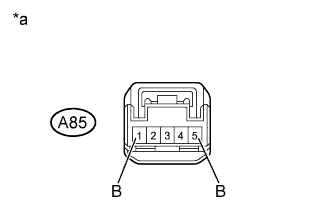
Text in Illustration *a Front view of wire harness connector
(to Stop Light Switch)
Disconnect the stop light switch connector.
-
Measure the voltage according to the value(s) in the table below.
Standard Voltage Tester Connection Condition Specified Condition A85-1 (B) - Body ground Always 11 to 14 V A85-5 (B) - Body ground Ignition switch ON 11 to 14 V -
Measure the resistance according to the value(s) in the table below.
Standard Resistance Tester Connection Condition Specified Condition A85-3 (GND) - Body ground Always Below 1 Ω -
Reconnect the stop light switch assembly connector.
NG
REPAIR OR REPLACE HARNESS OR CONNECTOR Click here
OK 
-
-
CHECK HARNESS AND CONNECTOR (STOP LIGHT SWITCH ASSEMBLY - ECM)
-
Disconnect the stop light switch assembly connector.
-
Disconnect the ECM connector.
-
Measure the resistance according to the value(s) in the table below.
Standard Resistance (Check for Open) Tester Connection Condition Specified Condition A85-2 (L) - G57-8 (STP) Always Below 1 Ω A85-4 (L) - G57-9 (ST1-) Always Below 1 Ω Standard Resistance (Check for Short) Tester Connection Condition Specified Condition A85-2 (L) or G57-8 (STP) - Body ground Always 10 kΩ or higher A85-4 (L) or G57-9 (ST1-) - Body ground Always 10 kΩ or higher -
Reconnect the stop light switch assembly connector.
-
Reconnect the ECM connector.
NG
REPAIR OR REPLACE HARNESS OR CONNECTOR Click here
OK
-
-
REPLACE STOP LIGHT SWITCH ASSEMBLY
-
Replace the stop light switch assembly Click here.
NEXT
-
-
CHECK WHETHER DTC OUTPUT RECURS
-
Connect the intelligent tester to the DLC3.
-
Clear the DTCs Click here.
-
Turn the engine switch off.
-
Turn the engine switch on (IG) and turn the tester on.
-
Depress and release the brake pedal.
-
Enter the following menus: Powertrain / Engine and ECT / DTC.
-
Confirm that the DTC is not output again.
OK DTC is not output again.
NG
REPLACE ECM Click here
OK 
END
-
-
REPAIR OR REPLACE HARNESS OR CONNECTOR
-
Repair or replace the harness or connector.
NEXT
CONFIRM WHETHER MALFUNCTION HAS BEEN SUCCESSFULLY REPAIRED Click here
-
-
REPLACE ECM
-
Replace the ECM Click here.
NEXT
-
-
CONFIRM WHETHER MALFUNCTION HAS BEEN SUCCESSFULLY REPAIRED
-
Connect the intelligent tester to the DLC3.
-
Clear the DTCs Click here.
-
Turn the engine switch off.
-
Turn the engine switch on (IG) and turn the tester on.
-
Depress and release the brake pedal.
-
Enter the following menus: Powertrain / Engine and ECT / DTC.
-
Confirm that the DTC is not output again.
NEXT
END
-