AUTOMATIC TRANSMISSION SYSTEM Shift Paddle Switch Circuit
DESCRIPTION
When the shift lever is in D, operating the "-" side shift paddle switch will enter fixed range mode which restricts the highest gear. By operating the shift paddle switches "+" (UP) or "-" (DOWN), the shift range can be changed.
When the vehicle is being operated in D position (fixed range mode), if the vehicle is stopped or the accelerator pedal is kept steady for a certain period of time with the transmission in the same gear, the vehicle will change back automatically to normal D position operation.
When the shift lever is in M, it is possible to make use of the highest engine speeds by holding the vehicle in a gear. Gear hold control means that gear shifts will not be performed as long as the paddle switches are not operated in either the "+" (UP), or "-" (DOWN) direction.
Tech Tips
For information on shift speeds and automatic operations related to the shift paddle switch circuit, refer to the instructions in Road Test Click here.
WIRING DIAGRAM
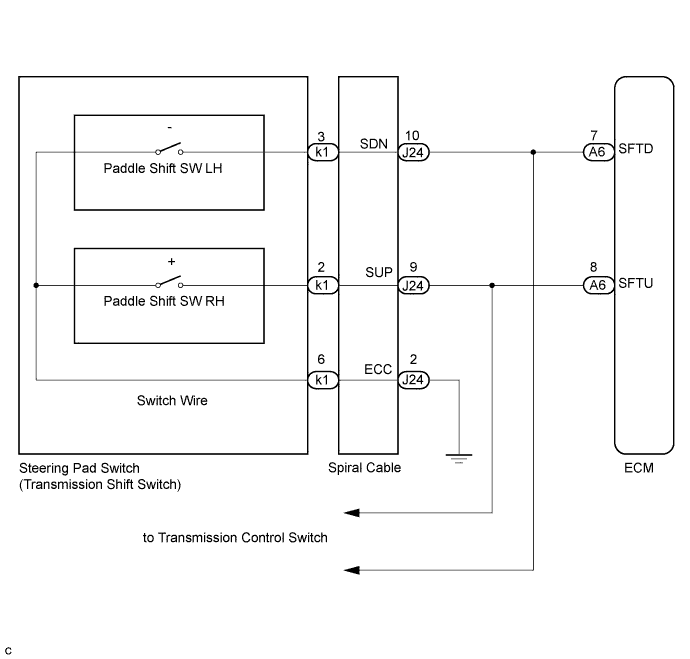
INSPECTION PROCEDURE
PROCEDURE
-
CHECK HARNESS AND CONNECTOR (SPIRAL CABLE - BODY GROUND)
-
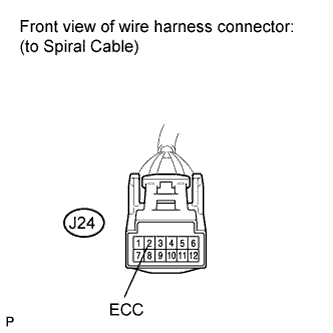
Disconnect the steering pad switch connector and spiral cable connector.
-
Measure the resistance according to the value(s) in the table below.
Standard Resistance Tester Connection Condition Specified Condition J24-2 (ECC) - Body ground Always Below 1 Ω
NG 
REPAIR OR REPLACE HARNESS OR CONNECTOR
OK 
-
-
INSPECT SPIRAL CABLE SUB-ASSEMBLY
-
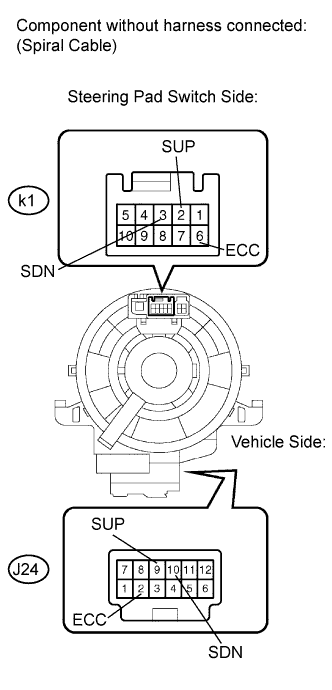
Measure the resistance according to the value(s) in the table below.
Standard Resistance Tester Connection Condition Specified Condition J24-2 (ECC) - k1-6 (ECC) Always Below 1 Ω J24-9 (SUP) - k1-2 (SUP) Always Below 1 Ω J24-10 (SDN) - k1-3 (SDN) Always Below 1 Ω
NG
REPLACE SPIRAL CABLE SUB-ASSEMBLY
OK
-
-
INSPECT TRANSMISSION SHIFT SWITCH ASSEMBLY
-
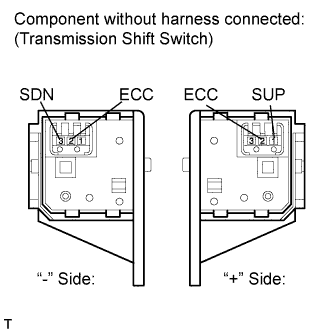
Disconnect the switch wire connector from the transmission shift switch.
-
Measure the resistance between each terminal when the paddle shift is moved to each position.
Standard Resistance Tester Connection Paddle Shift Position Specified Condition SUP - ECC Pull continuously
"+"
(Up shift)
Below 1 Ω Release
"+"
(Up shift)
10 kΩ or higher SDN - ECC Pull continuously
"-"
(Down shift)
Below 1 Ω Release
"-"
(Down shift)
10 kΩ or higher
NG
REPLACE TRANSMISSION SHIFT SWITCH ASSEMBLY
OK
-
-
CHECK HARNESS AND CONNECTOR (SPIRAL CABLE - TRANSMISSION SHIFT SWITCH)
-
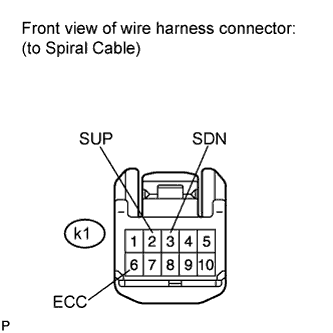
Connect the switch wire connector to the transmission shift switch.
-
Measure the resistance between each terminal when the paddle shift is moved to each position.
Standard Resistance Tester Connection Paddle Shift Position Specified Condition k1-2 (SUP) - k1-6 (ECC) Pull continuously
"+"
(Up shift)
Below 1 Ω Release
"+"
(Up shift)
10 kΩ or higher k1-3 (SDN) - k1-6 (ECC) Pull continuously
"-"
(Down shift)
Below 1 Ω Release
"-"
(Down shift)
10 kΩ or higher
NG
REPAIR OR REPLACE HARNESS OR CONNECTOR
OK
-
-
CHECK HARNESS AND CONNECTOR (SPIRAL CABLE - ECM)
-
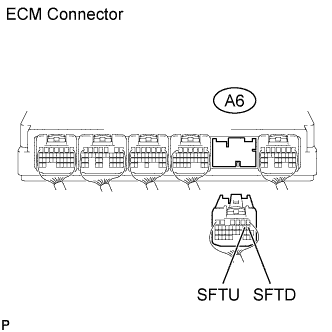
Connect the spiral cable connector and steering pad switch connector.
-
Disconnect the ECM connector.
-
Disconnect the transmission control switch connector.
-
Measure the resistance according to the value(s) in the table below when the paddle shift is moved to each position.
Standard Resistance Tester Connection Paddle Shift Position Specified Condition A6-8 (SFTU) - Body ground Pull continuously
"+"
(Up shift)
Below 1 Ω Release
"+"
(Up shift)
10 kΩ or higher A6-7 (SFTD) - Body ground Pull continuously
"-"
(Down shift)
Below 1 Ω Release
"-"
(Down shift)
10 kΩ or higher
NG
REPAIR OR REPLACE HARNESS OR CONNECTOR
OK 
PROCEED TO NEXT CIRCUIT INSPECTION SHOWN IN PROBLEM SYMPTOMS TABLE Click here
-