SFI SYSTEM, Diagnostic DTC:P0505

| DTC Code | DTC Name |
|---|---|
| P0505 | Idle Control System Malfunction |
DESCRIPTION
The idle speed is controlled by the electronic throttle control system. The electronic throttle control system is comprised of: 1) one valve type throttle body; 2) the throttle actuator, which operates the throttle valve; 3) the throttle position sensor, which detects the opening angle of the throttle valve; 4) the accelerator pedal position sensor, which detects the accelerator pedal position; 5) the ECM, which controls the electronic throttle control system. Based on the target idle speed, the ECM controls the throttle actuator to provide the proper throttle valve opening angle.
| DTC No. | DTC Detection Condition | Trouble Area |
|---|---|---|
| P0505 | Idle speed continues to vary greatly from target speed (2 trip detection logic) |
|
MONITOR DESCRIPTION
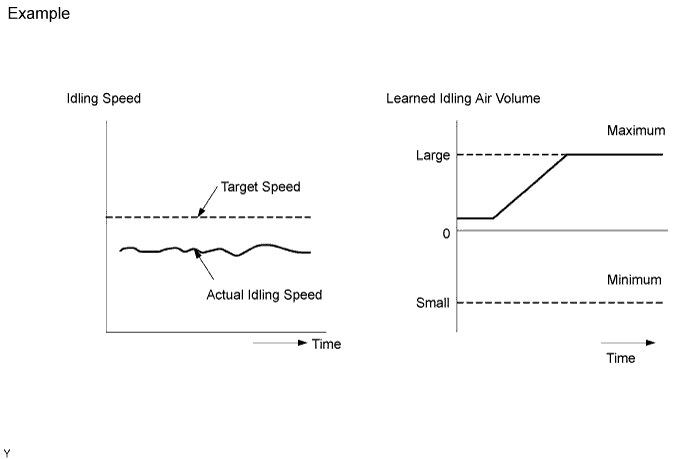
The ECM monitors the idling speed and idling air flow volume to conduct Idle Speed Control (ISC). The ECM determines that the idle speed control system is malfunctioning if the following conditions are met:
-
The learned idling air flow volume remains at the maximum or minimum 5 seconds during a driving cycle.
-
After driving at 6 mph (10 km/h) or more, the actual engine idling speed varies from the target idling speed by between 100 rpm and 200 rpm, 5 times or more during a driving cycle.
-
Example:
-
If the actual idling speed varies from the target idling speed by more than 200 rpm* 5 times during a driving cycle, the ECM illuminates the MIL and sets the DTC.
Tech Tips
*: Threshold idling speed varies with engine load.
INSPECTION PROCEDURE
Tech Tips
-
The following conditions may also cause DTC P0505 to be set:
-
The floor carpet overlapping onto the accelerator pedal, causing the accelerator pedal to be slightly depressed and therefore the throttle valve position to be slightly open.
-
The accelerator pedal being not fully released.
-
Read freeze frame data using the intelligent tester. Freeze frame data records the engine condition when malfunctions are detected. When troubleshooting, freeze frame data can help determine if the vehicle was moving or stationary, if the engine was warmed up or not, if the air fuel ratio was lean or rich, and other data from the time the malfunction occurred.
PROCEDURE
-
CHECK ANY OTHER DTC OUTPUT (IN ADDITION TO DTC P0505)
-
Connect the intelligent tester to the DLC3.
-
Turn the engine switch on (IG).
-
Turn the tester ON.
-
Enter the following menus: Powertrain / Engine / DTC.
-
Read the DTCs.
Result Result Proceed to DTC P0505 is output A DTC P0505 and other DTCs are output B Tech Tips
If any DTCs other than P0505 are output, troubleshoot those DTCs first.
B 
GO TO DTC CHART Click here
A 
-
-
CHECK PCV HOSE (HOSE CONNECTION)
-
Inspect the PCV hose connections Click here.
OK PCV hose is connected correctly and is not damaged.
NG
REPAIR OR REPLACE PCV HOSE Click here
OK
-
-
CHECK INTAKE SYSTEM
-
Check the intake system for vacuum leakage Click here.
OK No leaks from intake system.
NG
REPAIR OR REPLACE INTAKE SYSTEM Click here
OK
-
-
CHECK THROTTLE BODY (VISUALLY CHECK THROTTLE VALVE)
-
Check for contamination between the throttle valve and the housing. If necessary, clean the throttle body. And check that the throttle valve moves smoothly.
OK Throttle valve is not contaminated with foreign objects and moves smoothly.
NG
REPLACE THROTTLE BODY Click here
OK 
REPLACE ECM Click here
-