-
DTCs for the CAN communication system are as follows: U0073, U0100, U0123, U0124, U0126, U0129, U0230*2 U0327*1, U1002*1*2and B1499.
*1: w/ Smart entry and start system
*2: w/ Power back door system
-
Refer to troubleshooting of each system if DTCs regarding the CAN communication system are not output.
- Click here
INSPECT BATTERY VOLTAGE
Standard voltage 11 to 14 V Tip:If the voltage is below 11 V, recharge or replace the battery before proceeding.
- NEXT
- Click here
CHECK AND CLEAR DTCS
Tip:
-
CAN communication DTCs are output when there is an open or short in any of the communication wires. Any problems with the power source of a corresponding ECU or sensor, or problems in the ECU or the sensor itself also cause these DTCs to be output.
-
If a CAN communication wire connector is disconnected with the ignition switch on (IG), the ECUs of the corresponding system and related systems record a DTC.
- NEXT
-
- Click here
CHECK INSTALLED SYSTEMS (ECU AND SENSOR) THAT USE CAN COMMUNICATION
-
Based on the vehicle equipment and specifications, confirm the systems that use CAN communication (Click here).
- NEXT
-
- Click here
CHECK DLC3 BRANCH WIRE AND CAN NO. 1 BUS CIRCUIT MAIN WIRE (CANH - CANL)
Note:
-
Turn the ignition switch off before measuring the resistances of the CAN main wire and the CAN branch wire.
-
After the ignition switch is turned off, check that the key reminder warning system and light reminder warning system are not in operation.
-
Before measuring the resistance, leave the vehicle as is for at least 1 minute and do not operate the ignition switch, any other switches or the doors. If the doors need to be opened in order to check the connectors, open the doors and leave them open.
Tip:Operating the ignition switch, any other switches, or a door triggers related ECU and sensor communication on the CAN. This communication will cause the resistance value to change.
-
Turn the ignition switch off.
-
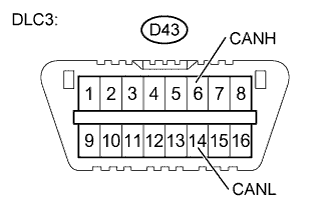
Measure the resistance according to the value(s) in the table below.
Standard resistance Tester Connection Condition Specified Condition D43-6 (CANH) - D43-14 (CANL) Ignition switch off 54 to 69 Ω Result Result Proceed to OK A 70 Ω or higher (LHD Models) B 70 Ω or higher (RHD Models) C Below 54 Ω (LHD Models) D Below 54 Ω (RHD Models) E
- B
- GO TO CAN MAIN WIRE FOR DISCONNECTION (LHD Models) (See pageClick here)
- C
- GO TO CAN MAIN WIRE FOR DISCONNECTION (RHD Models) (See pageClick here)
- D
- GO TO CHECK CAN BUS LINES FOR SHORT CIRCUIT (LHD Models) (See pageClick here)
- E
- GO TO CHECK CAN BUS LINES FOR SHORT CIRCUIT (RHD Models) (See pageClick here)
- A
-
- Click here
CHECK FOR SHORT TO GND IN CAN BUS (CANH, CANL - CG)
-
Turn the ignition switch off.
-
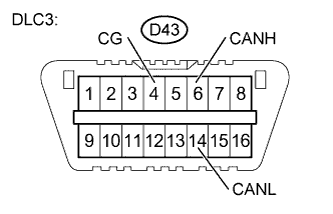
Measure the resistance according to the value(s) in the table below.
Standard resistance Tester Connection Condition Specified Condition D43-6 (CANH) - D43-4 (CG) Ignition switch off 200 Ω or higher D43-14 (CANL) - D43-4 (CG) Ignition switch off 200 Ω or higher Result Result Proceed to OK A NG (LHD Models) B NG (RHD Models) C
- B
- GO TO CHECK CAN BUS LINE FOR SHORT TO GND (LHD Models) (See pageClick here)
- C
- GO TO CHECK CAN BUS LINE FOR SHORT TO GND (RHD Models) (See pageClick here)
- A
-
- Click here
CHECK FOR SHORT TO +B IN CAN BUS (CANH, CANL - BAT)
-
Disconnect the negative battery terminal.
-
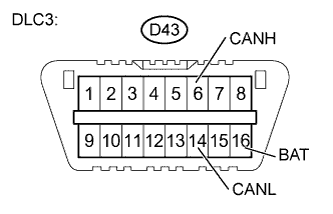
Measure the resistance according to the value(s) in the table below.
Standard resistance Tester Connection Condition Specified Condition D43-6 (CANH) - D43-16 (BAT) Disconnect negative battery terminal 6 kΩ or higher D43-14 (CANL) - D43-16 (BAT) Disconnect negative battery terminal 6 kΩ or higher Result Result Proceed to OK A NG (LHD Models) B NG (RHD Models) C
- B
- GO TO CHECK CAN BUS LINE FOR SHORT TO +B (LHD Models) (See pageClick here)
- C
- GO TO CHECK CAN BUS LINE FOR SHORT TO +B (RHD Models) (See pageClick here)
- A
-
- Click here
CHECK ECUS CONNECTED TO CAN BUS (USING INTELLIGENT TESTER)
-
Select "Bus Check" from the "System Select" screen on the intelligent tester (Click here).
-
Select "Communication Bus Check" from the "Bus Check" screen, and then select "Enter".
-
Observe the screen for approximately 1 minute to check the ECUs and sensors displayed on the screen.
Result Result Proceed to All ECUs and sensors connected to the CAN communication system are displayed on the screen.
(CAN bus circuit is currently normal)
A One of the ECUs and sensors connected to the CAN communication system is not displayed on the screen.
(Open in ECU or sensor branch wires, or communication interrupted)
B(*1)
Some ECUs and sensors repeatedly appear and disappear from the screen, during this check.
(Open in one side of ECU or sensor branch wires)
C
-
All ECUs and sensors except the main body ECU connected to the CAN MS bus are not displayed on the screen.
-
The main body ECU outputs DTC U1002.
(Open in CAN MS bus main wire or short in CAN MS bus wire)
D All ECUs and sensors connected to the CAN MS bus are not displayed on the screen.
(Open in main body ECU branch wire or main body ECU malfunction)
E Note:
-
The systems (ECUs, sensors) that adopt CAN communication vary depending on the vehicle and optional equipment. Check which systems (ECUs, sensors) are installed on the vehicle (Click here).
-
Non-installed ECUs or sensors will not be displayed. Do not mistake them for being in the communication stop mode.
-
The ECUs and sensors that repeatedly appear and disappear from the screen during this check are considered normal. (The response to the intelligent tester and the tester display are affected by signals output from other ECUs which have an open circuit in either of their CAN branch wires.)
Tip:
-
(*1): See the "DTC CHART" instead of the "COMMUNICATION STOP MODE TABLE" when some of the ECUs connected to the CAN MS bus are not displayed on the screen (Click here).
-
The ECUs connected to the CAN MS bus are displayed on the screen by the main body ECU.
- B
- GO TO "COMMUNICATION STOP MODE TABLE" (See pageClick here)
- C
- GO TO "OPEN IN ONE SIDE OF CAN BRANCH WIRE" (See pageClick here)
- D
- GO TO "U1002 (CAN MS BUS)" (See pageClick here)
- E
- GO TO "MAIN BODY ECU COMMUNICATION STOP MODE" (See pageClick here)
- A
-
-
- Click here
RECHECK DTC
Tip:
-
Sometimes CAN communication system DTCs are output, but all the ECUs and sensors connected to the CAN communication system are displayed on the intelligent tester. In this case, previous or history DTCs may indicate the cause of the problem.
-
ECUs related to a problem in the CAN bus will store DTCs to indicate communication malfunctions. The communication stop mode in the CAN bus can be determined by comparing the combination of DTCs that have been set. Refer to the DTC combination table for the CAN bus.
-
The main body ECU will store communication error DTCs when the ECUs connected to the CAN MS bus cannot communicate, or if a network malfunction occurs.
Result Result Proceed to Communication error DTCs other than the codes output from the main body ECU is output. (A malfunction occurred in the CAN No. 1 bus) A The main body ECU outputs DTC U1002.
(A malfunction occurred in the CAN MS bus)
B The main body ECU outputs DTCs other than DTC U1002.
(A malfunction occurred in an ECU branch wire connected to the CAN MS bus)
C
- B
- GO TO "U1002 (CAN MS BUS)" (See pageClick here)
- C
- GO TO "DTC CHART" (See pageClick here)
- A
-
- Click here
DTC COMBINATION TABLE
-
Confirm trouble according to the combination of output DTCs regarding the CAN communication system (Click here).
Tip:Previous CAN communication system DTCs may be the cause if CAN communication system DTCs are output and all ECUs and sensors connected to the CAN communication system are displayed on the intelligent tester's "Communication Bus Check" screen.
- NEXT
-
- Click here
CIRCUIT INSPECTION
- NEXT
- Click here
IDENTIFICATION OF PROBLEM
- NEXT
- Click here
REPAIR OR REPLACE
- NEXT
- Click here
CONFIRMATION TEST
- NEXT
- END