WIRELESS DOOR LOCK CONTROL SYSTEM (w/o Smart Entry and Start System) Only Wireless Control Function is Inoperative
DESCRIPTION
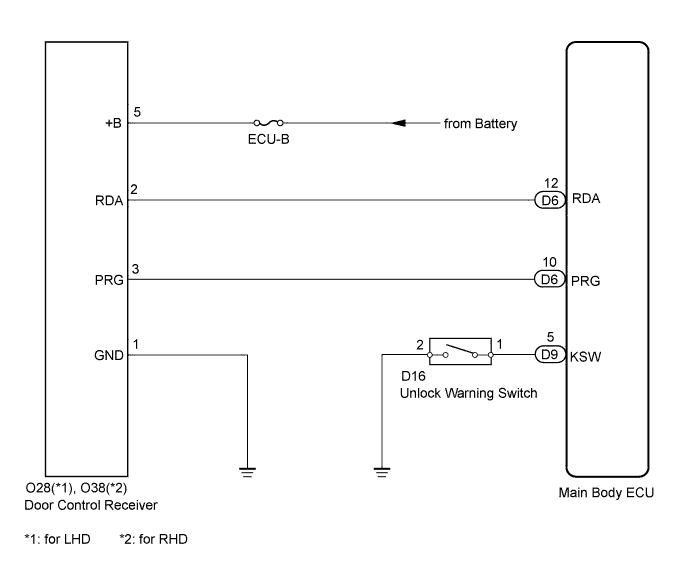
The door control receiver receives signals from the transmitter and sends these signals to the main body ECU. The main body ECU then controls all doors by sending lock/unlock signals to each door, and sends hazard flasher relay signals to the turn signal flasher relay (hazard warning lights).
WIRING DIAGRAM
INSPECTION PROCEDURE
PROCEDURE
-
CHECK WIRELESS DOOR LOCK CONTROL FUNCTIONS
-
Check the wireless door lock control system function Click here.
Result Result Proceed to The wireless door LOCK/UNLOCK function does not operate with transmitter A The power back door function does not operate with transmitter B The glass hatch function does not operate with transmitter C
B 
GO TO POWER BACK DOOR SYSTEM Click here
C
GO TO GLASS HATCH OPENER SYSTEM Click here
A 
-
-
CHECK DOOR CONTROL TRANSMITTER
-
When another registered door control transmitter is used, check that the wireless operates normally.
Result Result Proceed to Wireless door LOCK/UNLOCK function and door control transmitter that did not operate is electrical key transmitter A Wireless door LOCK/UNLOCK function function does not operate B
B 
CHECK ROOM LIGHT ASSEMBLY Click here
A
-
-
CHECK TRANSMITTER LED ILLUMINATION
-
Check that the transmitter's LED illuminates 3 times when the switch is pressed 3 times.
Result Result Proceed to Transmitter's LED does not illuminate 3 times when switch is pressed 3 times A Transmitter's LED illuminates 3 times when switch is pressed 3 times B The transmitter's LED does not illuminate the second or third time C Tech Tips
If the transmitter's LED does not illuminate the second or third time, replace the transmitter battery as it is depleted.
B
REPLACE DOOR CONTROL TRANSMITTER
C
REPLACE TRANSMITTER BATTERY Click here
A
-
-
INSPECT TRANSMITTER BATTERY
-
Electrical key transmitter
-
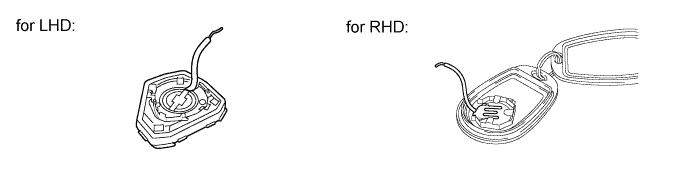
Remove the battery from the electrical key transmitter that does not operate. Attach a lead wire (0.6 mm (0.0236 in.) in diameter or less including wire sheath) with tape or equivalent to the negative terminal Click here.
Note
Do not wrap the lead wire around a terminal, wedge it between terminals, or solder it. A terminal may be deformed or damaged, and the battery will not be able to be installed correctly.
-
Carefully pull the lead wire out from the position shown in the illustration and install the previously removed transmitter battery.
-
Using an oscilloscope, check the transmitter battery voltage waveform.
Tech Tips
Measure the transmitter battery voltage while pressing the LOCK or UNLOCK switch on the transmitter.
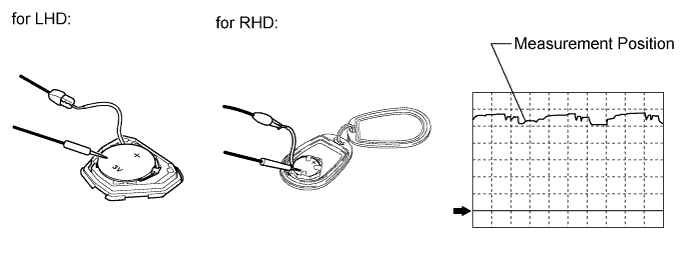
Standard voltage Item Content Tester Connection Battery positive (+) - Battery negative (-) Tool Setting 0.5 V/DIV., 100 ms/DIV. Condition Ignition switch OFF, all doors closed and lock switch pushed Specified Condition 2.2 to 3.2 V (Refer to the waveform)
-
NG
REPLACE TRANSMITTER BATTERY Click here
OK 
REPLACE DOOR CONTROL TRANSMITTER
-
-
CHECK ROOM LIGHT ASSEMBLY
-
Check that the room light illumination operates normally.
OK Room light operation normally.
NG
Go to LIGHTING SYSTEM Click here
OK
-
-
SWITCH TO SELF-DIAGNOSTIC MODE
-
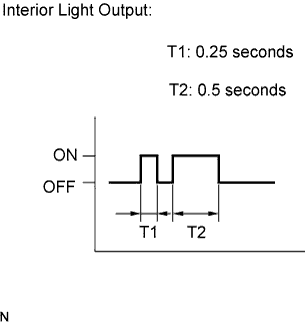
Switch to self-diagnostic mode by operating the ignition key cylinder.
-
Make sure the vehicle is in its initial condition. Then insert the key into the ignition key cylinder and remove it.
-
Within 5 seconds of removing the key, insert the key into the ignition key cylinder (ignition switch OFF). Then turn the ignition switch to the ON position and then OFF.
-
Within 30 seconds of turning the ignition switch OFF, perform the following operation 9 times: turn the ignition switch to the ON position and then OFF.
Note
If the system cannot enter self-diagnostic mode, the system returns to normal mode.
Tech Tips
-
Turning the ignition switch to the ON position after the above operations have been completed ends self-diagnostic mode.
-
Do not lock or unlock doors during self-diagnostic mode.
-
-
-
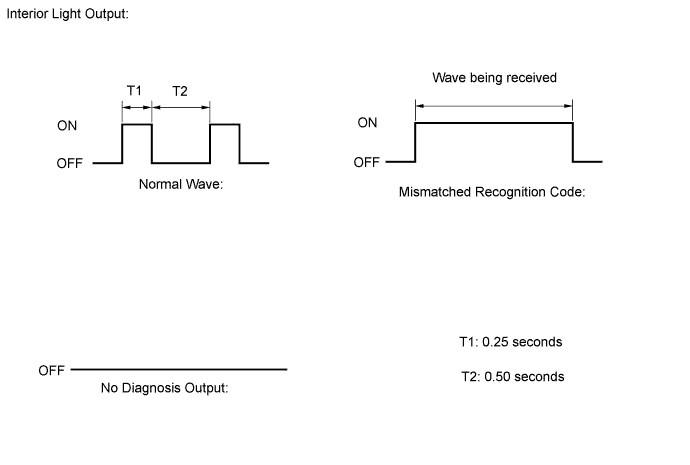
Check that the system has switched to self-diagnostic mode by checking the room light flash pattern.
OK Flash pattern is same as illustration.
NG
INSPECT UNLOCK WARNING SWITCH ASSEMBLY Click here
OK
-
-
CHECK BY SELF DIAGNOSTIC MODE
-
Inspect the diagnosis outputs when the door control transmitter switch is held down. The diagnosis outputs can be checked by the flash patterns of the room light.
Result Result Proceed to Unmatching recognition code is output A Normal waves (light flash patterns) are output B No diagnosis outputs C
B
REPLACE MAIN BODY ECU
C
CHECK DOOR CONTROL RECEIVER (RESPONSE) Click here
A
-
-
REGISTER RECOGNITION CODE
-
Check that the system can be switched to rewrite mode or add mode, and that a recognition code can be registered Click here.
OK Recognition code can be registered.
NG
REPLACE DOOR CONTROL TRANSMITTER Click here
OK
END
-
-
CHECK DOOR CONTROL RECEIVER (RESPONSE)
-
Prepare the door control transmitter of another vehicle.
-
Held down the door control transmitter,s switch.
-
Check that an unmatching recognition code is output.
OK Unmatching recognition code is output.
NG
REPLACE DOOR CONTROL RECEIVER Click here
OK
REPLACE DOOR CONTROL TRANSMITTER
-
-
REPLACE DOOR CONTROL RECEIVER
-
Temporarily replace the door lock control receiver with a new or normally functioning one Click here.
NEXT
-
-
REGISTER RECOGNITION CODE
-
Perform the REGISTRATION procedures Click here.
NEXT
-
-
CHECK DOOR CONTROL RECEIVER (OPERATION)
-
Check that the doors can be locked and unlocked by using the transmitter LOCK and UNLOCK switches.
OK Doors can be locked and unlocked with transmitter.
NG
REPLACE MAIN BODY ECU
OK
END (DOOR CONTROL RECEIVER IS DEFECTIVE)
-
-
INSPECT UNLOCK WARNING SWITCH ASSEMBLY
-
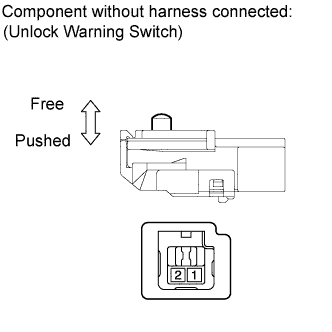
Remove the unlock warning switch Click here.
-
Measure the resistance according to the value(s) in the table below.
Standard resistance Tester Connection Switch Condition Specified Condition 1 - 2 Free 10 kΩ or higher Pushed Below 1 Ω -
Reconnect the unlock warning switch.
NG
REPLACE UNLOCK WARNING SWITCH ASSEMBLY Click here
OK
-
-
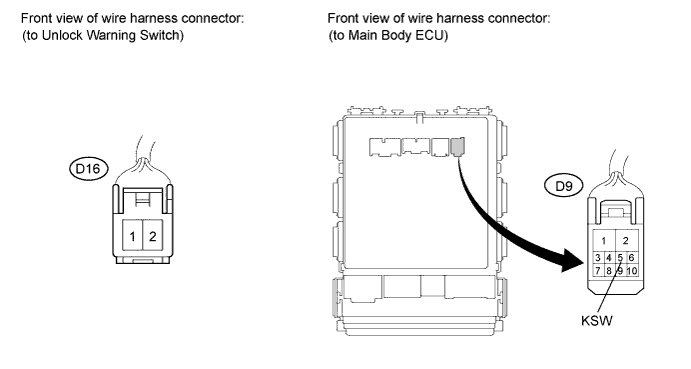
CHECK HARNESS AND CONNECTOR (UNLOCK WARNING SWITCH - MAIN BODY ECU AND BODY GROUND)
-
Disconnect the D16 unlock warning switch connector.
-
Disconnect the D9 main body ECU connector.
-
Measure the resistance according to the value(s) in the table below.
Standard resistance Tester Connection Condition Specified Condition D16-1 - D9-5 (KSW) Always Below 1 Ω D16-2 - Body ground D9-5 (KSW) or D16-1 - Body ground Always 10 kΩ or higher -
Reconnect the unlock warning switch connector.
-
Reconnect the main body ECU connector
NG
REPAIR OR REPLACE HARNESS OR CONNECTOR
OK
-
-
CHECK DOOR CONTROL RECEIVER (OUTPUT)
-
for LHD:
-
Measure the voltage according to the value(s) in the table below.
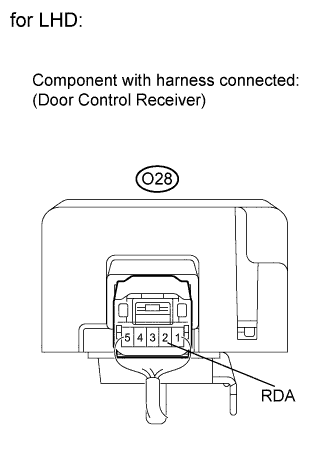
Standard voltage Tester Connection Switch Condition Specified Condition O28-2 (RDA) - Body ground Transmitter switch ON → OFF (No key in ignition key cylinder, all doors closed) Below 1 V → 6 to 7 V → Below 1 V
-
-
for RHD:
-
Measure the voltage according to the value(s) in the table below.
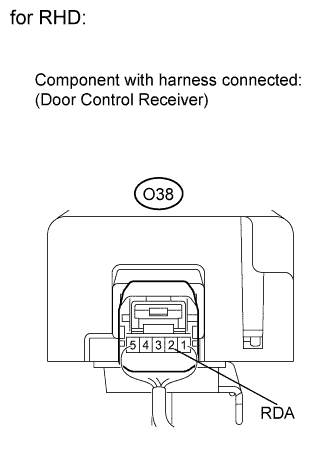
Standard voltage Tester Connection Switch Condition Specified Condition O38-2 (RDA) - Body ground Transmitter switch ON → OFF (No key in ignition key cylinder, all doors closed) Below 1 V → 6 to 7 V → Below 1 V
-
NG
REPLACE DOOR CONTROL TRANSMITTER Click here
OK
REPLACE MAIN BODY ECU
-
-
REPLACE DOOR CONTROL TRANSMITTER
-
Temporarily replace the door control transmitter module with a new or normally functioning one.
NEXT
-
-
REGISTER RECOGNITION CODE
-
Perform the REGISTRATION procedures Click here.
NEXT
-
-
CHECK DOOR CONTROL TRANSMITTER MODULE
-
Check that the doors can be locked and unlocked by using the transmitter LOCK and UNLOCK switches.
OK Doors can be locked and unlocked with transmitter.
NG
REPLACE DOOR CONTROL RECEIVER Click here
OK
END (DOOR CONTROL TRANSMITTER MODULE IS DEFECTIVE)
-