THEFT DETERRENT SYSTEM (w/o Smart Entry and Start System) SYSTEM DESCRIPTION
-
OUTLINE OF THEFT DETERRENT SYSTEM
-
The theft deterrent system can be set by locking the doors using the transmitter. (for LHD)
-
The theft deterrent system can be set by locking the doors using the transmitter or key, or by opening and closing the doors (for RHD).
-
The alarm function will be activated when someone attempts to forcibly unlock any of the doors or open any of the doors, engine hood, and back door while the system is in the armed state.
-
In the alarm sounding state, the system illuminates the interior light and flashes the hazard warning lights. At the same time, the system sounds the vehicle horn(s) and security horn to deter break-in and theft as well as to warn people around the vehicle.
-
The alarm can be cancelled by unlocking the doors using the transmitter. (for LHD)
-
The alarm can be cancelled by unlocking the doors using the transmitter or key. (for RHD)
-
The theft deterrent system has the active arming mode. There are 4 states; a disarmed state, an arming preparation state, an armed state, and an alarm sounding state.
-
Disarmed state:
-
The alarm function is not operating.
-
The theft deterrent system is not operating.
-
-
Arming preparation state:
-
The time until the system goes into the armed state.
-
The theft deterrent system is not operating.
-
-
Armed state:
-
The theft deterrent system is operating.
-
-
Alarm sounding state:
-
The alarm function is operating.
Refer to the table below for alarm methods and time: Alarm Method Headlights*
Flashing Taillights*
Flashing Hazard Warning Lights Flashing Interior Light Illuminating Vehicle Horn(s) Sounding
(approx. 0.4 second cycles)
Security Horn Sounding Alarm Time Approx. 30 sec. Tech Tips
-
*: for RHD (used for panic alarm)
-
If any of the doors are unlocked when the key is not in the key cylinder during the armed state, a forced door lock signal will be output (see FORCED DOOR LOCK CONTROL).
-
-
-
FUNCTION OF MAIN COMPONENTS
Component Function Security indicator light Informs driver of theft deterrent system status. Security horn Sounds when attempted break-in or theft is detected. Headlights* Flash when PANIC switch on wireless transmitter is pressed. Taillights* Flash when PANIC switch on wireless transmitter is pressed. Hazard warning lights Flash when attempted break-in or theft is detected. Interior light Comes on when attempted break-in or theft is detected. Vehicle horn(s) Sound when attempted break-in or theft is detected. Door courtesy light switch Detects door status (open or closed). Door unlock detection switch Detects door status (locked or unlocked). Engine hood courtesy switch Detects engine hood status (open or closed). Back door courtesy switch Detects back door status (open or closed). Glass hatch courtesy switch Detects glass hatch status (open or closed). Tech Tips
-
*: for RHD (used for panic alarm)
-
-
ACTIVE ARMING MODE
Tech Tips
Active arming mode starts the alarm control immediately after the doors are locked.
-
Active arming mode:
This system operates as described in the diagram below when one of the items for each condition is met.
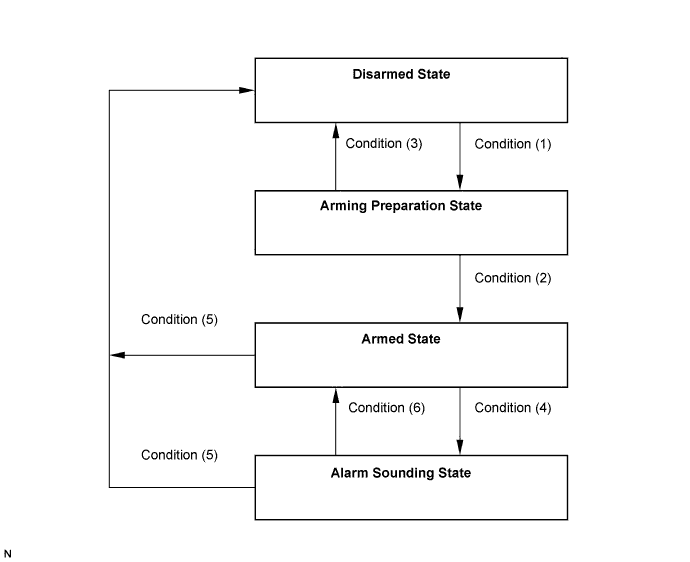
Tech Tips
The following terms "all doors" and "door" also refer to the back door.
Condition Item Condition (1) In the disarmed state, the system state is switched if one of the following conditions is met when the key is not in the key cylinder:
-
With all doors, engine hood, and glass hatch closed, all doors are locked by key operation.*1
-
With all doors, engine hood, and glass hatch closed, all doors are locked by wireless operation.
-
With the engine hood closed, any door or the glass hatch is closed and all doors are locked without using the key.*1
Condition (2)
-
Approx. 30 seconds elapse after condition (1) is met.
Condition (3)
-
A wireless unlock signal is received.
-
The driver's door only or all doors are unlocked by key operation.*1
-
Any door is unlocked.
-
Any door or the glass hatch is opened.
-
The key is inserted into the ignition key cylinder.
-
The ignition switch is turned to the ON or ACC position.
-
The battery is reconnected.
Condition (4)
-
The engine hood is opened.
-
The battery is reconnected.
-
Any door or the glass hatch is opened.
-
Any door is unlocked when all doors are locked.
-
The ignition switch is turned to the ON position without using the key.
Condition (5)
-
A wireless unlock signal is received.
-
The driver's door only or all doors are unlocked by key operation.*1
-
The ignition switch is turned to the ON position and the engine is run for more than 2 seconds.
Condition (6)
-
Approx. 35 seconds elapse. (The alarm stops and the system returns to the armed state.)*2
-
Approx. 30 seconds elapse. (The alarm stops and the system returns to the armed state.)*1
Tech Tips
-
*1: for RHD
-
*2: for LHD
-
-
-
FORCED DOOR LOCK CONTROL
-
The forced door lock control prevents the vehicle from being tampered with. Immediately after a door is unlocked (alarm starts), all doors are forced to lock by a forced door lock signal.
-
Conditions that force the doors to lock:
The key is not in the key cylinder and both of the following conditions are met:
-
The theft deterrent system is in the alarm sounding state of active arming mode.
-
Any door is unlocked.
Tech Tips
(only for LHD): Forced door lock control does not operate if any door is unlocked by key operation.
-
-
-
-
PANIC ALARM CONTROL (for RHD)
-
The panic alarm control makes it possible to voluntarily set off the panic alarm by pressing the PANIC switch on the wireless transmitter.
-
Conditions that cause the panic alarm control to set off the panic alarm:
The PANIC switch on the wireless transmitter is pressed under the following conditions:
-
The ignition switch is off.
-
The theft deterrent system is not in the alarm sounding state.
-
-
Conditions that cause the panic alarm control to shut off the alarm:
Any of the following conditions is met during panic alarm operation:
-
The ignition switch is turned to the ON position.
-
The PANIC switch is pressed again.
-
Any of the switches on the wireless transmitter (LOCK/UNLOCK/POWER BACK DOOR* or GLASS HATCH OPEN) is pressed.
-
The panic alarm ends (approx. 30 sec. have passed).
-
The theft deterrent system switches to the alarm sounding state. Under this condition, the theft deterrent system is controlling the alarm rather than the panic alarm control. In order to cancel this alarm, refer to the theft deterrent system alarm sounding state cancellation procedure.
Tech Tips
-
*: w/ Power Back Door System
-
-
-
-
SECURITY INDICATOR LIGHT OUTPUT
-
The main body ECU outputs a signal to turn on the security indicator light, according to the state of the theft deterrent system. However, some of the actual lighting conditions of the security indicator light are different from the output signals of the main body ECU.
Output: State of Theft Deterrent System Security Indicator Light Output Signal from Main Body ECU Actual Lighting Condition Disarmed state OFF OFF (Immobiliser system unset)
BLINKING (Immobiliser system set)
Arming preparation state ON ON Armed state OFF BLINKING Alarm sounding state ON ON Blinking cycle: Time Security Indicator Light 0.2 sec. ON 1.8 sec. OFF Tech Tips
When the immobiliser system is set, the security indicator light blinks during both the disarmed state and the armed state, due to output signals from the immobiliser system.
-