ELECTRIC POWER CONTROL SYSTEM, Diagnostic DTC:B22A1

| DTC Code | DTC Name |
|---|---|
| B22A1 | Battery Current Sensor |
DESCRIPTION
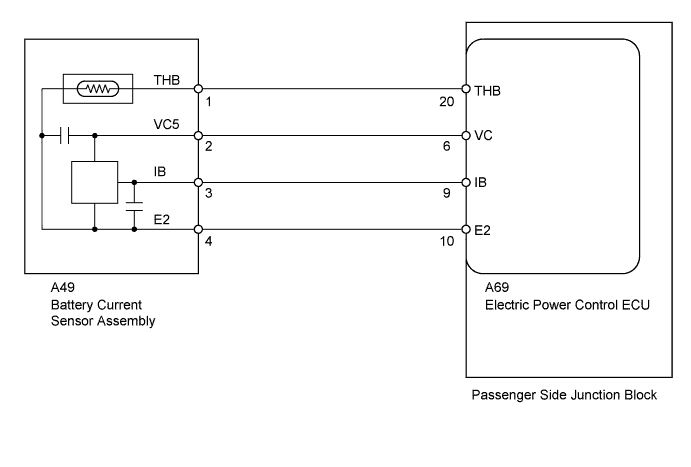
The battery current sensor converts current to voltage, and outputs the value to the electric power control ECU. The electric power control ECU detects the battery condition, and performs load control and generator control.
| DTC Code | DTC Detection Condition | Trouble Area |
|---|---|---|
| B22A1 | Electric power control ECU detects one of following conditions:
|
|
WIRING DIAGRAM
INSPECTION PROCEDURE
PROCEDURE
-
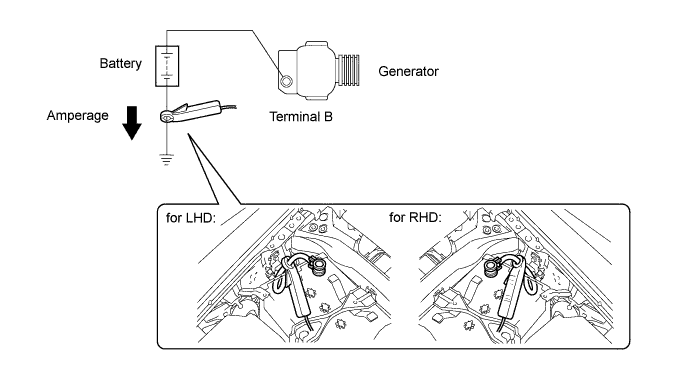
READ VALUE USING INTELLIGENT TESTER (BATTERY CURRENT)
-
Put the vehicle in a no load test condition. Then set the headlights to high beam, set the heater blower switch to Hi, and run the engine at 2000 rpm. Using an electrical tester and probes, measure the current.
-
Using the intelligent tester, read the Data List.
-
Intelligent tester
Electric Power Control Item Measurement Item / Display (Range) Normal Condition Diagnostic Note Electrical Charge Current Current battery current value display/
Min.: -300, Max.: 100 [A]
Amperage value is displayed - OK Values of electrical tester and intelligent tester are almost the same.
-
NG 
CHECK BATTERY CURRENT SENSOR ASSEMBLY (VC5 VOLTAGE) Click here
OK 
-
-
INSPECT BATTERY CURRENT SENSOR ASSEMBLY (TEMPERATURE SENSOR VOLTAGE)
-
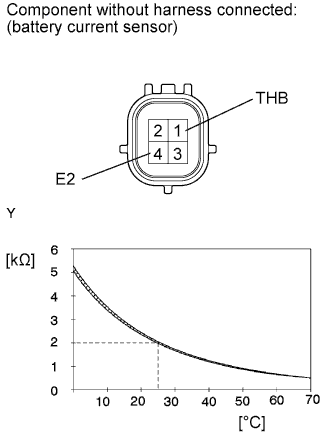
Disconnect the A49 sensor connector.
-
Measure the resistance according to the value(s) in the table below.
Standard resistance Tester Connection Condition Specified Condition A49-1 (THB) - A49-4 (E2) 20 to 30°C (68 to 86°F) 1.5 to 2.1 kΩ (0 to 70°C (32 to 158°F)) (0.3 to 6.0 kΩ) Note
The temperature shown in the inspection condition is for the area surrounding the sensor, not the sensor itself.
NG 
REPLACE BATTERY CURRENT SENSOR ASSEMBLY Click here
OK
-
-
CHECK HARNESS AND CONNECTOR (ELECTRIC POWER CONTROL ECU - BATTERY CURRENT SENSOR)
-
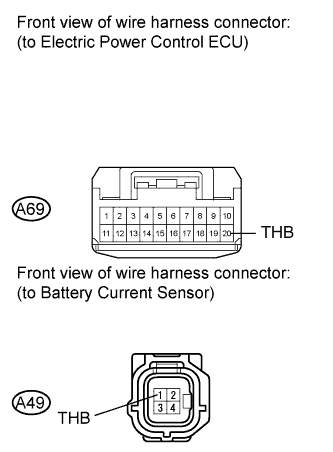
Disconnect the A69 ECU connector.
-
Disconnect the A49 sensor connector.
-
Measure the resistance according to the value(s) in the table below.
Standard resistance Tester Connection Condition Specified Condition A69-20 (THB) - A49-1 (THB) Always Below 1 Ω A69-20 (THB) or A49-1 (THB) - Body ground Always 10 kΩ or higher
NG
REPAIR OR REPLACE HARNESS OR CONNECTOR
OK 
REPLACE PASSENGER SIDE JUNCTION BLOCK (ELECTRIC POWER CONTROL ECU)
-
-
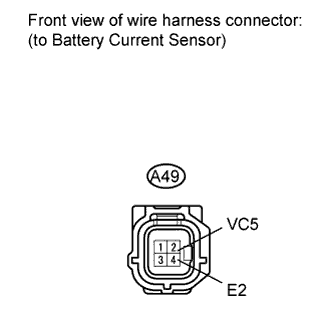
CHECK BATTERY CURRENT SENSOR ASSEMBLY (VC5 VOLTAGE)
-
Disconnect the A49 sensor connector.
-
Measure the voltage according to the value(s) in the table below.
Standard voltage Tester Connection Switch Condition Specified Condition A49-2 (VC5) - A49-4 (E2) Engine switch on (IG) 4.5 to 5.5 V
OK
CHECK HARNESS AND CONNECTOR (ELECTRIC POWER CONTROL ECU - BATTERY CURRENT SENSOR) Click here
NG
-
-
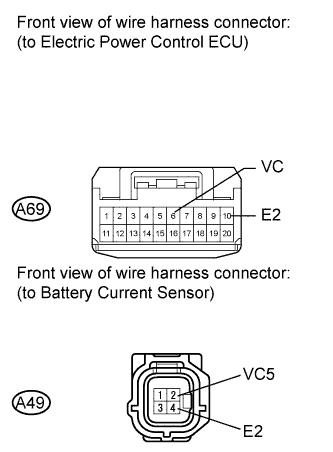
CHECK HARNESS AND CONNECTOR (ELECTRIC POWER CONTROL ECU - BATTERY CURRENT SENSOR)
-
Disconnect the A69 ECU connector.
-
Disconnect the A49 sensor connector.
-
Measure the resistance according to the value(s) in the table below.
Standard resistance Tester Connection Condition Specified Condition A69-6 (VC) - A49-2 (VC5) Always Below 1 Ω A69-10 (E2) - A49-4 (E2) Always Below 1 Ω A69-6 (VC) or A49-2 (VC5) - Body ground Always 10 kΩ or higher A69-10 (E2) or A49-4 (E2) - Body ground Always 10 kΩ or higher
NG
REPAIR OR REPLACE HARNESS OR CONNECTOR
OK
REPLACE PASSENGER SIDE JUNCTION BLOCK (ELECTRIC POWER CONTROL ECU)
-
-
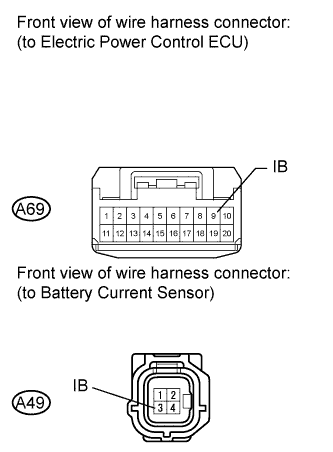
CHECK HARNESS AND CONNECTOR (ELECTRIC POWER CONTROL ECU - BATTERY CURRENT SENSOR)
-
Disconnect the A69 ECU connector.
-
Disconnect the A49 sensor connector.
-
Measure the resistance according to the value(s) in the table below.
Standard resistance Tester Connection Condition Specified Condition A69-9 (IB) - A49-3 (IB) Always Below 1 Ω A69-9 (IB) or A49-3 (IB) - Body ground Always 10 kΩ or higher
NG
REPAIR OR REPLACE HARNESS OR CONNECTOR
OK
-
-
CHECK BATTERY CURRENT SENSOR ASSEMBLY (OPERATION)
-
Temporarily replace the battery current sensor with a new or normally functioning one Click here.
-
Delete the DTC Click here.
-
Check for DTC again Click here.
OK No DTC is output.
NG
REPLACE PASSENGER SIDE JUNCTION BLOCK (ELECTRIC POWER CONTROL ECU)
OK
END (BATTERY CURRENT SENSOR IS DEFECTIVE)
-